Crude Oil
June 17, 2026
Chinese independent refineries in no hurry to secure Iranian crude amid Middle East peace talks
Editor:
HIGHLIGHTS
US-Iran MOU may bring sanctions waivers to Iranian oil
Russian crude to be refiners' top alternative
To shut 786,000 b/d refining capacity in June amid losses
Chinese independent refineries, the main buyers of sanctioned Iranian crude, are in no hurry to secure more cargoes, even though a possible US waiver on Iranian oil following the expected signing of a memorandum of understanding June 19 would eliminate the deep discounts they enjoy, refining and trading sources told Platts, part of S&P Global Energy, June 17.
Instead, due to refining losses amid weak domestic demand and high feedstock costs, these Iranian crude buyers prefer to shut for maintenance rather than shop the last few available cargoes, they said, adding that Russian crude cargoes are an alternative.
Washington and Teheran are scheduled to sign an MOU June 19 to allow shipping to resume through the Strait of Hormuz. Some market sources, including Rachel Ziemba, a senior adviser with Horizon Engage, expected the near-term deal to likely have sanctions waivers to allow the sale of some volumes of Iranian crude supply.
"Competitors will be invited to buy Iranian crude once the waiver is issued, which will definitely push up the price of the cargoes," a Dongying-based refiner said.
Two Shandong-based traders said the price for Iranian Light has been supported, and expected it to rise to a premium as high as $2/barrel over ICE September Brent futures for June delivery, from the tradable price of a discount of $1-$2/b with the same basis.
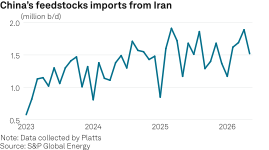
The independent refineries are almost the sole frequent buyers of Iranian crude, importing about 1.58 million barrels/day in January-May, according to Platts data.
These refineries leverage the deep discount of the sanctioned crudes to survive the competition against the state-run oil companies, according to market sources.
Prices to fall
"But the relationship or even the agreement between the two parties is fragile; there are lots of uncertainties, let alone the waivers," the Dongying-based refiner added.
Moreover, five refiners believed the crude market will remain oversupplied if the Strait of Hormuz stays open and Iranian crude is not sanctioned, making it unnecessary to build inventories beforehand.
"Regular crude prices will fall further as those from the Middle East, West Africa and Latin America have been falling," a second Dongying-based refiner said.
The 400,000 b/d Hengli Petrochemical has stopped buying Iranian crude oil and is now taking regular crudes, including West African barrels.
In addition, Russian ESPO, the most favorable feedstock for independent refineries, was offered at a premium of about $1-$2/b to ICE Brent futures on a DES Shandong basis for July delivery, down from about $2-$3/b a week earlier, according to trade sources.
"Russian crude is the top choice as sanctions keep the barrels at discounts against the regular cargoes," the second Dongying-based refiner said. "But the discount will be narrow if there is no competitor in the sanctioned crude market once Iranian oil is offered with waivers."
Therefore, independent refineries were not in a hurry to purchase, though a few had started to inquire about cargo availability, two trading sources said.
Refining losses, product demand
In addition, "financial losses since the start of the war in the Middle East have weakened the refineries' financial positions, constraining their ability to purchase more feedstocks," a trading source said.
Independent refineries are more cautious about feedstock purchases due to margin and product demand concerns, another trader said.
Refining margins determine crude feedstock purchases, so independent refineries are focused on oil products demand, a source at a Dongying-based independent refinery said.
According to local information provider JLC, refining losses from processing imported crude oil stood at Yuan 667/metric ton ($17.27/b) in the week to June 10, slightly narrowed from losses of Yuan 693/mt in the week to June 3.
At least five independent refineries, with a combined 39.3 million metric tons/year (786,000 b/d) of refining capacity, are scheduled to be offline in June, according to market sources.
The offline capacity will further increase by 14.5 million mt/year in July when three other independent refineries will shut for maintenance, they added.
Market analysts have a subdued outlook on future demand for oil products, which will ultimately determine the demand for crude as feedstock.
"We believe the demand for oil products is unlikely to fully recover to its prewar level, as the replacement of gasoline and gasoil in some sectors is not recoverable, only positive for jet fuel," said a Beijing-based expert with a state-owned research institute.
