Crude Oil
June 15, 2026
Middle East oil flows face a long recovery despite US-Iran deal
By Lulwa Albuainain and Rosemary Griffin
Editor:
HIGHLIGHTS
Tanker, infrastructure issues hamper recovery
Gulf oil output drops to 13.4 mil b/d in May
Full recovery may extend into 2027: NOC CEOs
A finalized peace deal between the US and Iran would reopen the Strait of Hormuz to Middle East oil exports, but analysts caution that it will take time for flows to normalize, given the infrastructure damage sustained and the buildup of tankers that have been restricted from transiting the Gulf.
Crude production from the Middle East, which accounts for about 20% of global oil supply, has plummeted since the war began. OPEC said that combined output in Saudi Arabia, the UAE, Iraq, Kuwait, and Iran was 13.406 million barrels/day in May, according to secondary sources the group uses to track members' production. This is down from 23.475 million b/d in February.
Carole Nakhle, founder of consultancy Crystol Energy, said the countries have a strong incentive to restore normal operations as quickly as possible to reaffirm their reputation as reliable suppliers to global markets, although shipping constraints through the Strait of Hormuz will be a bigger immediate issue.
"In many cases, the disruption was driven more by logistical constraints and shipping risks than by extensive damage to oil fields," she said.
The initial US-Iran peace deal framework, announced June 14, seeks to end the regional conflict and unlock the Strait of Hormuz for commercial traffic to alleviate the pressures of the current global energy supply crisis.
Ali al-Riyami, a former director-general of Oman's Ministry of Energy and Mining, who is now an independent consultant, said that Gulf producers are approaching the latest announcements with a blend of relief and realism, with any minor incident in the strait potentially reigniting risks.
"The pace of recovery hinges on two main factors: first, the willingness of commercial vessels to re-enter the Gulf with confidence in maritime safety; and second, the repair and readiness of any local infrastructure affected during the period of tension," Riyami said.
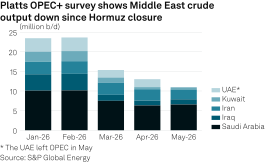
Kuwait saw the harshest drop among the Gulf countries, according to the Platts OPEC+ survey, with production sinking to about 550,000 b/d in May from 2.58 million b/d in February.
Shaikh Khaled al-Sabah, managing director of international marketing at state-owned Kuwait Petroleum Corp., told Platts June 3 that the company would be able to restore 70% of its production within at least six weeks upon the reopening of the strait. KPC could not be reached for comment on how the peace deal will affect its operations.
On the other hand, Saudi Arabia and the UAE have been able to offset a significant portion of their export losses through alternative shipping routes via Red Sea-situated ports and Fujairah, respectively. The UAE has terminated its membership in OPEC as of May.
Saudi Arabia's East-West pipeline has about "5 million b/d potential for exports through the Yanbu North and South terminals," Aramco CEO Amin Nasser said May 11, adding that the company is "in the process of increasing that" Nasser said.
ADNOC's CEO, Sultan al-Jaber, also highlighted May 20 that the UAE's second pipeline to Fujairah, expected to double the state oil company's export capacity outside the Strait of Hormuz, is due for completion in 2027 and is currently 50% constructed.
Aramco and ADNOC did not respond to requests for comment; neither did the OPEC secretariat nor several OPEC delegates.
Seven key members of the OPEC+ alliance, led by Saudi Arabia and Russia, are due to meet July 5 to discuss production quotas for August.
The group has been gradually raising quotas over the past several months, even though the war has severely impacted production.
Saudi-based independent energy consultant and analyst Abdulaziz al-Muqbil said that restoring operations to pre-conflict capacity will not be achieved simply by signing an agreement.
"It will require time to safely restart facilities, rebuild logistical networks, and recover from more than one hundred days of interrupted production and trade, the effects of which continue to cast a long shadow over global energy markets," he said.
Both ADNOC and Aramco's CEOs separately anticipated the oil market recovery would last well into 2027, they said.
"If the Strait of Hormuz opens today, it will still take months for the market to rebalance, and if its opening is delayed by a few more weeks, then normalization will last into 2027," Aramco's Amin Nasser said in a May earnings call.
ADNOC's Sultan al-Jaber said May 20 that the region would require four months to return to 80% of prewar oil flows, while a full recovery may not be possible until the first or second quarters of 2027.
Oil prices tumbled on news of the agreement, although ship owners are cautious about US President Donald Trump's announcement that the Strait of Hormuz would see a "toll-free opening" and the US naval blockade on the chokepoint would be lifted.
Benchmark Platts Cash Dubai was assessed $4.28/barrel lower at $78.90/b at the June 15 Asian close, while its spread to same-month Dubai futures narrowed by $2.69/b during the session to a $2.28/b premium. These levels were last seen just before the war started.
Attacks on Middle East energy infrastructure had eased in the run-up to the June 14 announcement, but have caused significant damage across the region.
Muqbil said that, ultimately, the conflict has represented more than a conventional supply shock driven by missing barrels.
"It has also exposed the limitations of rerouting strategies adopted by producers outside the region in an attempt to compensate for disrupted oil and gas supplies—a process that has proven far more complex and difficult than many initially anticipated," he said.
