Crude Oil
June 15, 2026
FACTBOX: US-Iran deal eases oil supply fears but full restoration to take time

By Staff
Editor:
HIGHLIGHTS
Oil futures fall 4% on peace framework news
Iran offers charge-free transit for 60 days
Supply normalization to extend through summer 2027
The US and Iran have reached a memorandum of understanding to end their conflict and reopen the Strait of Hormuz in a development expected to ease long-term oil supply concerns, although physical crude markets are expected to remain tight through the summer months.
US President Donald Trump announced the framework deal June 14, saying the strait would reopen "toll-free" and that the US would lift its naval blockade on Iranian ports. The formal agreement is scheduled to be signed in Switzerland on June 19, though full terms remain undisclosed and significant uncertainties persist.
"Expectations of a Strait of Hormuz reopening under the memorandum of understanding are bearish for future oil prices and risk premiums, yet normalization will take time, leaving physical crude markets tight through summer," analysts at S&P Global Energy CERA said in a June 15 note.
The following are key facts about the US-Iran peace deal and its impact on global oil markets:
Trade flows
The Strait of Hormuz has been effectively closed to most commercial traffic since the beginning of March, when Iran seized control following US and Israeli airstrikes, disrupting flows that typically account for one-fifth of global crude supplies.
- Supply losses are expected to exceed 1.5 billion barrels by end-June, with Hormuz normalization likely extending into 2027, according to S&P Global Energy CERA analysts.
- An LNG tanker successfully transited the strait June 15 with its tracking system fully visible, according to S&P Global Commodities at Sea data.
- Japan's NYK Line said June 15 it expects "an early normalization" of navigation through the strait following the deal announcement.
- No oil tankers were seen moving through the main Hormuz Traffic Separation Scheme channels June 15, despite Trump's announcement, with around 12 tankers per day typically transiting before the conflict.
- US crude exports are expected to fall by potentially 1 million b/d as inventories bottom out in July, intensifying the supply squeeze, CERA analysts said.
- West African crude differentials for Asian buyers should weaken as returning Middle East supply reduces urgency, if a credible deal holds, CERA analysts said.
- China's independent refiners have resumed crude inquiries following the announcement, with most holding only two to three weeks of feedstock due to recent volatility, refinery and trade sources told Platts, part of S&P Global Energy.
- Chinese refiners are prioritizing purchases of spot cargoes stored on tankers near Shandong ports, with volumes estimated at 6 million-7 million mt.
Prices
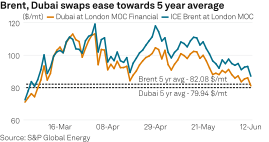
Oil futures fell sharply on the news, but analysts warn that physical markets have not yet priced in the relief trade, creating a disconnect between paper and physical markets.
- ICE August Brent futures were down by $3.62/b (4%) to $83.71/b at 0553 GMT June 15, while NYMEX July light sweet crude dropped $4.03/b (4.8%) to $80.85/b following the announcement.
- The August Dubai swap was pegged at $77.42/b at 0200 GMT June 15, down 79 cents/b (1%) from the previous Asian close.
- Iranian Light crude discounts widened to $1-$1.50/b to September ICE Brent futures over the weekend, reflecting limited buying interest.
- "If the Strait of Hormuz remains restricted through July before gradually reopening, futures should firm but remain well below physical levels," CERA analysts said.
- Average refining losses for Chinese independent refiners processing imported crude narrowed to Yuan 680/mt in early June from Yuan 1,398/mt in May.
- Shipping rates have shown little reaction. Platts assessed the rate to carry a 270,000 metric ton cargo of crude from the Persian Gulf to China at $73.45/mt on June 15, up 52 cents/mt on the day. Platts assessed the rate to carry a 65,000 mt cargo of refined products from the Persian Gulf to UK/Continent at $75.38/mt June 15, stable on the day.
Infrastructure
The deal's implementation faces significant hurdles, with full normalization of shipping operations expected to take months and key details remaining unclear.
- At least two memorandum of understanding drafts have circulated: the US version stresses nuclear dismantlement with phased sanctions relief, while Iranian leaks cite $300 billion in reconstruction funding.
- Mines in the Strait of Hormuz must be removed before full reopening, adding complexity to the normalization process.
- An informed source told Iran's semi-official Fars news agency that, for the coming 60 days, transiting the strait will be charge-free. "The future of management of shipping services at the Strait of Hormuz" will be determined by Iran and Oman, the source quoted the text of the agreement as saying.
- Afterwards, Iran intends to offer safety, shipping, environmental and insurance services and use the income for domestic economic development.
- Last-minute modifications assert Iran-Oman sovereignty over the Strait of Hormuz, the source said.
- Average utilization rates at Shandong's independent refineries fell to 51% in early June from 53% in May, with further declines expected as refiners plan maintenance shutdowns.
- Middle distillate cracks are expected to strengthen from July to October, with global stocks remaining tight until November, CERA analysts said.
- Gasoline cracks are likely to peak in July before easing by late summer and converging closer to diesel levels, CERA analysts said.
- Refining margins remain at record highs for players with prompt crude and spot product exposure, but only for Asian refiners with hedged products, CERA analysts said.
- Peak refinery runs and limited Strategic Petroleum Reserve draw capacity should intensify the summer squeeze on crude supplies, CERA analysts said.
- Israel remains a key wildcard, with any escalation in Lebanon potentially disrupting deal implementation, CERA analysts said.
