Crude Oil
June 10, 2026
Trump official says Venezuela oil recovery on track after Maduro ouster

Editor:
HIGHLIGHTS
May oil output rises to 1.155 million b/d
Pillar of broader energy strategy in hemisphere
The Trump administration views the recovery of Venezuela's oil sector as broadly on track five months after the US military operation that ousted Nicolas Maduro, senior administration officials said June 10 -- with the South American country serving as a key pillar of a broader focus on energy production in the Western Hemisphere.
"We're really only five months out from the Jan. 3 operation," US Assistant Secretary of State for Economic, Energy, and Business Affairs Caleb Orr said during a panel at the Energy Imperatives Summit in Washington. "It may feel longer than that, but I think we're kind of exactly where you would want to see the relationship on a trajectory."
Venezuelan state oil company PDVSA and foreign partners averaged 1.155 million b/d of crude production in May, compared to 1.130 million b/d in April and 940,0000 b/d in January, according to data from the Ministry of Hydrocarbons. In an April presentation, Executive Vice President Jovanny Martinez told oil industry executives the country expects to produce 1.37 million b/d by the end of 2026.
Orr called Venezuela one of the "signal initiatives" of the administration's energy diplomacy, saying Washington was working with authorities in Caracas "every single day" to restore output. Orr praised the increase in Venezuelan oil production in 2026, but declined to provide a specific long-term recovery timeline, saying the administration was "focused on outcomes ... more than timeframes."
Orr said the administration continued to follow a three-phase plan outlined by Secretary of State Marco Rubio: stabilizing the country and averting collapse, recovering the economy and oil sector, and encouraging an eventual political transition.
Orr said Venezuela's annual inflation had fallen from 600% in 2025 to below 10% on a monthly basis in the latest State Department data. US Gulf Coast refiners configured for heavy crude are "extremely well positioned to benefit from Venezuelan crude coming back online," he said, noting that Europe and India were also buying Venezuelan barrels.
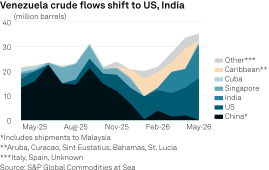
Dirty tanker shipments from the US and Americas surged to record highs in May, fueled by the ongoing disruption of shipping through the Strait of Hormuz. Increased US shale oil production, the relaxation of sanctions on Venezuelan crude, production from new floating production storage and offloading vessels in Brazil and the startup of Guyana's Yellowtail field in August 2025 all contributed to the historic export levels, analysts from shipping association BIMCO said in a June 8 report.
Western Hemisphere energy doctrine
In a wider discussion of strategy, Orr positioned the Western Hemisphere as a central theater of the administration's energy and security agenda, tied to the National Security Strategy issued in December — an approach centered on ensuring the US and its partners "control the destiny of the region and not any adversarial outside power."
The hemisphere now accounts for 32% of global crude production and is "growing every year," Orr said, pointing to new supply from the Permian Basin, offshore Guyana and Argentine shale. He named Ecuador, Argentina and El Salvador among governments Washington works with "hand in glove" on security, calling security the "table stakes" for any productive economic relationship and the foundation of the regional turn. Beyond oil and gas, he emphasized critical minerals, US LNG exports and power-grid infrastructure.
Those comments were echoed by National Energy Dominance Council executive director Jarrod Agen, who told a Politico energy conference the administration was attempting to shift the center of the world's energy output closer to US shores.
"The global focus on energy has now shifted to the Western Hemisphere," Agen said. "The Western Hemisphere is now the leading driver of energy in the world. We are the center of the energy world from Alaska down to Venezuela. What we want is the crude product coming out of Alaska, coming out of Venezuela, coming into US refineries, getting refined, and then exporting to the world."
Venezuela was a template of US companies and the government "working directly in an extremely hands-on fashion" to bring barrels online "in a time when energy markets really needed new production," Orr said.
Asked by the moderator whether the administration envisioned a formal hemispheric energy pact, Orr demurred but did not rule it out. "Stay tuned," Orr said.
