Agriculture, Biofuels, Sugar, Grains
September 07, 2026
Indian sugar surge stress tests grain ethanol pivot limit
Editor:
HIGHLIGHTS
Grain ethanol comprises 76% of India supply
Sugar prices surge 33%, prompt import move
Ethanol output forecast drops by 750M liters
India's grain-led ethanol transition is cushioning its biofuel program from a sharp rise in sugar prices, but lower cane diversion, record import values and constraints on blending demand are exposing the limits of the insulation.
Retail sugar prices surged nearly 33% to Rupees 63.97/kg on Aug. 25 from Rupees 48.18/kg on July 20, prompting New Delhi to allow 1 million mt of tariff-free imports and impose tighter dealer stockholding limits.
The interventions have since moderated retail and wholesale prices, but they remain elevated relative to pre-rally levels.
According to the Ministry of Consumer Affairs data, retail sugar prices on Sept. 7 averaged at Rupees 61.09/kg and wholesale prices stood at Rupees 56.10/kg
Meanwhile, Platts assessed anhydrous ethanol CFR India for a one-month ahead shipment at $751/metric tons Sept. 1, up $17/mt month over month, while the two-month ahead shipment assessment stood at $749/mt CFR India Sept. 1, up $18/mt month over month.
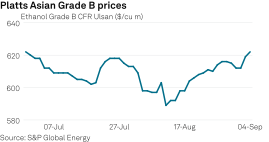
The contrasting developments reveal an increasingly complex relationship between India's sugar and ethanol markets.
Grain now accounts for more than three-quarters of India's ethanol supplies, and administered domestic procurement prices limit the direct transmission of sugar-market volatility.
Yet reduced cane-based production still removes flexibility from the ethanol feedstock pool, while tighter international sugar balances increase the opportunity cost of producing ethanol from sugarcane.
The central question is therefore no longer whether grain can replace sugar as India's principal ethanol feedstock. It largely has. The question is whether that transition can sustain ethanol growth when policymakers are prioritizing sweetener availability, and existing blending demand is struggling to absorb the production capacity already established.
Grain softens the shock, but outlook weakens
India's increasing reliance on grain provides an important buffer against sugar market volatility, but recent production forecasts suggest the transition may not fully sustain the pace of ethanol growth.
The International Sugar Organization cut its forecast for India's 2026 fuel ethanol production by 750 million liters to 11.3 billion liters, attributing the revision to constraints associated with the country's blending mandate rather than insufficient processing capacity.
The organization also expects sugar diversion to ethanol to fall to 1 million mt in the coming season from 2.8 million mt previously, highlighting the policy trade-off between safeguarding sweetener supplies and expanding fuel blending.
That outlook adds nuance to the grain transition.
Grain-based feedstocks accounted for 76% of India's ethanol supplies in July, according to All India Distillers' Association data. Corn and surplus Food Corporation of India grain each contributed 79 million gallons, while sugarcane-based feedstocks supplied 58 million gallons, or 24% of the monthly total.
Grain can consequently compensate for part of the reduction in cane-derived ethanol. But the forecast downgrade suggests feedstock substitution alone may not be sufficient if blending demand, procurement and policy constraints limit how much ethanol the market can absorb.
Global tightness complicates India's intervention
India's efforts to cool domestic prices are unfolding as the international sugar balance becomes less comfortable.
The ISO halved its estimate of the 2025-26 global sugar surplus to 1.1 million mt from 2.2 million mt and forecast a 200,000 mt deficit for 2026-27.
Although the projected deficit is small, it follows a sharply reduced surplus and could leave prices more responsive to weather or production setbacks.
ICE New York No. 11 raw sugar futures reached 18.06 cents/lb on Sept. 3, the highest since May 2025, reflecting concerns over weaker production and potential weather disruption in major origins
This global strength complicates India's duty-free import program. The government can remove the tariff barrier, but it cannot guarantee favorable import economics if world raw sugar prices remain firm while domestic prices retreat.
That helps explain why market participants are divided over quota uptake. Some expect the application window to be extended if the quota is undersubscribed or allocations are surrendered. Others consider imports unlikely after the decline in Indian prices narrowed potential margins.
A Delhi-based sugar exporter also agreed, stating that if 100% of the import quota can be utilized, the window is likely to be extended. "If 100% do not get subscribed, or there are surrenders, it will get extended," the exporter said.
Another sugar trader said, "Even if there is an extension for the application date, prices are down. So, no import, I think."
Strong closing
India's ethanol program is better protected from sugar volatility than it was several years ago, but it is not fully insulated.
The rapid expansion of corn and surplus-grain ethanol has reduced dependence on cane and limited the sugar rally's immediate impact on administered domestic prices.
Nevertheless, lower sugar diversion is shrinking feedstock flexibility, global tightness is raising import and opportunity costs, and blending constraints are weakening the production outlook.
Even global grain markets are showing signs of entering a stronger pricing cycle in 2027 as declining inventories, the effect of elevated geopolitical volatility on fertilizer costs and expanding biofuel demand increase competition for agricultural supplies.
Government intervention may stabilize sweetener availability in the near term. The more consequential test will be whether India can create enough demand for its expanding grain-ethanol capacity while maintaining food-market stability, as grain may have softened the sugar shock. It has not removed the policy trade-off.
