Agriculture, Biofuels, Vegetable Oils
July 01, 2026
Brazilian biodiesel contracts in July-August see marginal change, defying producers hopes

Editor:
HIGHLIGHTS
Biodiesel fees rise marginally for second consecutive period
Oversupply and weak demand pressure margins
Distributors strengthen coordination in lengthy negotiations
Brazilian biodiesel logistics differentials for July-August contracts between producers and distributors saw only modest increases, defying producers' hopes for cost and margin recovery amid abundant feedstock availability and persistently weak diesel demand.
Biodiesel producers initially targeted cost recovery of about Real 300/cubic meter from the previous period, amid rising input costs linked to geopolitical tensions and anticipated seasonal demand, but persistent distributor negotiations during the window resulted in prices significantly below expectations.
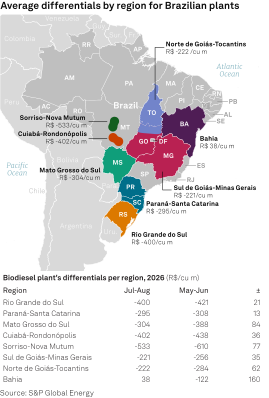
Considering the average of the eight regions assessed, the differentials were around Real 60/cubic meter higher than the May-June period, when contract levels also frustrated the plants' expectations and rose only to Real 115/cubic meter on average. Year-to-date, despite the recent increases, the fees remain more than Real 850/cu m lower than the levels recorded at the end of 2025.
Platts, part of S&P Global Energy, surveyed 49 companies June 24-30 to calculate the simple average differential, or "fee" as it is commonly called, for biodiesel term contracts across the key regions highlighted in the map. The fee reflects the producer's margin and comprises a pricing formula that also factors in soybean oil futures on the Chicago Board of Trade, the vegetable oil price differential at the Paranagua port, and the Brazilian Real/US dollar exchange rate.
The state of Bahia recorded the largest bimonthly advance, with the fee increasing by Real 160/cubic meter. The second-largest growth was in the Mato Grosso do Sul state, where fees rose by Real 84/cubic meter compared to May-June.
Prices fluctuated less in the South region of Brazil, with the microregion Parana-Santa Catarina and the state of Rio Grande do Sul recording increases of Real 13/cubic meter and Real 21/cubic meter, respectively, compared to the previous two-month period.
Blend and diesel on the equation
Several small and medium-sized distributors in the sector initially anticipated higher fee increases ahead of negotiations, but revised their expectations downward after aggressive bids from larger competitors prompted mills to concede during talks.
"We also have a lot of biodiesel backlog, and therefore, the sector did not demand more," said a distributor source.
A scenario of "oversupply" of biodiesel was cited by several players in the sector, who associated the non-consolidation of the increase in the biofuel blend with diesel in the country from 15% to 16% in 2026 and the lack of prospects for any increase in the mandate to occur this year as one of the fundamentals behind this market context. In addition, consumption of the fossil fuel equivalent is still weaker than expected seasonally.
"Importing diesel remains very difficult, with arbitrage closed and those who have Petrobras quotas do not want to give them up, so the major distributors have a lot of bargaining power to negotiate biodiesel contracts," said a second distributor source.
Soybean oil on the radar
Although there is ample availability of soybean oil in the country due to the record harvest, prices for this key raw material have not dropped enough to ease margin pressure on local producers, who are dealing with other rising costs in the international scenario, such as methanol. Platts assessed the Brazilian soybean oil FOB Paranagua price at $1,169.11/metric ton on June 30 for the most liquid month; at the close of the previous two-month period, the assessment was at $1,158.31/metric ton on April 30.
Some biodiesel producers in the country, seeing the levels negotiated for the July-August period, have reduced their participation via contracts and expect to be now more exposed in the spot market. They believe they will have more room to negotiate at prices "that sacrifice margins less." The production sector is also closely watching the development of the next crop and the potential impact of El Niño on pricing.
Considering the risks of El Niño, S&P Global Energy CERA analysts Leydiane Brito, Gabriel Diniz Faleiros, and Silvia Navarro lowered the 2026/27 Brazil soybean production estimate by 6 million mt to 177 million mt from 182 million mt expected in the current harvest. "Our area forecast remains unchanged, as we are already projecting the smallest expansion in around 20 years, although further downside risks remain," said the analysts.
