Agriculture, Grains, Oilseeds, Rice, Sugar
June 26, 2026 · Updated June 29, 2026
India's monsoon season starts slowly as El Niño threatens crops

Editor:
HIGHLIGHTS
India's monsoon begins 32% below normal
El Niño threatens rice, cotton, oilseeds
Soybean imports rise 500,000 mt on drought
India's 2026 kharif crop season has begun under pressure from below-normal monsoon rains and emerging El Niño conditions that threaten production of key commodities, including rice, cotton and oilseeds, across the world's most populous country.
The Indian Meteorological Department forecast seasonal rainfall at 90% of the long-period average, with an 84% probability of below-normal or deficient precipitation as El Niño develops, potentially disrupting supplies of agricultural exports that feed global markets from soybeans to sugar, the US Department of Agriculture said in a report June 26.
The southwest monsoon, which delivers roughly 70% of India's annual rainfall, reached Kerala June 4 and has since advanced into Karnataka, Tamil Nadu, Goa and the northeast.
However, cumulative rainfall through June 15 ran 32% below normal, with the northwest region recording a 91% deficit and central India 49% below average, according to the USDA's Foreign Agricultural Service in Mumbai.
The southern peninsula was the only region to exceed normal levels, with rainfall 4% above average due to strong onset conditions.
Kharif sowing as of June 5 totaled 7.257 million hectares, down 3% from 7.461 million hectares a year earlier, with cotton plantings falling 23% to 0.751 million hectares from 0.972 million hectares, the USDA said.
The rice area increased 8% to 0.285 million hectares, while pulses jumped 49% to 0.052 million hectares, and maize rose 41% to 0.038 million hectares. Oilseeds declined 19% to 0.042 million hectares, with groundnut down 44% and sesamum off 60%.
The conditions have developed with a 63% probability that the event will reach a very strong status, ranking among the most powerful climate episodes in the historical record dating to 1950, according to the US National Oceanic and Atmospheric Administration and the European Space Agency.
The World Economic Forum warned that the emerging El Niño weather pattern poses a systemic shock to global markets, with shipping industry analysts flagging potential disruptions to Asian coal demand and agricultural trade flows as the climate event develops through 2026-27, with far-reaching consequences for commodity markets and supply chains.
El Niño impact
India is transitioning from neutral conditions toward El Niño, which typically weakens the southwest monsoon by disrupting atmospheric circulation over the Indian and Pacific oceans, the USDA said.
The timing of the weather event coincides with peak Asian power demand, Indian monsoon risk and grain-crop formation across major producing regions, creating potential volatility for freight rates.
The weather pattern is likely to develop during the monsoon season and exert greater influence from July through September, with reduced rainfall disproportionately affecting rain-fed kharif crops, including rice, pulses, oilseeds, maize, cotton and sugarcane.
The Indian Ocean Dipole, which can offset El Niño's drying effects when positive, remains neutral as of June, meaning India's southwest monsoon is expected to face the full impact of El Niño without a moderating influence, the USDA said.
The government has identified nearly 200 districts as highly vulnerable to El Niño-related impacts on agriculture and has prepared contingency plans. Severe droughts in 2002, 2009 and 2015 coincided with active El Niño episodes, though not every event produces catastrophic outcomes.
India experienced severe heat wave conditions in April and May, with temperatures exceeding 113 degrees F across northwest, central and parts of eastern India, and peak episodes approaching 116-118 degrees F in some locations, the USDA said.
Above-normal temperatures persist across northwestern and central regions, with readings of 104-111 degrees F continuing in parts of Rajasthan, Haryana, Delhi, Uttar Pradesh, Vidarbha and Madhya Pradesh.
Reservoir levels stood at 54.7 billion cubic meters June 4, or 30% of total capacity and above the 10-year norm, though significant regional stress exists in southern and eastern areas, with acute deficits in specific reservoirs in Karnataka, Kerala, Tamil Nadu and Uttarakhand, according to the Central Water Commission data cited in the USDA report.
India is set to import 700,000 mt of soybeans in MY 2025-26 (October-September), up 500,000 mt as surging domestic soybean meal prices and concerns over a weak monsoon are impacting the Indian soybean meal prices, which reached nearly a 60% premium compared to US origin over the past month.
Also, India's sugar export ban is likely to remain in place through MY 2026-27 (October-September) as the world's second-largest producer after Brazil prioritizes domestic supply and ethanol production amid crop concerns linked to El Niño weather patterns.
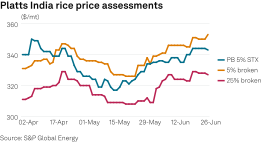
Platts, part of S&P Global Energy, assessed Indian parboiled 5% STX rice CFR Cotonou at $410/metric ton, up $1/mt day over day.
