Agriculture, Meat
May 14, 2026
EU blocks Brazil meat imports from Sep other Mercosur nations retain access
Editor:
HIGHLIGHTS
EU blocks Brazil meat exports over antibiotics
Brazil exported 42,728 mt chicken, up 42% YOY
Thailand, China poised to fill supply gap
The European Commission removed Brazil from its list of approved meat and live animal exporters May 12, blocking shipments from Sept. 3 due to Brazil's failure to comply with EU regulations on antimicrobial use in livestock production.
The decision prohibits Brazil from exporting cattle, horses, poultry, eggs, aquaculture products, honey, and casings to the EU unless it meets standards banning growth-promoting antibiotics and reserving certain antimicrobials for human treatment. Argentina, Uruguay, Paraguay, Chile, Colombia, and Mexico continue to retain export authorization, according to the European Commission.
Scale of relationship at risk
In the first four months of 2026, Brazil exported 42,728 metric tons of frozen chicken breast meat to the EU, up 42% year over year, according to data from Brazil's Foreign Trade Agency released May 12.
The EU decision to block Brazil's meat exports coincides with the provisional implementation of the EU-Mercosur trade agreement May 1 and the bloc's efforts to apply health standards uniformly to domestic and foreign suppliers.
Market impact: beef, poultry diverge
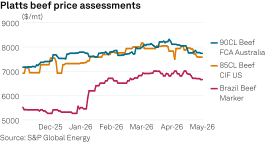
"Beef prices will likely increase due to reduced supply," said S&P Global CERA analysts, though they noted the impact on poultry would probably be limited since European markets "are much more self-sufficient" in that sector.
"If the EU stops importing boneless breast meat from Brazil, demand will shift to Thailand's boneless breast," a Japanese importer said, adding that prices for Thailand's boneless breast meat could increase significantly.
China's emergence as a competing global supplier adds a further layer of complexity to the trade rerouting picture. China's chicken meat production is forecast to climb to 17.3 million mt in 2026, up 5% year over year and overtaking Brazil as the world's second-largest producer behind the US, USDA said in April.
China became a net exporter in 2024, with shipments reaching 1.09 million mt in 2025, nearly double the 2020 figure, and USDA expects exports to rise further to 1.4 million mt in 2026, primarily targeting price-sensitive developing countries in Africa, Cambodia, Kyrgyzstan and Iraq.
Brazil already under logistics pressure
The ban compounds operational stress on Brazil's meat export sector.
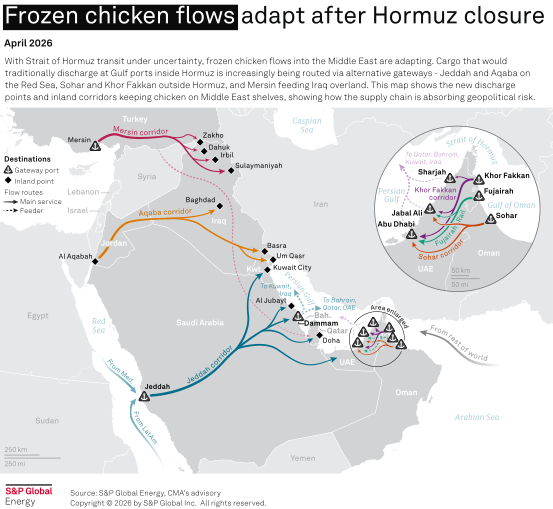
Brazilian poultry and beef exporters face higher freight costs and rerouted shipping lanes due to the Middle East conflict, with the region accounting for 30% of Brazil's chicken exports and serving as a key transit hub for beef shipments to China and Southeast Asia.
EU regulations prohibit the use of antimicrobials to promote animal growth or productivity and ban treating livestock with antibiotics reserved for human infections. These rules, part of the bloc's "One Health" strategy, have applied to European producers since 2022 and will extend to third-country exporters from Sept. 3.
"Our farmers respect some of the strictest sanitary and antimicrobial standards in the world," European Agriculture Commissioner Christophe Hansen said. "It is therefore legitimate that imported products should be subject to the same requirements. The decision adopted today demonstrates that the European control system works."
Brazil response: surprise with cautious optimism
The Brazilian government said May 13 it received the decision with "surprise" and pledged to take immediate steps to reverse the exclusion.
The Ministries of Agriculture, Foreign Affairs, and Development, Industry and Commerce issued a joint statement saying Brazil would work to return to the authorized countries list and maintain export flows to a market it has supplied for 40 years.
A Brazilian trader supplying the EU market questioned whether the exclusion reflects miscommunication rather than actual compliance issues. "The vet control in Brazil is not inferior to Argentina, Uruguay or Paraguay," the trader told Platts, part of S&P Global Energy.
The Brazilian Association of Meat Exporting Industries said May 13 the private sector is working with the Agriculture Ministry to develop protocols for EU compliance before September. The commission said reinstatement depends on internal measures and production cycles in export chains.
A Thai-based exporter said EU demand for breast meat has been subdued in recent months, particularly for June-July shipments, with local suppliers holding ample stocks. The exporter added that if the EU were to ban Brazilian meat imports, demand from Thailand would likely increase.
"It would be around 12,00-15,000 mt/month of chicken meat to be affected. I'm sure that the Brazilian Government will fight back," a Japan-based importer added.
Platts Brazil Beef Marker was assessed at $6,661/mt FCA Santos, unchanged. The Platts Brazil boneless chicken leg price was assessed at $2,624/mt FCA Paranaguá May 13.
