Agriculture, Maritime & Shipping, Meat
March 17, 2026
Brazil's meat exporters navigate shipping disruptions, rising costs amid Middle East war

By Lalita Avd
HIGHLIGHTS
Brazilian chicken, beef exports under pressure
Exporters reroute flows after Hormuz disruption
Carriers impose hefty deviation, security fees
Brazilian poultry and beef exporters are grappling with logistical challenges and rising freight costs, as the ongoing conflict in the Middle East disrupts key shipping routes, multiple traders and exporters told Platts, part of S&P Global Energy.
Disruptions to traffic through the Strait of Hormuz have left ships waiting offshore, forced shipments to be rerouted, prompted war-risk surcharges and led major global carriers to temporarily suspend new bookings, the traders and exporters added.
Refrigerated cargoes are particularly affected, with extended waiting times and diversions sharply increasing operational costs, while trade flows remain under pressure as exporters work to reroute shipments to minimize losses, according to market participants.
Chicken exports
Brazil's chicken exports to the Middle East are feeling the strain, as key Gulf markets are heavily reliant on trade flows from the country. Although shipments to Iran are limited, it remains an important regional importer, while the UAE and Saudi Arabia are the largest importers of Brazilian chicken.
The Middle East accounts for 30% of Brazil's chicken exports, with Saudi Arabia sourcing about half of its chicken needs and the UAE about 74% from the country, Brazilian media reported, citing Ricardo Santin, president of the Brazilian Animal Protein Association.
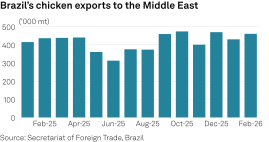
With current disruptions affecting Gulf shipping lanes, Brazilian poultry and beef exporters expect some impact on trade from delayed shipments; however, industry participants believe the overall effect will remain limited, as shipping companies are actively rerouting ships to mitigate potential losses.
"Exporters are adopting alternative routes to keep trade flowing to the Middle East and Asia," a market analyst said, while a chicken exporter said, "We are exploring alternative maritime routes to ship to Middle Eastern countries, sidestepping risk-prone areas such as the Strait of Hormuz."
One alternative route recently adopted to reach Saudi Arabia and Jordan is the Bab al-Mandab Strait, located between Yemen and Djibouti, which provides access to the Red Sea and onward to the eastern coast of Saudi Arabia, Santin said. To reach Dubai, shipping companies are increasingly using the Port of Salalah in southern Oman, from where cargo can be transported overland to the city.
Additionally, a third routing option has emerged, with shipments delivered to the Port of Khorfakkan on the UAE's eastern coast before proceeding to their final destinations, Santin added.
Another chicken exporter said shipments to Saudi Arabia can be rerouted via the Cape of Good Hope in Southern Africa, which, while longer and more expensive, offers a safer alternative. Some traders are also redirecting shipments originally bound for Middle Eastern countries to other markets.
Despite these adjustments, market participants said the ability to diversify logistics routes could help offset disruptions and prevent significant long-term effects on Brazilian meat exports, although rerouting shipments could increase logistics costs and slow container clearance.
Platts assessed the CIF Middle East chicken breast price at $2,550/metric ton on March 16, up $150/mt day over day, while the FCA Brazil chicken leg price was assessed at $2,690/mt, unchanged over the same period.
Beef exports
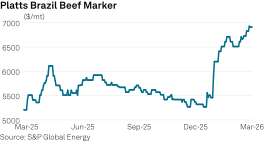
Brazil's beef exports could also be disrupted by the Middle East conflict, with Roberto Perosa, president of the Brazilian Beef Exporters Association, saying the war could affect 30%-40% of the country's exports.
Although the Middle East accounts for about 10% of Brazil's beef exports -- roughly 250,000 mt -- the region plays a critical role as a transit hub for shipments bound for Asia. Ports in Bahrain, Qatar, Oman and the UAE serve as stopovers, with cargo redistributed to markets such as China, the largest importer of Brazilian beef, Perosa added.
Brazil exported 3 million mt of beef in 2025, Perosa said, and in a worst-case scenario, up to 1 million mt could face disruption, including shipments to China and Southeast Asia. Logistics routes that rely on Middle Eastern stopovers would be disrupted, significantly affecting global supply chains, with ships carrying Brazilian beef already waiting offshore and unable to dock at regional ports, while some shipping companies have suspended contracts.
War-risk surcharges of up to $4,000 per container have further raised export costs, making some shipments commercially unviable. Industry representatives said there are currently no immediate alternative markets capable of absorbing the potentially affected volumes.
War-risk fees
Major global carriers have responded by adjusting routes and imposing additional fees. Mediterranean Shipping Co. introduced an $800-per-container "deviation surcharge" for shipments bound for ports in the Persian Gulf, citing regional security concerns.
On March 4, MSC implemented war-risk surcharges of $4,000 per refrigerated container, $3,000 per 40-foot container and $2,000 per 20-foot container for cargo departing the Arabian Peninsula to West Africa, East Africa, South Africa, Mozambique and Indian Ocean islands.
Other major carriers, including Maersk, Hapag-Lloyd and CMA CGM, have suspended transits through the Strait of Hormuz and imposed similar war-risk surcharges. CMA CGM is charging up to $4,000 per refrigerated container and resuming Middle East shipments via alternative routes, albeit at additional cost.
Shipping companies acknowledged that these measures may disrupt logistics and supply chains but said they are necessary to manage security risks and rising operating costs.
On March 11, CMA CGM reopened import and export bookings for dry, reefer and in-gauge containers to and from the Middle East. The company said in an advisory that it has designed "multimodal solutions" using alternative ports in the Red Sea or Gulf of Oman and a "bonded land bridge" to reestablish access to key Persian Gulf markets, including Iraq, Kuwait, Qatar, Bahrain, Saudi Arabia and the UAE.

Editor: