Agriculture, Energy Transition, Refined Products, Biofuel, Renewables, Jet Fuel
January 06, 2026
COMMODITIES 2026: SAF short-term supply taxis smoothly as feedstock race clouds 2030 targets
HIGHLIGHTS
Waste oils threaten scalability of the 10% by 2030 targets
Asia-Pacific SAF infrastructure pivot focuses more on small refineries
Short-term offtakes, book-and-claim registries to manage green premiums
As the aviation industry taxis toward 2026, the global sustainable aviation fuel market is entering a pivotal transition year. While 2025 was defined by the rollout of binding mandates in Europe, 2026 is shaping up as a test of the industry's ability to scale supply amid divergent policy frameworks and intensifying competition for feedstocks.
The targeted takeoff is hitting a tangible ceiling of a feedstock bottleneck that threatens to ground 2030 ambitions.
With binding obligations now clashing against a supply chain still dependent on limited waste oil pools, 2026 becomes a stress test for the sector's ability to convert policy targets into physical gallons.
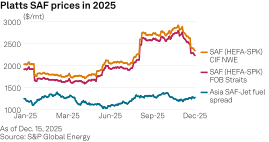
Mandates create market
Singapore, with other emerging Asia mandates and ReFuelEU requirement (2025-2029), lock in cross-continental demand, reinforced by the UK's carbon-intensity framework that will continue anchoring non-negotiable demand signals.
Market participants interviewed by Platts, part of S&P Global Energy, expect global SAF production and consumption to remain broadly balanced in 2026, with no material supply-demand mismatches and prices to stabilize, barring major feedstock disruptions.
"Assuming no new legislation is introduced, there should not be a significant gap between SAF uplift and production in 2026. Prices should remain at current levels or trend lower over the year," an Asia-based biofuels trader said.
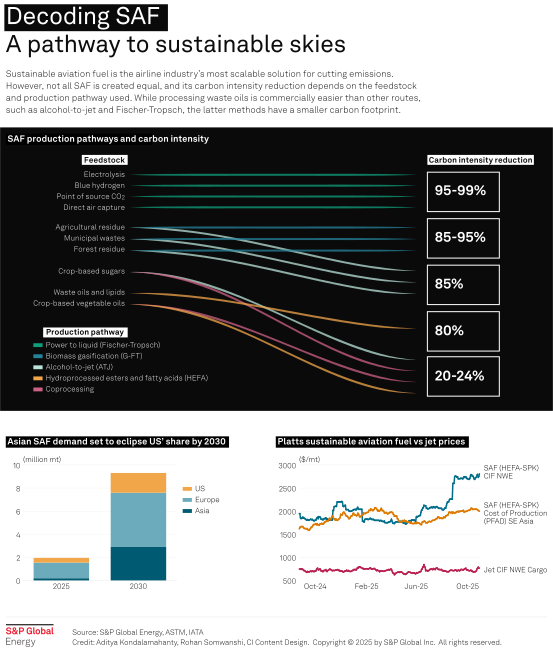
Global SAF consumption is projected at 2.47 million metric tons for 2026, closely matched by production of approximately 2.54 million mt, according to S&P Global Sustainable1.
However, supply responses are increasingly from Asia.
"APAC [Asia-Pacific] is pivoting from feedstock exporter to SAF producer," said LT Leong, president at NGen Energy. "2026 marks infrastructure catch-up to meet mandate-driven demand, with smaller 50,000-120,000 mt refineries popping in Southeast Asia for 2028-2029 startup."
Financial realism
The market isn't just dealing with physical fuel, but with the credit risks associated with high transition costs.
Aviation finance intelligence firm Ishka mentioned that financial stakeholders have factored SAF costs into their credit models.
"Lessors and lenders factor SAF-related cost burdens into assessments," Ishka said, adding that for European carriers, "Lower ATF prices in 2025 have absorbed ETS and SAF compliance cost increases," though this cushion might vanish as mandates tighten and carbon allowance phase-outs accelerate.
Feedstock, HEFA stifle as Asia exports emerge
China's 1.2 million mt export whitelist positions Asia-Pacific as the critical swing supplier for 2026, with Thailand, Indonesia, and Malaysia ramping hydroprocessed esters and fatty acids capacity. However, feedstock constraints threaten to bottleneck these mega-refineries despite projects coming online through 2026-2028.
Combined UCO from Indonesia, Malaysia and Thailand cannot sustain a single 620,000 mt like Phoenix mega-refinery, LT said. "This constraint pushes toward smaller 50,000-120,000 mt facilities securing adequate feedstock per month locally without overextending. Start small and manageable."
With over 80% announced SAF projects relying on HEFA while supply covers near-term mandates, constraints on aforementioned feedstocks suggest that progress toward 2030 ambitions require rapid diversification.
Thailand and Malaysia's HEFA capacity ramp-up will further boost Asia SAF supply in 2026, aiding EU compliance while intensifying UCO competition.
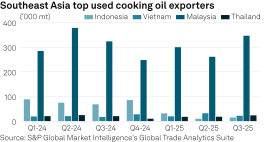
Asian UCO and PFAD hit three-year highs in 2025, fueled by regional (Indonesia-China) export restriction. Regional tensions over feedstock definitions persist, as Europe restricts POME which Asian producers consider essential resources.
Policy-induced pause
The US SAF market is facing a set of contrasting headwinds.
Supply in 2026 is forecast at 11,600 b/d against demand of 11,800 b/d, down from 13,900 b/d in 2025, according to S&P Global Energy analysts reflecting no federal mandate, RFS feedstock competition, and 45Z credit restrictions under "One Big, Beautiful Bill Act."
The July 2025 legislation limits eligible feedstocks to North American sources, removes the $1.75/gal advanced credit, and excludes ILUC from carbon scoring.
The production is projected to rebound to 16,200 b/d in 2027 on a $1/gal incentive for fuels achieving 50% GHG reduction, supported by the 45Z Clean Fuel Production Credit, according to S&P Global Energy's analyst.
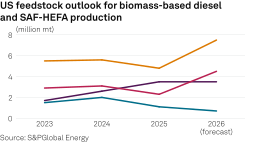
EU antidumping duties have stifled transatlantic trade. US Customs recorded zero SAF exports in November 2025; however, policy clarity and new capacity are expected to restore flows by 2027.
Data centers compete for renewable energy, constraining SAF inputs. IATA projects SAF at just 0.8% of 2026 fuel consumption (2.4 million mt) with a $4.5 billion incremental cost, exposing policy fragmentation.
Bridging green premium via Scope 3 and registries
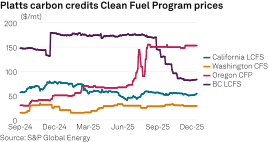
The "Green Premium" with SAF prices three to five times higher than jet fuel remains aviation's most formidable barrier. In 2025, IATA estimated the industry absorbed $3.6 billion in SAF premiums.
While mandates drive volume, airline appetite for long-term price exposure is cooling, as average offtake durations have plummeted from 3.7 years in 2023 to just 2.2 years in 2025, Ishka said as carriers pivot toward short-term compliance over long-term hedging in a volatile market.
For European carriers, SAF costs are increasingly assessed within a broader environmental cost stack, often overshadowed by rising EU ETS expenses. "For many European airlines, EU ETS costs now exceed SAF costs, so they are viewed as a combined environmental cost," Ishka said.
"Airlines will reevaluate 10% SAF by 2030 commitments as production falls short," said Willie Walsh, director general of IATA.
Corporate Scope 3 targets fuel SAF certificate demand through book-and-claim systems, enabling a London flight to claim decarbonization from Los Angeles-pumped SAF.
Companies offset travel emissions by purchasing certificates, subsidizing the green premium.
The market migrates from bilateral deals to centralized registries, bridging price gaps where policy incentives falter.
IATA's SAF Registry, operated by CADO, tracks global transactions and signaled a critical shift toward centralized tracking and standardization, aiming to prevent double-counting while building investor confidence.
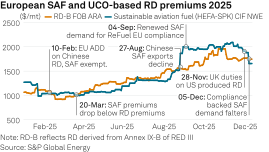
Fragmentation between CORSIA and regional initiatives raises costs and curtails emissions reductions; airlines remain committed to net zero, but policymakers must harmonize global energy transition frameworks, said Marie Owens Thomsen, IATA SVP Sustainability and Chief Economist.
Though challenges around credibility, double-counting, and regulatory recognition persist.
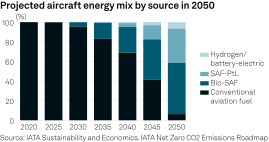
SAF enters 2026 at a maturation crossroads: balanced fundamentals provide stability, but feedstock constraints demand the urgent deployment of ATJ, FT, and e-SAF, capable of sustainable scaling beyond 2030. Coordinated policy, corporate commitments, and infrastructure investment must unlock diverse feedstock streams, including residues, CO2, and hydrogen.
Regulatory and investment decisions made this year will determine whether SAF's takeoff trajectory continues or stalls at current cruise altitude, market participants said.

Editor: