Agriculture, Energy Transition, Refined Products, Biofuel, Renewables, Jet Fuel, Vegetable Oils
December 16, 2025
COMMODITIES 2026: Global UCO supplies tighten as emission mandates boost SAF output
By Samyak Pandey and Chau kit Boey
HIGHLIGHTS
Asia slows UCO exports to prioritize domestic SAF mandates
EU regulations squeeze waste-based feedstock supply
Compliance costs rise due to stringent traceability requirements
This is part of the COMMODITIES 2026 series, where our reporters bring you key themes that will drive commodities markets in 2026.
Key Asian used cooking oil-producing nations are increasingly restricting exports as governments expand domestic sustainable aviation fuel output to meet decarbonization targets, amid tighter RED III standards in Europe and Germany's pending exclusion of feedstock palm oil mill effluent, leading to higher compliance costs for downstream users worldwide.
Malaysia, the world's biggest UCO supplier, has begun domestic SAF production, with the planned startup of EcoCeres' commercial facility in Tanjung Langsat, Johor. The facility is aiming for full ramp-up by January 2026.
Thailand's Alternative Energy Development Plan 2024-37 mandates a 1% SAF blend by 2026, rising to 8% by 2036. Initial production is expected to rely on UCO before transitioning to alcohol-to-jet pathways beyond a 3% blend.
Indonesia raised its UCO export levy to over 9% in May, while restricting exports of palm residues, including POME, to secure supply for its B40 biodiesel mandate and SAF program.
China, toward the end of 2024, canceled export tax rebates for UCO, signaling a shift toward domestic processing. In April 2025, Beijing launched a SAF export pilot, initially authorizing three producers with a combined annual quota of 828,000 metric tons. The export list has since expanded to about 1.2 million m/y.
Malaysia, Vietnam, Thailand, Indonesia and China are the world's top five UCO producers, according to S&P Global Market Intelligence's Global Trade Analytics Suite.
SE Asia ring-fence
Regional exporters in Southeast Asia have taken steps to reserve UCO for local hydroprocessed esters and fatty acids-based SAF operations, targeting both domestic mandates and export opportunities.
- Malaysia's national oil company, Petronas, launched a pilot UCO collection program at petrol stations in 2023 and is working on an upcoming SAF biorefinery with Enilive and Euglena that is targeted to begin operations in the second half of 2028. Immediate demand has been driven by EcoCeres' 350,000 mt/y SAF biorefinery, which began ramping up output in October.
- Vietnam's UCO exports doubled from 18,745 mt in the first quarter of 2025 to 31,744 mt in Q2 2025, according to GTAS, as Indonesia's early-2025 export restrictions forced buyers in the Straits to seek alternative supplies from Thailand, Malaysia, and Vietnam. However, market participants have raised concerns about traceability and composition, citing inconsistent documentation and opaque supply chains. These challenges have increased compliance costs for European buyers, who must adhere to stricter RED III sustainability verification requirements. "The paperwork burden has doubled," a European trader said. "We are seeing rejections at port because the chain of custody does not meet EU standards."
- In April, Bangchak inaugurated a 1 million liter/d UCO-exclusive SAF facility, Thailand's first. The government has estimated that UCO supplies for SAF production meeting the International Civil Aviation Organization standards will amount to about 58,000 mt, producing around 34 million liters of SAF. Thailand's Civil Aviation Authority signed a memorandum of understanding on Nov. 17 with eight domestic airlines to begin coordinated use of SAF from 2026. "Exporting UCO is no longer the priority," a regional producer said. "Thai producers will prioritize domestic sourcing to avoid the premium attached to imported UCO."
- The International Council on Clean Transportation said Oct. 15 that Indonesia could collect up to 715,000 mt/y of UCO, equivalent to roughly 187,000 kiloliters of SAF feedstock. Indonesia is targeting a 1% SAF blend by 2027, which will require about 60,000 kl of HEFA fuels. US Department of Agriculture data show that Indonesian UCO exports peaked in 2021, before the introduction of a $35/mt levy in 2022.
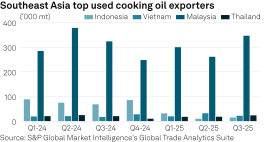
"As Singapore's SAF mandate kicks in, this is structurally bullish for domestic prices," an Asia-based UCO aggregator said. "A significant portion of Malaysian UCO will be reserved for local SAF projects, reducing export availability."
India, which has an estimated potential UCO supply of about 3 million-4 million mt annually according to government estimates, faces a hurdle, as market participants estimate that over 80% of the country's UCO continues to flow through informal channels. Manish Marwaha, founder and CEO of cleantech company Byufuel India, argued that the single most effective intervention to unlock scale would be "mandatory, enforceable source-level disposal of UCO exclusively through authorized aggregators."
Asian UCO exports:
| UCO exports (in mt) | Indonesia | Vietnam | Malaysia | Thailand | China |
| 2024 Q1 | 88244.65 | 18744.5 | 284417.0799 | 20057.604 | 551905.763 |
| 2024 Q2 | 74771.3 | 20019.43 | 378057.0352 | 24193.678 | 857634.254 |
| 2024 Q3 | 67915.32 | 16828.66 | 323424.9015 | 20077.603 | 715122.625 |
| 2024 Q4 | 85171.85 | 27356.84 | 247607.406 | 9675.011 | 826250.452 |
| 2025 Q1 | 31337.6 | 19156.98 | 299724 | 17359.175 | 579192.004 |
| 2025 Q2 | 9531.501 | 31743.82 | 260942.9447 | 17689.067 | 682492.846 |
| 2025 Q3 | 14552.04 | 21739.01 | 346232.3532 | 23300.068 | 634352.51 |
Source: GTAS
Chinese exports
EU and US policy shifts reversed China's UCO export flows in 2025, redirected volumes toward domestic SAF production.
Market participants said most buyers in China have already met their 2025 emissions targets, and some SAF plant maintenance has further dampened demand. "Interest could remain low until after Chinese New Year 2026 [in February]," a China-based producer said.
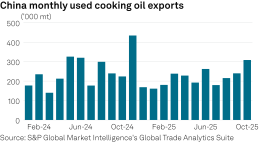
Longer-term policy signals remain bullish as Beijing has supported blending domestically produced biodiesel with marine fuel oil, which could further put pressure on supplies.
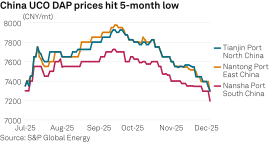
Platts-assessed UCO DAP Tianjin port prices fell to Yuan 6,895/mt on Dec. 12 from Yuan 7,925/mt on Sept. 23. Nantong port prices dropped 13.3% during the period to Yuan 6,895/mt, while Nansha port prices declined 9.4% to Yuan 6,995/mt. Platts is part of S&P Global Energy.
The five-month low in prices reflects reduced production as some plants halted operations for scheduled maintenance in November and December, according to market sources.
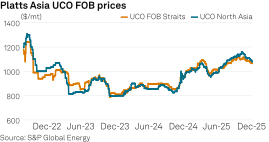
The weakness was reflected in FOB Straits UCO prices. Platts assessed the price at $1,060/mt on Dec. 12, down from $1,130/mt on Sept. 17. UCO FOB China decreased to $1,029/mt on Dec. 12 from $1,160/mt on Oct. 10.
Maintenance turnarounds, EU buyers having already secured their needs and uncertainty surrounding RED III implementation weighed on prices, according to market sources.
According to S&P Global Energy CERA, tighter Asian UCO availability, increased scrutiny of eligible feedstocks in the EU for meeting greenhouse gas reduction mandates and firmer palm oil prices are expected to support UCO values in 2026.
EU and RED III
Regulatory clarity improved after Germany's Cabinet approved the RED III draft law on Dec. 10, confirming the elimination of double-counting for advanced biofuels from Jan. 1, 2026.
For Asian exporters, the removal of multipliers means that European buyers will need to purchase larger physical volumes at spot prices to meet mandates, shifting pricing power toward producers with scale and verified traceability, according to market sources.
"Single-counted volumes mean plants will have to run harder," a Singapore-based trader said.
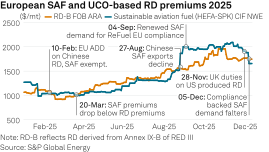
The bill also excludes POME from 2027, creating a narrow window of heightened demand in 2026.
POME processors anticipate a 20%-30% price increase as buyers front-load commitments before restrictions tighten, taking advantage of POME's final year of eligibility as an Annex IX-A advanced feedstock.

Editor: