Agriculture, Energy Transition, Refined Products, Biofuel, Renewables, Jet Fuel
November 17, 2025
CAAT, Thai airlines agree 2026 SAF rollout; regulator weighs carbon fee mechanism

HIGHLIGHTS
Thailand inks SAF cooperation pact with 8 airlines
Carbon fee mechanism under study for 2026 rollout
Domestic, regional SAF momentum accelerates
Thailand's Civil Aviation Authority has signed a memorandum of understanding on Nov. 17 with eight domestic airlines to begin coordinated use of sustainable aviation fuel from 2026.
The MOU includes Thai Airways, Bangkok Airways, K-Mile Air, Nok Air, Thai AirAsia, Thai AirAsia X, Thai Lion Air and Vietjet Thailand. Senior officials from the Department of Energy Business, Department of Alternative Energy Development and Efficiency, Office of Transport and Traffic Policy and Planning, Airports of Thailand, BAFS, PTT and Bangchak witnessed the ceremony.
CAAT Director-General Air Chief Marshal Manat Chavanaprayoon said the agreement establishes a joint framework for SAF adoption, lifecycle emissions calculation and alignment with ICAO's Carbon Offsetting and Reduction Scheme for International Aviation, for which Thailand had joined the pilot phase in 2021.
Under the pact, airlines and regulators will coordinate on SAF procurement planning, reporting standards, and verification requirements. The initiative stems from the work of a cross-agency subcommittee formed earlier this year to develop technical and economic guidelines for scaling SAF use.
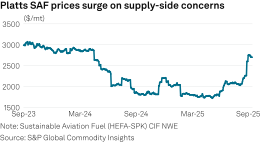
Carbon surcharge proposal
CAAT said rising energy costs related to SAF adoption remain a concern for airlines. To address this, regulators are evaluating a voluntary carbon surcharge mechanism for international flights beginning in 2026. The fee would allow carriers to transparently separate costs associated with emissions reduction and offsetting activities.
CAAT is considering a voluntary cost-segregation approach for international routes, expected to begin in 2026. The purpose of this surcharge is to demonstrate the costs associated with reducing and offsetting carbon emissions in Thailand's aviation sector. CAAT will monitor transparency and ensure compliance with international regulations
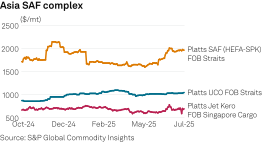
Domestic and regional momentum
The MOU follows a series of SAF moves by Thai carriers, including Vietjet Thailand's expansion of its Fly Green program. Vietjet recently signed an agreement with PTT Oil and Retail (OR) to extend regular SAF use on its Bangkok-Da Nang and Bangkok-Phu Quoc services, and plans to launch additional "Green Routes," including Bangkok–Cam Ranh, in the first quarter of 2026.
Thailand has yet to finalize a national SAF blending requirement, though the Ministry of Energy is assessing waste- and residue-based feedstocks such as used cooking oil, PFAD and ethanol as part of a domestic production road map targeted for the late 2020s.
The region has seen accelerating policy action. Singapore is implementing Asia's first SAF mandate with a 1% blend from 2026, rising toward 3%-5% by 2030. Malaysia is advancing plans to become a regional feedstock and refining hub, leveraging UCO availability, palm oil waste streams and new HEFA projects.
Japan targets 10% SAF use by 2030 and is supporting domestic production via refiner-aviation partnerships.
The Asian jet fuel/kerosene market complex strengthened further Nov. 17, supported by robust demand ahead of the seasonally strong winter period.
Platts assessed the front-month December-January jet fuel/kerosene swaps time spread at plus $2.84/b at the Nov. 14 Asian close, widening 27 cents day over day.
Platts-assessed cash differential for jet fuel/kerosene loading from Singapore rose 26 cents/b day over day to plus $2.82/b to Mean of Platts Singapore jet fuel/kerosene assessments on Nov. 14, staying at over-two-year highs.

Editor: