Agriculture, Energy Transition, Refined Products, Biofuel, Renewables, Jet Fuel
December 30, 2025
China designates Puyang as SAF export pilot zone, adds Henan as producer

HIGHLIGHTS
Puyang designated as SAF export pilot zone
Henan Junheng Biotechnology added to SAF export whitelist
China expands SAF export capacity, nearing EU demand
China has named the city of Puyang in Henan province as a pilot zone for sustainable aviation fuel exports and approved a local producer for the national export "whitelist," expanding the country's controlled program to supply SAF to overseas markets, according to the Puyang municipal government.
Puyang was included in China's third batch of pilot cities for bio-aviation fuel exports, following joint approval by the Ministry of Commerce, the General Administration of Customs, the National Energy Administration and the State Administration of Foreign Exchange, according to a Dec. 28 announcement by the local government.
Henan Junheng Biotechnology was simultaneously added to the SAF export whitelist, becoming the first company in Henan province and the fifth nationwide to receive approval. The company was granted an annual export quota of 240,000 metric tons, according to the Puyang government.
China operates a strict entry system for the production and export of sustainable aviation fuel, which is typically made from waste oils such as used cooking oil and animal fats.
The whitelist pilot scheme enables qualified producers in approved cities to apply for export licenses within their assigned capacity, thereby easing the restrictions that apply to refined oil exports.
Puyang officials said Junheng Biotechnology's inclusion reflects years of technological development. The company operates facilities capable of processing about 400,000 mt of waste oil per year and, in 2024, became the first private enterprise in China to obtain a Civil Aviation Administration of China airworthiness certificate for SAF.
It has also supplied SAF domestically and is developing a larger project expected to start up in 2026.
The addition of Puyang and Junheng further expands China's SAF export capacity.
Prior approvals had lifted the country's total authorized SAF export quota to around 1.2 million mt/year, a volume market participants say could meet much of Europe's near-term demand under the ReFuelEU Aviation mandate.
Puyang authorities stated that the city has prioritized biomass energy as part of its economic transition and established a multi-agency task force to support the application process. The city aims to build a broader bioenergy and bio-based materials cluster through the SAF export pilot, the statement said.
The Civil Aviation Administration of China has been evaluating phased mandates for 2026-2030, with early drafts suggesting a 1%-2% SAF blending requirement for trunk airlines, which is expected to rise thereafter—policy shifts that could spur additional domestic capacity.
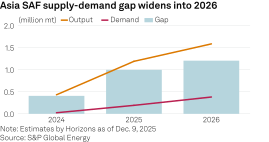
China currently trails Singapore and Japan in commercial SAF output; however, it has more than 1 million mt/year of announced capacity in planning and construction, heavily weighted toward HEFA pathways due to UCO availability and established export collection networks.
Since China began issuing SAF export quotas, the country is estimated to have shipped 182,000 mt of SAF between May and October 2025, according to data from S&P Global Energy CERA.
In November, China's eastern Shandong province completed its first large-scale export of sustainable aviation fuel, with a 14,000 mt cargo of used cooking oil-based SAF sailing to the EU in recent days.
The shipment was supplied by Shandong Haike Chemical Co., operator of what the authorities describe as China's largest single-train SAF unit, located in the Dongying Chemical Industry Park, according to a Nov. 12 update from the provincial government.
Haike Chemical was granted an annual export quota of 370,000 mt, making it one of just four companies nationwide with approved export capacity under the scheme. At the same time, EcoCeres was allocated 300,000 mt/year and Shandong Sanju Bioenergy received 158,000 mt/year.
This followed an earlier allocation of 372,400 mt/year to Zhejiang Jiaao Enprotech in April, taking China's total authorized SAF export quota pool to 1.2 million mt/year across four facilities.
China's internal SAF consumption is also ramping up following a March directive requiring all flights departing from Beijing Daxing, Chengdu Shuangliu, Zhengzhou Xinzheng, and Ningbo Lishe airports to refuel with a 1% SAF blend, adding an estimated 50,000 mt/year of new demand.
The authorities plan to extend the program to major provincial airports, particularly in the Yangtze River Delta, Pearl River Delta and Beijing-Tianjin-Hebei regions.
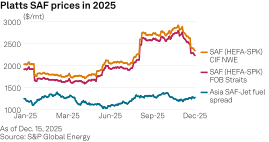
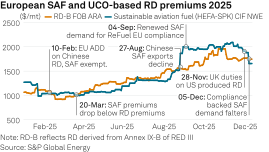
Platts, part of S&P Global Energy, assessed the Sustainable Aviation Fuel FOB FARAG premium over Platts Jet steady at $1,624.75/mt Dec. 30, with no disproving indications heard on the day.
Platts assessed the sustainable aviation fuel CIF NWE premium over Platts Jet steady at $1,634.75/mt Dec. 30, reflecting an established CIF NWE/FOB FARAG spread at plus $10/mt.

Editor: