Maritime & Shipping, LNG, Coal, Natural Gas, Electric Power, Agriculture, Energy Transition, Thermal Coal, Biofuels, Sugar, Renewables
November 03, 2026
COMMODITY TRACKER: 5 charts to watch this week
Container rates from West Coast India to the Middle East reached five-year highs and Asian LNG prices remained elevated ahead of winter. Turkey's thermal coal imports fell to a four-year low as renewable energy surged, while European ammonia production costs rose on higher gas prices.
1. West Coast India-Middle East container rates rise
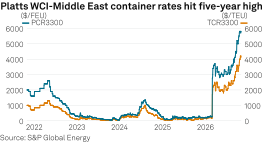
What's happening? Container spot rates from West Coast India to the Middle East reached a five-year high on Oct. 28 amid space shortages, port congestion, and carrier reluctance to deploy vessels and equipment to the region. Platts, part of S&P Global Energy, assessed PCR 3300 at $5,500/FEU and TCR 3300 at $4,000/TEU, both about 1,900% higher since Feb. 27, the day before the beginning of the Middle East war. Equipment availability is also under pressure as longer container dwell times at regional hubs have led to a build-up of container stock. Market sources reported higher storage and inland transport costs, while some shippers have held back lower-value cargo as elevated freight rates and port delays challenge shipment economics.
What's next? Market participants are watching whether carrier reluctance, equipment imbalances and congestion at alternative Middle East gateways ease. Some sources expect cargo volumes to increase from late November through January ahead of Ramadan in February 2027, which could add further pressure if vessel space and equipment availability remain constrained.
2. Asia LNG prices rise ahead of the winter season
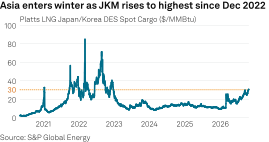
What's happening? Asia's LNG market has entered the winter demand season, with prices supported by stronger regional demand and continued competition with Europe for available cargoes. The Platts JKM rose above $30/MMBtu on Oct. 19 for the first time since December 2022 and has remained above that level. Buying interest from China and South Korea has strengthened as buyers looked to build inventories and secure supply ahead of peak winter demand, an Asian market source said. Firm European gas prices have also underpinned Asian LNG prices by affecting the economics of moving flexible cargoes between the Atlantic and Pacific basins.
What's next? Asian LNG prices are likely to remain sensitive to winter weather, supply availability, and competition with Europe. Colder-than-expected temperatures in Northeast Asia or Europe, or an escalation in tensions in the Middle East that disrupts LNG production or shipping flows, could tighten balances and push prices higher. These demand and supply risks will continue to influence Asian LNG prices through the winter.
3. Turkey thermal coal imports at 4-year low
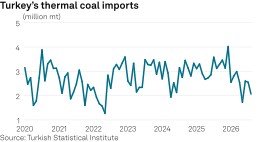
What's happening? Turkey's thermal coal imports fell 18.77% year over year to 19.90 million metric tons in January-August, the lowest for the period since 2022, according to Turkish Statistical Institute data. The decline was driven by a sharp rise in renewable energy, which accounted for more than 60% of total power generation, up from 47.20% year over year, supported by record hydro output of 75.16 TWh, according to Turkish Electricity Transmission Corp. data. Coal-fired generation, including hard coal, lignite and imported coal, fell to 67.2 TWh from 77.9 TWh year over year. Despite weaker Turkish appetite capping gains, Platts -assessed CIF Med 45,000 mt Russian-origin coal averaged $98.75/mt in January-August, up from $85.85/mt year over year, while non-Russian-origin coal averaged $112.15/mt, up from $91.45/mt, with the latter displaying stronger prices amid US-Iran war-driven energy price increases.
What's next? Turkey's 2026 coal imports are forecast at about 30 million mt, down about 8 million mt year over year, according to the International Energy Agency. However, market participants suggest a demand recovery is possible during winter months, following a pickup in coal-fired generation in July and August as hydropower output eases. Sustained increases in seaborne coal prices could limit demand growth, with prices beyond a certain threshold potentially becoming uneconomic for Turkish power plants, according to sources.
4. European ammonia production costs rise on higher gas prices
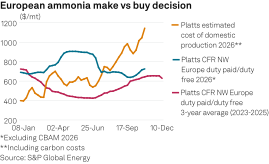
What's happening? European ammonia consumers face mounting pressure as domestic production costs reached approximately $1,180/mt on Oct. 28, the highest level since the 2022 energy crisis, driven by the Dutch TTF front-month contract exceeding Eur100/MWh for the first time since December 2022. Platts assessed NW Europe ammonia at $730/mt CFR duty paid/duty free on Oct. 29, up $10/mt on the day. Meanwhile, production outages in global supply hubs like North Africa, the US Gulf and Southeast Asia are limiting availability in the international market.
What's next? European nitrate producers are preparing for the peak spring application season, which could sustain elevated prices despite some demand destruction already observed. US producers may increase exports to Europe, benefiting from lower production costs of $145/mt based on the Henry Hub front-month gas contract settling at $2.952/MMBtu on Oct. 29. Vessel availability is expected to cap price growth, according to market participants.
5. Pakistan anhydrous ethanol prices rise on tight supply
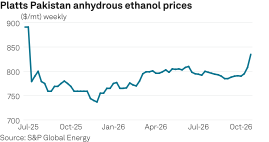
What's happening? Pakistan's anhydrous ethanol market climbed to its highest level in more than 15 months on Nov. 2, supported by tightening domestic supply and steady export demand. Platts assessed Pakistan anhydrous ethanol at $835/mt FOB Karachi on Oct. 26, up $27/mt week over week, marking the highest level since July 7, 2025, when it was assessed at $891/mt FOB Karachi. The recent strength in prices was primarily attributed to limited product availability ahead of the start of the new crushing season. Karachi-based sources said inquiries from Europe and East Asia lend additional support to prices.
What's next? Fresh molasses supplies are expected to arrive from the end of November, according to Kamran Zafar, General Manager at JDW Group. Supply tightness is expected to continue supporting prices in the near-term. Pakistan's crushing season is anticipated to begin toward the end of November, with peak ethanol production typically occurring between February and March, which could ease supply constraints later in the marketing year.
Reporting and analysis by Tanya Kalra, Cindy Yeo, Hardik Verma, Mollie Gorman and Muskan Agarwal.
