Natural Gas, LNG
October 22, 2026
Asia enters winter LNG demand season just as JKM hits four-year high amid uncertainties
Editor:
HIGHLIGHTS
State-backed buyers secure Dec LNG cargoes
Market structure flips into contango
EU gas storage sits below historical norms
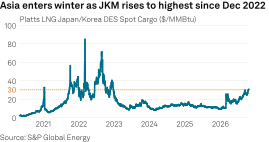
Asia is entering the winter LNG season just as Platts JKM has hit its highest level since December 2022, amid price-swing factors such as uncertainty over the war in the Middle East, the EU's ban on Russian LNG imports, and the impact of El Niño on weather.
Nevertheless, winter procurement by major Northeast Asian LNG buyers has gathered pace despite elevated spot prices, with a Chinese national oil company and a South Korean LNG importer securing cargoes as market expectations shifted away from the softer year-end conditions anticipated in September, according to market sources.
"Winter restocking by state-backed LNG importers in North Asia — mainly China, South Korea and Taiwan — has been key to bolstering the region's winter balances and is one of the key reasons for pushing JKM to the $30/MMBtu level," said Eric Yep, senior principal analyst for First Take Gas at S&P Global Energy CERA. "This is expected to continue at a reasonable level despite the broad assessment for a warmer-than-usual winter, as these countries will still require LNG for a normal cold season."
"The winter procurement is also being driven by Europe stepping in to bolster its own winter stockpiles and higher demand in Europe's seven largest gas markets on colder weather forecasts," Yep said.
The purchases were mainly aimed at preparing for winter heating demand and meeting storage-filling targets, reflecting the Chinese company's supply-security obligations as a national oil company, several Chinese sources said.
The buying contrasted with limited activity among China's second-tier companies, which remained on the sidelines as prices stayed high, sources said.
The Korean LNG importer, which had earlier sought up to eight cargoes in a tender that closed in early October, has bought at least five to six cargoes for December and January delivery, according to sources.
Market participants also said they expected Taiwan to seek LNG cargoes soon, citing its exposure to Middle East supply disruptions and its reliance on the region for LNG imports.
The recent purchases marked a shift from September, when buyers had largely adopted a wait-and-see approach on expectations that a mild winter and increased availability of LNG cargoes via the Strait of Hormuz would ease the market and weigh on prices later in the year.
The November-December JKM structure was backwardated by 12.4 cents/million British thermal units on Oct. 1, according to data from Platts, part of S&P Global Energy. The structure flipped into a contango, with the JKM December cumulative average standing at $30.283/MMBtu on Oct. 21, $3.751/MMBtu above the JKM November full-month average, underscoring how expectations of cheaper winter supplies have been challenged.
"I think people were not pricing in winter fear earlier and now they are panicking," a Singapore-based trader said, adding that similar concerns were evident in Europe, although less pronounced than in Asia.
Platts JKM rose above $30/MMBtu on Oct. 19 for the first time since December 2022 as geopolitical risks heightened concerns over winter LNG supply, and extended its gains Oct. 22 on sustained winter buying interest.
Platts assessed the JKM — the benchmark price reflecting LNG delivered to Northeast Asia — for December at $30.761/MMBtu on Oct. 22, an increase of 32.9 cents/MMBtu compared to $30.432/MMBtu on Oct. 19. The JKM benchmark was last higher on Dec. 21, 2022, at $32.171/MMBtu.
"While JKM has recently risen above $30/MMBtu, current market conditions are also conducive to demand destruction, particularly in China and South Asia, through reduced LNG imports and switching to alternative fuels. We expect this will provide some restraint on further price increases," said an Asian market source.
"On the supply side, in addition to supply risks stemming from the situation in the Middle East, attention is focused on Europe's LNG procurement ahead of winter demand, as European gas inventories remain below both year-ago levels and historical norms."
"We expect competition between Asia and Europe for LNG cargoes, including against the backdrop of policy developments concerning Russian LNG, to affect the supply-demand balance and price formation this winter," the source said.
The EU is set to ban all imports of Russian LNG from Jan. 1, 2027, under legislation approved at the start of this year.
Some European companies with long-term Russian LNG contracts can continue to divert some shipments outside the EU until at least late July 2027 under a carve-out in the EU's latest sanctions package against Moscow, approved in July.
European implications
The winter landscape in Europe appears to paint a picture of uncertainty, with market sentiment mixed over whether the region has sufficient volumes to last the incoming season.
A persistent backwardated market structure in Europe over the past few months has placed resistance on any meaningful gas storage injections, leaving the build-up slow.
EU-wide gas storage was 74.58% full as of Oct. 21, according to the latest data from Gas Infrastructure Europe.
Buying appetite for LNG in the prompt market does appear to be building, however, with US liquefaction terminals' feedgas demand reaching notable levels to respond to the increased market signals, sources said.
"All of the liquefaction plants are pushing as much as possible," an LNG trader said. "Considering the [NWE-TTF] spreads we are seeing."
Another LNG trader said a stronger winter in Europe was being priced in.
However, market participants have also noted that LNG purchases for December could remain strained if LNG-TTF discounts persist at current levels, with players struggling to cover regasification costs.
"If winter remains [with narrow LNG-TTF discounts], it won't be in the money for regas, and people won't sell," the first LNG trader said.
