Maritime & Shipping, Crude Oil, Containers
October 28, 2026
West Coast India-Middle East container spot rates hit 5-year high

By Tanya Kalra
Editor:
HIGHLIGHTS
West Coast India-Middle East rates surge 1,900% since Feb
Carrier reluctance grows amid Middle East disruptions
Port calls shift outside Strait of Hormuz
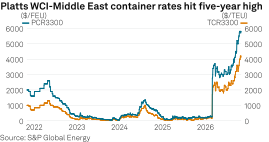
Container spot rates from West Coast India to the Middle East have reached a five-year high Oct. 28, eight months into the Middle East conflict, surpassing the previous peak in November 2021.
Platts, part of S&P Global Energy, assessed PCR 33 West Coast India to the Middle East at $5,500/FEU and TCR 33 for the same route at $4,000/twenty-foot equivalent unit Oct.28. Both are up roughly 1,900% from Feb. 27, rising by $5,225/FEU and $3,800/TEU, respectively.
Space shortage, carrier reluctance
Market sources noted a growing shortage of space on the trade lane as carriers become increasingly reluctant to send vessels to the Middle East.
"Rates are now secondary; there are not enough vessels being taken to Khor Fakkan," an India-based shipper said.
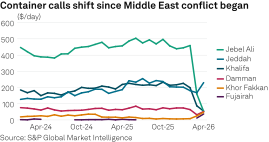
With access to Persian Gulf ports cut off, carriers have shifted calls to ports outside the Strait of Hormuz, including Khor Fakkan, Fujairah, Sohar, and Jeddah, where delays are mounting. Port calls at these locations are also higher than before the conflict due to limited options.
Recently, Singapore-registered container ships GFS Pride and GFS Giselle were struck by unknown projectiles while transiting the Strait of Hormuz on Oct. 13 and Oct. 14, respectively, the Maritime and Port Authority of Singapore said.
"We are hearing that DP World Jebel Ali is not accepting any direct ships, especially after the attacks, so cargo would go via Khorfakkan or other ports," the shipper said.
With yard utilization rising at Khorfakkan, limited berthing, and vessel congestion, the terminal is relocating containers to ICD Sajja. Similar measures are being announced for Fujairah.
"Due to ongoing operational constraints and yard density at Fujairah Terminal, the terminal has, at its discretion, begun shifting selected full laden containers with a final place of delivery of Jebel Ali to the Al Hayl off-dock yard, Fujairah," Maersk said in an advisory Oct. 26.
"We have faced a lot of issues; even when our cargo cleared fast, it took 8-10 days for the containers to reach Jebel Ali via inland movement," an India-based carrier source said. "We are taking less interest in the Middle East due to issues."
Equipment imbalance
Carriers are also reluctant to send equipment to the Middle East while they already have inventory stuck in the region.
"The Middle East is an import-driven region that requires ongoing equipment management and repositioning. Following recent shifts in regional vessel movements, container dwell times at key regional hubs increased, leading to a buildup of container stock," a spokesperson for ONE told Platts.
"Carriers offering SOC rates instead of COC would also mean that they don't want to take their equipment to the Middle East because there are delays," a Southeast Asia-based NVOCC source said.
Separately, market sources reported increased port congestion and vessel delays at Khor Fakkan, and higher inland transport costs to Jebel Ali.
Furthermore, market sources highlighted higher storage costs that are impacting margins.
"Even when the ocean freight is high right now, additional costs have come up, including higher storage costs that one has to pay for the container stuck at the ports," an India-based NVOCC Source said.
Hormuz traffic
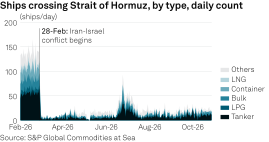
The Strait of Hormuz, between Iran and Oman, saw 21 ship transits on Oct. 26, compared with 22 on Oct. 25. Crude oil exports from the Persian Gulf and Red Sea rose to a preliminary 16.1 million barrels from 14.4 million barrels, according to S&P Global Commodities at Sea data as of Oct. 27.
Market sentiment was largely unchanged, with some shippers holding back cargo of low-value commodities amid rising freight rates and heavy port delays. Some sources, however, expect volumes to increase from late November through January, ahead of Ramadan in February 2027.
