Agriculture, Maritime & Shipping, Chemicals, Metals & Mining, Refined Products, Biofuels, Polymers, Aromatics, Non-Ferrous, Ferrous, Jet Fuel, Diesel-Gasoil, Gasoline
October 13, 2026
COMMODITY TRACKER: 5 charts to watch this week

By Staff
Editor:
Black Sea tanker rates rise amid security risks as Russia's shadow fleet faces growing sanctions pressure. The EU advances critical raw materials security with 46 new strategic projects spanning extraction to recycling. Meanwhile, European SAF demand softens amid compliance shifts, West African polypropylene markets tighten and Asian toluene prices reach multiyear peaks on supply constraints.
1. Black Sea tanker economics strengthen on security risks
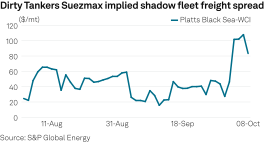
What's happening? Black Sea tanker economics strengthened sharply in late September and early October as attacks on commercial shipping and tighter scrutiny of Russia-linked tonnage increased costs. Platts, part of S&P Global Energy, assessed the Black Sea-West Coast India Suezmax spread for Russia's shadow fleet against the Global Suezmax Index, which widened to $83.36/metric ton on Oct. 8 from $47.22/mt on Sept. 29. Novorossiysk-Vadinar time charter equivalent earnings rose to $879,766/day on Oct. 8 from $517,674/day on Sept. 29. The UK added 12 tankers to its sanctions list on Oct. 8, while the Joint War Committee added the Black Sea to its Listed Areas on Sept. 16. More than 1,600 vessels linked to Russian trade accounted for 73% of the total shadow fleet at end-August, according to S&P Global Commodities at Sea.
What's next? The divergence between Baltic and Black Sea shadow fleets is likely to persist in the near term, with Black Sea rates remaining sensitive to security incidents, sanctions enforcement and vessel-acceptance constraints, market participants said. The Baltic-West Coast India Aframax spread widened to minus $44.71/mt on Oct. 8 from minus $19.93/mt on Sept. 29, although Ust Luga-Sikka time charter equivalent earnings rose to $227,957/day on Oct. 8.
2. EU adds 46 strategic raw material projects
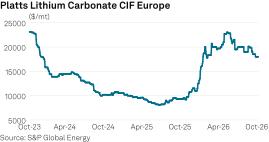
What's happening? The EU selected 46 new strategic projects on Oct. 9 to strengthen critical raw materials supply security, adding to the 47 EU-based projects announced in March 2025 and the 13 overseas projects announced in June 2025, according to the European Commission. The projects span 16 member states and cover lithium, nickel, cobalt, manganese, graphite, magnesium, tungsten and rare earths elements. Eight focus on extraction, 11 on processing, 19 on recycling and eight are integrated projects. As of March 2025, 25 projects had completed environmental impact assessments, while 17 had obtained construction permits, EC said. Platts assessed CIF Europe battery-grade lithium carbonate at $18,000/mt on Oct. 8, unchanged day over day and week over week.
What's next? The 106-project portfolio aims to help the EU meet Critical Raw Materials Act benchmarks by 2030: 10% of annual consumption through extraction, 40% through processing and 25% through recycling, EC said. The projects could fully meet extraction benchmarks for lithium, nickel, rare earths elements, magnesium and tungsten.
Related video: The new tungsten rush: UK, US look to secure supply chain
3. European Q3 SAF demand weakens amid compliance needs, US competition
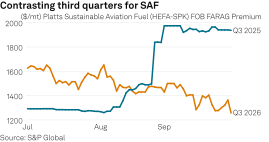
What's happening? European sustainable aviation fuel demand weakened in Q3 as most obligated suppliers had already secured volumes for ReFuelEU's 2% requirement, avoiding the late-year rush seen in 2025, traders said. Voluntary demand shifted toward the US, where stacked producer credits make SAF more competitive. Surplus 2025 Dutch volumes depressed Scope 3 certificate prices. Outright SAF CIF NW Europe cargo prices averaged $2,992.25/mt in September, up $268.25/mt year over year, according to Platts. However, the SAF premium to jet fuel fell $552.25/mt, or 28.1%.
What's next? Several producers remain cautious that persistent supply concerns in fossil fuel markets could drive suppliers to procure renewable alternatives, according to market participants. They highlighted the rapid depletion of strategic petroleum reserves and the East's inability to meet Europe's jet fuel and diesel requirements, while the US continues to threaten a diesel export ban. These concerns arise as major airlines begin tendering for next year's fuel requirements.
4. West Africa PP copolymer premium narrows on supply shifts
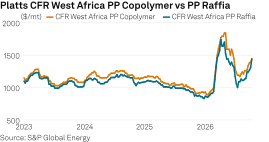
What's happening? The polypropylene copolymer premium over homopolymer diminished across West African markets as suppliers redirected materials to Asia and prioritized copolymer production, a Middle East-based producer said Oct. 8. Producers directed volumes to India, Pakistan and Southeast Asia, where netbacks were stronger, reducing allocations to Africa and making homopolymer the hardest grade to source, market participants said. Demand in India strengthened as limited feedstock availability constrained domestic production. Platts assessed CFR West Africa polypropylene raffia at $1,440/metric ton on Oct. 7, while CFR West Africa polypropylene copolymer was assessed at $1,445/mt, narrowing the spread between the two grades to $5/mt, down $75/mt week over week.
What's next? The spike in homopolymer prices will undermine the slight uptick in buying interest previously seen, prompting consumers to draw on their existing inventories, according to a producer. Another producer said that with the declining inventories, buyers would have little negotiating power in their pricing discussions.
5. Asian toluene prices hit multiyear highs on tight supply
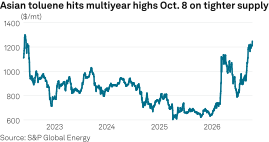
What's happening? Asian toluene prices rose on Oct. 8, with the Platts FOB Korea marker closing at $1,248/mt, its highest since June 16, 2022, when it closed at $1,255/mt. Platts assessed Asian toluene up $35/mt day over day at $1,248/mt FOB Korea and $1,242/mt FOB China on Oct. 8. Chinese sellers were not inclined to offer due to low availability of spot cargoes, a China-based producer said. The prompt ex-tank east China price rose 385 yuan/mt day over day to 9,055 yuan/mt on Oct. 8.
What's next? Toluene prices are unlikely to drop for the time being as supply remains too tight, a Northeast Asian producer said. Suppliers were indicating November cargoes at FOB Korea plus $90-$100/mt on a CFR Southeast Asia basis, citing a strong gasoline market, a Southeast Asian trader said. Chinese futures markets rose on the trading session, driven by capital market inflows, a Chinese broker said.
Reporting and analyses by Marina Ledakis, Euan Sadden, Daniel Workman, Akul Gupta and Isaac Foong.
