Maritime & Shipping, Crude Oil, Refined Products, Wet Freight, Diesel-Gasoil
October 09, 2026
Russia's shadow fleet freight rates fracture on Black Sea premiums

Editor:
HIGHLIGHTS
Black Sea tanker premiums widen as security, sanctions risks intensify
Baltic Aframax spreads weaken despite stronger outright earnings
Clean MR routes diverge as Russian energy flows are disrupted
Black Sea tanker economics strengthened sharply in late September and early October as attacks on commercial shipping, disruption to Russian energy flows and tighter scrutiny of Russia-linked tonnage increased the cost and complexity of moving cargoes. Baltic routes moved in the opposite direction: Aframax spreads fell further into discount territory against global benchmarks even as outright earnings rose.
The divergence reflects a growing segmentation in Russian seaborne trade. Vessels operating from the Black Sea are attracting higher compensation for security, insurance and voyage-execution risks, while Baltic routes continue to trade below their relevant benchmarks amid the operational and commercial constraints associated with Russia-linked tonnage.
The UK added 12 tankers to its sanctions list on Oct. 8, alongside measures against Russian oil companies Zarubezhneft and INK Capital.
The move followed the Joint War Committee's decision on Sept. 16 to add the Black Sea to its Listed Areas, increasing war-risk insurance considerations for vessels operating in the region. Sanctions and attacks have not removed Russian oil from global trade, but they have changed the vessels, routes, counterparties and risk premiums required to move it.
More than 1,600 vessels linked to Russian trade over the past two years accounted for 73% of the total shadow fleet at the end of August, according to S&P Global Commodities at Sea data. The size of the Russia-linked fleet, combined with the latest designations, highlights the widening separation between tonnage active in Russian trade and vessels readily accepted by mainstream charterers, insurers, banks and terminals.
The latest pricing reflects that shift. Black Sea Suezmaxes command the strongest relative returns as owners seek compensation for elevated security and execution risks. Baltic Aframaxes remain at the deepest discount to their relevant benchmark, while clean MR economics continue to vary sharply by loading region and destination.
Black Sea dirty tanker shadow fleet
The Black Sea-West Coast India Suezmax spread for Russia's shadow fleet against the Global Suezmax Index for non-scrubber-fitted, non-eco vessels widened to $83.36/mt on Oct. 8, from $47.22/mt on Sept. 29, according to Platts data. Platts is part of S&P Global Energy.
Novorossiysk-Vadinar TCE earnings rose to $879,766/day on Oct. 8, from $517,674/day on Sept. 29 and $493,692/day on Sept. 16. The route had been assessed at $288,088/day on Sept. 8.
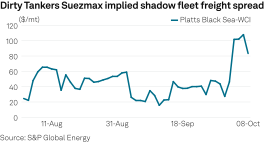
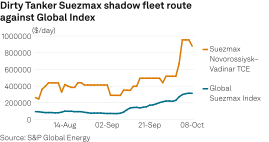
Market participants said the deteriorating security environment had made Black Sea fixtures more difficult to execute. Uncertainty around vessel acceptance, insurance coverage and voyage execution has supported higher returns on trades where owners require greater compensation.
The widening Suezmax premium also came against a broader rise in dirty tanker earnings. The implied spread depends on how each Russian-linked route performs against its relevant Platts index. Black Sea Suezmax earnings strengthened relative to the benchmark, while the Baltic Aframax route lagged behind its benchmark.
Baltic dirty tanker shadow fleet
The Baltic-West Coast India Aframax spread for Russia's shadow fleet against the Global Aframax Index widened to minus $44.71/mt on Oct. 8, from minus $19.93/mt on Sept. 29, according to Platts data.
Ust Luga-Sikka TCE earnings nevertheless rose to $227,957/day on Oct. 8, from $178,125/day on Sept. 29 and $116,671/day on Sept. 16.
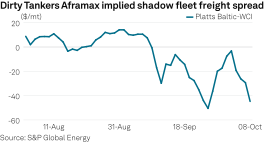
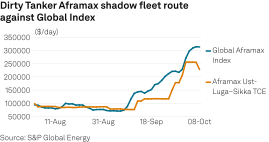
The deeper discount does not indicate a fall in Baltic earnings. It shows that the relevant Aframax benchmark strengthened faster than the Russian-linked route. Baltic Aframax TCE earnings have remained below the Global Aframax Index since Sept. 9.
Russian seaborne crude exports increased to 4.09 million b/d in September, from 3.82 million b/d in August, while non-G7 tankers carried 2.89 million b/d, according to S&P Global Platts.
MR clean tankers shadow fleet
Russian product flows provided an important backdrop to the clean tanker market. Black Sea diesel exports fell to zero in the week to Sept. 24. Across all Russian ports, diesel and gasoil exports totaled 479,000 mt in September, the lowest monthly level recorded by CAS, according toPlatts data.
The Black Sea-Mediterranean MR spread against the Global Medium Range Index for non-scrubber-fitted, non-eco vessels widened to $24.56/mt on Oct. 8, from $4.78/mt on Sept. 29.
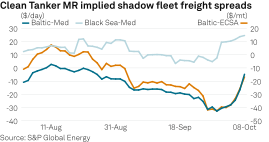
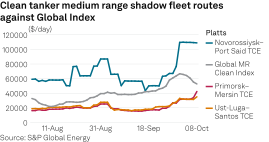
Novorossiysk-Port Said TCE earnings rose to $108,940/day on Oct. 8, from $67,042/day on Sept. 29 and $56,458/day on Sept. 16.
Baltic clean MR discounts narrowed but remained negative. The Baltic-Mediterranean MR spread against the Global Medium Range Index narrowed to minus $4.82/mt on Oct. 8, from minus $29.56/mt on Sept. 29. Primorsk-Mersin TCE earnings rose to $42,267/day, from $26,817/day over the same period and $15,512/day on Sept. 16.
The longer-haul Baltic-East Coast South America MR discount narrowed to minus $16.88/mt on Oct. 8, from minus $41.11/mt on Sept. 29. Ust Luga-Santos TCE earnings rose to $35,041/day on Oct. 8, from $26,186/day on Sept. 29.
The divergence between the Baltic and Black Sea shadow fleets is likely to persist in the near term, with Black Sea rates remaining sensitive to security incidents, sanctions enforcement and vessel-acceptance constraints, while Baltic economics will depend more heavily on Russian cargo volumes, available compliant tonnage and the strength of global tanker benchmarks. Any easing in regional risk or improvement in vessel access could narrow the spreads, but further sanctions or disruptions to Russian trade would likely deepen the segmentation.
