Maritime & Shipping, Crude Oil, Natural Gas, Refined Products, Wet Freight
October 07, 2026
Russian tanker operators lift crude exports to highest level since G7 price cap

By Max Lin
Editor:
HIGHLIGHTS
Non-G7 tankers help Russia lift crude exports
Russian tanker operators play bigger role
Mainstream companies lack incentives to stay in Russia
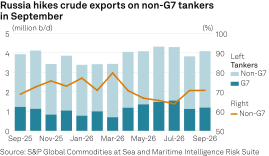
Russia increased crude exports in September by relying more heavily on non-G7 tankers, particularly those operated by domestic companies, whose shipments reached their highest level since Western nations imposed a price cap.
Tankers flagged, owned and operated by companies not based in G7 countries and their allies, and not insured by Western protection and indemnity clubs, lifted nearly 2.89 million barrels/day in September, compared with 2.7 million b/d in August, according to S&P Global Commodities at Sea and Maritime Intelligence Risk Suite data.
The increase came as overall Russian seaborne exports rose to 4.09 million b/d from 3.82 million b/d in the same period.
While the overall share of Russian crude exports on non-G7 tankers, mainly from the shadow flee established to bypass Western sanctions, showed little change month on month, Russian tanker operators were shouldering more responsibilities for their home country's overseas sales.
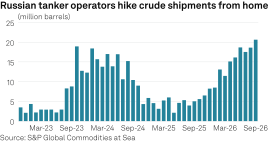
Continuing the upward trajectory seen in recent months, shipments rose from 18.6 million barrels in August to 20.6 million barrels in September -- the highest since the G7 and EU began banning maritime service firms from participating in Russian crude exports unless the barrels were sold below a certain threshold in December 2022.
State carrier Sovcomflot's tankers loaded 6.4 million barrels in September, while the remainder were generally lifted by tankers owned by small, little-known companies, according to the CAS and MIRS data. All of the ships were flagged in Russia.
Flag clampdown
The International Maritime Organization has launched a campaign against falsified flag registration in recent quarters. In 2026, some members states -- including Cameroon and the Cook Islands -- told the UN agency that more than 110 ships with a total carrying capacity of 9.78 million deadweight tons were removed from their flag registries or wrongly claimed to be flagged with them.
More than 100 of these were tankers designated by Western authorities for sanctioned Russian trades or other reasons, according to an earlier Platts review of their circulars. Platts is part of S&P Global Energy.
Meanwhile, 107 ships were reflagged in Russia between January 2025 and June 2026, 56% of which joined the Russian registry after previously reporting false flag information following designation by Western authorities, according to a study by the Centre for Research on Energy and Clean Air.
"'Shadow' fleet vessels have been funneled into the Russian ship registry as their other options have been slowly closed off," the nonprofit said in a note published in September. "Under diplomatic pressure from sanctioning countries, many open registries began significantly withdrawing their flagging services for 'shadow' vessels. With vessels increasingly being removed from open registries, many vessels turned to false flags."
Sanctions impact
As for the G7 fleet, Greek-operated tankers loaded 17.3 million barrels in September, up from 13.6 million barrels in August, according to the data. The increase came as fewer tanker attacks were reported in the Black Sea.
But freight market conditions point to limited financial incentives for mainstream companies to remain in Russian trade going forward. The time-charter-equivalent earnings for Aframaxes shipping Russian oil from the Baltic to West Coast India have been below the Global Aframax Index since Sept. 9, according to Platts assessments.
Moreover, US President Donald Trump on Sept. 18 signed legislation allowing him to impose tariffs of up to 100% on goods imported from the five largest importers of Russian crude or natural gas by volume, and to impose sanctions on tankers used to evade sanctions.
"The measures could potentially increase the number of sanctioned vessels and raise compliance risks for companies involved in transporting Russian crude," shipbroker BRS said in a note in September. "For the oil market, the measure could further disrupt established Russian trade flows, particularly if tighter restrictions on vessels are combined with pressure on major buyers to reduce purchases of Russian crude oil and refined products."
