Refined Products, Crude Oil, Agriculture, LNG, Maritime & Shipping, Electric Power, Gasoline, Diesel-Gasoil, Oilseeds, Meat, Grains
September 29, 2026
COMMODITY TRACKER: 5 charts to watch this week

By Staff
Editor:
This week, S&P Global Energy editors and analysts are monitoring market reactions following talks about the US potentially restricting diesel exports. Agricultural product exports will also be watched over the coming months, following discussions during the Trump-Xi summit. South Korea's crude imports, US clean energy capacity additions and India's LNG procurement activities are also in focus.
1. US diesel export ban talk sparks global concern
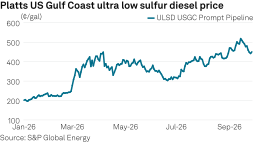
What's happening? US President Donald Trump has said he is still considering a ban on the country's diesel exports, after talk of new restrictions have triggered alarm across global markets. He conceded, however, that such a move could push up gasoline prices, while US Energy Secretary Chris Wright said Sept. 23 said that voluntary restrictions were more likely than a full ban. Recent comments from the Trump administration come as officials have sought to combat record prices ahead of the midterm elections, due to take place in November. US diesel exports reached a record high of 1.6 million barrels/day in August, according to S&P Global Commodities at Sea. Bulk of the exports went to Latin America and Europe. Platts, part of S&P Global Energy, assessed the US diesel price at an all-time high of $5.182/gallon on Sept. 15. Prices have since eased, closing at $4.500/gal on Sept. 28.
What's next? A US ban on diesel exports is expected to intensify competition for Asian and Middle Eastern barrels among European and Latin American buyers, driving up prices. "Latin America currently meets roughly one-third of its diesel demand through US imports, while Europe has grown increasingly reliant on US barrels after losing significant volumes from Russia and the Middle East. Removing up to 1.5 million b/d of US diesel exports from the international market would likely trigger sharp price increases in both regions and further tighten already tight global product balances," S&P Global Energy CERA said in its Sept. 24 Global Political Risk Scorecard.
Related podcast:Global diesel shortages squeeze the Americas
2. US-China tariff cut talks may spur demand for agricultural products
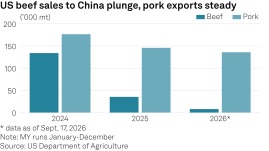
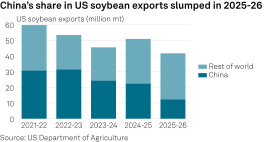
What's happening? China has agreed to reduce tariffs on a host of US-origin agricultural products, excluding soybeans. China has been aggressively purchasing soybeans from the US for marketing year 2026-27 (September-August), but purchases for other commodities have remained low. So far in MY 2026-27, China has committed to purchase 10.17 million mt of soybeans from the US, compared with total imports of 12.4 million mt in MY 2025-26, according to the US Department of Agriculture.
What's next? US-based traders now expect China to increase their purchases of US-origin beef, pork, corn and wheat, among other products. China has agreed to consider reducing import tariffs on these commodities, which may spur demand for these in the upcoming months, US-based traders said. As of Sept. 17, the US had sold 7,800 mt of beef in MY 2026 (January-December), compared with 35,000 mt of beef in the same period in MY 2025, USDA data showed.
3. South Korea expands crude freight rebates to 100%
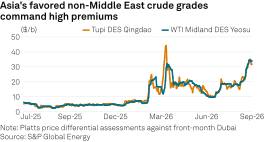
What's happening? South Korea expanded freight rebates to 100% for crude imports from outside the Middle East through December, up from the typical 25% coverage, as Asian refiners compete for spot cargoes from the Americas and Africa. The enhanced incentives helped push WTI Midland DES Yeosu basis to a record premium of $34.6/barrel over front-month Dubai on Sept. 18, while Brazilian Tupi crude DES Qingdao basis averaged a $27.06/b premium in September. South Korean refiners imported 131.1 million barrels from North America over January-July, up 20% year over year, maintaining their position as Asia's largest US crude buyer.
What's next? The government aims to reduce Middle East crude's share of total imports to 50% from about 70% currently, according to the Ministry of Trade, Industry and Resources. Seoul plans to help domestic refiners upgrade processing units configured for heavy, sour Middle Eastern grades to handle more light, sweet crude from the US and other non-Middle Eastern suppliers. The enhanced 100% reimbursement rate applies through December, while the underlying freight rebate program remains in effect through 2027. The ministry also temporarily waived minimum-volume and contract-duration requirements to facilitate spot purchases of non-Middle East crude through year-end.
4. US adds over 18 GW of clean energy capacity added in Q2, Texas leads with 3.993 GW
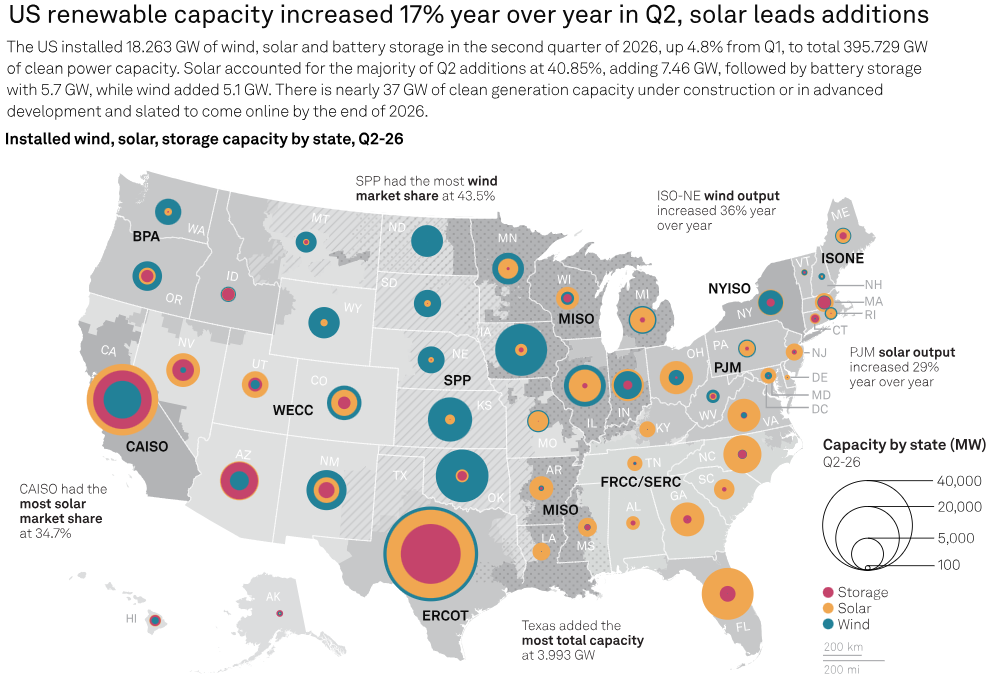
What's happening? The US added 18.263 gigawatts of clean energy capacity to total 395.729 GW by the end of Q2. Solar had the most additions at 7.46 GW, followed by energy storage with 5.7 and wind with 5.103 GW. Texas surpassed California in energy storage capacity to lead the US. The state already ranked first in solar and wind capacity.
What's next? Data from S&P Global Markte Intelligence shows that 22.92 GW of solar is either under construction or in advanced development, and is slated to come online this year. "We do expect solar and storage additions to continue to climb, with both technologies expected to have record years of deployment," said Shayne Willette, CERA senior research analyst. "Texas is expected to continue to lead both solar and storage additions owing to its deep pipeline and developer-friendly market." Willette said Arizona is also worth watching, given "significant levels of solar+storage configurations" in the state. There is nearly 37 GW of clean generation capacity under construction or in advanced development that is slated to come online by the end of 2026.
Related infographic: US renewables tracker Q2-26
5. India actively procures near-term LNG, BPCL awards JKM-linked cargo
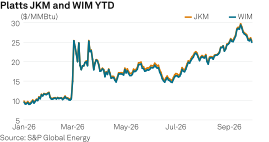
What's happening? India continues to seek LNG cargoes, with about nine cargoes awarded for October and three for November. Demand from India's city gas distribution segment and the subsidized fertilizer sector continues to support LNG imports. India's Empowered Pool Management Committee awarded GAIL, IOCL and BPCL contracts to supply 11.41 TBtu of regasified LNG to 26 fertilizer plants over Oct. 1-15 at $25.89-$26.70/MMBtu. IOCL separately secured a contract to supply 3.34 TBtu over Sept. 26-30 at $26.33/MMBtu. BPCL bought a free trade agreement cargo Sept. 23 for Nov. 21-30 delivery at December JKM plus 25-30 cents/MMBtu, a rare move among Indian spot buyers, which typically transact at flat prices, marking the company's first use of Platts JKM in a spot tender.
What's next? India remains one of Asia's most active LNG markets, with buying expected to remain strong despite elevated prices. The country is seeking alternative supplies, having sourced about 60% of its LNG from the Middle East before the Iran war.
Reporting and analysis by Sambit Mohanty, Kelly Norways, Janet McGurty, Sampad Nandy, Gawoon Philip Vahn, Kasey Micek, Jamie Wong, Atsuko Kawasaki and Shermaine Ang
