Metals & Mining, Electric Power, Energy Transition, Non-Ferrous, Renewables, Ferrous
October 29, 2026
Tight copper supply, AI demand dominate LME Week dialogue

By Euan Sadden
Editor:
The annual London Metal Exchange Week, held in London over Oct. 19-23, brought together leading stakeholders from the metals and mining industry — including company executives, government officials, traders and financiers — for high-level discussions on the outlook for global metals markets.
Delegates highlighted the risk of significant copper shortages during the 2030s, alongside a widening imbalance between mine supply and smelting capacity. Discussions also focused on the increasing fragmentation of global trade, as tariffs, export controls, carbon regulations and domestic-processing requirements reshape flows between regions.
The following is a selection of the key themes discussed during the week.
Looming copper deficits
The mining sector is not developing copper supply quickly enough to meet projected demand from electrification, renewable energy, power grids, EV, defense and digital infrastructure.
Vale Base Metals has warned of an annual copper deficit of 8-10 million metric tons between 2035 and 2040. Global mine supply is expected to decline by 2% this year, driven by operational disruptions, extreme weather, declining ore grades and project-execution challenges.
Industry participants warn that these constraints could produce substantial annual copper deficits throughout the 2030s. The challenge is not simply securing capital. New mines can take many years to discover, permit, finance and construct, while the sector also requires supporting infrastructure, processing capacity and skilled personnel.
Mine-to-smelter imbalance
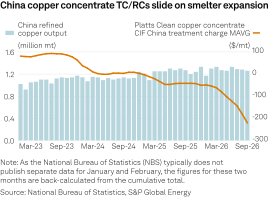
The challenge is not limited to a shortage of copper ore. Smelting capacity is expanding faster than new mines can be developed, intensifying competition for concentrate.
Competition for scarce concentrate has driven spot treatment charges into negative territory. With the CIF China charge currently down around minus US$240 per metric ton, according to Platts assessments, Chinese smelters are incurring estimated losses of approximately US$140 per dry metric ton processed.
Although negative margins would normally prompt production cuts, delegates heard that China's strategic interest in maintaining refined copper supplies could encourage smelters to continue operating, thereby prolonging the imbalance.
AI build-out accelerates demand expectations
Artificial intelligence infrastructure is creating a significant new source of copper demand, in addition to the metal's established use in power generation and transmission.
Trafigura estimates that data centers could consume almost 1 million metric tons of copper this year. Their construction is also supporting demand for steel, aluminum and lead.
The build-out could nevertheless be constrained by the availability of electricity. Trafigura has identified a potential 50-gigawatt gap between planned data-center requirements and available power by 2030.
The trading company has also warned that a sharp slowdown in AI investment could simultaneously weaken copper demand, construction activity, economic growth and equity markets. The risk is particularly significant because Trafigura forecasts that copper demand outside the data-center sector will decline this year, leaving the near-term market unusually dependent on continued technology-sector spending.
Fragmentation of the global metals trade
Delegates also discussed the fragmentation of global metals trade into regional "fortresses." Tariffs, quotas, export controls, domestic-processing requirements and carbon regulations are replacing a relatively integrated global market with partially connected regional systems.
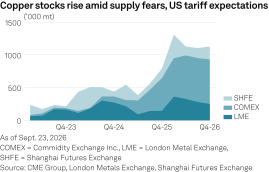
The US reportedly attracted approximately 900,000 mt of refined copper amid tariff uncertainty, tightening availability in other markets. Meanwhile, US Section 232 steel tariffs and the EU's Carbon Border Adjustment Mechanism are contributing to separate regional pricing structures.
As a result, supplier selection is increasingly shaped not only by price, but also by emissions standards, political relationships and national security considerations.
Critical minerals as a national security priority
Critical minerals are increasingly viewed as a national security priority because they underpin energy systems, advanced technologies, defense equipment and industrial production.
Delegates heard that governments are no longer focused solely on securing access to mines. They are also competing for refining capacity, processing facilities, scrap, inventories and reliable trade routes.
Concentrated supply chains increase this strategic vulnerability. Indonesia dominates nickel production, while China has significant influence over copper mining investment and refining capacity. Disruptions, export controls, production quotas and trade restrictions can therefore affect prices, industrial output and technological development.
In response, governments are pursuing domestic processing, strategic stockpiling, permitting reform, public financing and partnerships with resource-producing countries.
