Metals & Mining, Non-Ferrous
October 20, 2026
LME Week: Copper supply struggles to keep pace with electrification demand

By Euan Sadden
Editor:
HIGHLIGHTS
Mine disruptions push copper prices up 35%
Chinese smelters lose $140/mt processed
US and China control 71% of global stockpiles
As industry leaders gather in London for one of the world's largest metals events, S&P Global Energy presents the LME Week thought leadership series, examining the forces redefining global metals markets and shaping the outlook for 2027 and beyond.
This feature examines whether the copper industry can deliver sufficient new supply, as demand from power grids, infrastructure, data centers and artificial intelligence continues to expand.
The copper market is under increasing pressure as mine disruptions, declining ore grades, and lengthy project development timelines constrain supply, while electrification, power grid investment and artificial intelligence infrastructure drive demand.
These pressures have pushed prices sharply higher. London Metal Exchange copper has averaged $13,395/metric ton in 2026, 35% above its 2025 average, according to the International Copper Study Group's September release. The LME cash price reached a 2026 high of $14,850/mt on Aug. 17 and averaged $14,353/mt in August, up 6% from July.
"Operational disruptions, lower production guidance from several producers, permitting delays, geopolitical risks and declining ore grades are all limiting supply growth," ING Commodities Strategist Ewa Manthey told Platts, part of S&P Global Energy. "As a result, the market is struggling to deliver enough new production despite strong price incentives."
Sucden Financial's Head of Research, Daria Efanova, said the underlying copper-price narrative had increasingly focused on supply becoming more constrained over time. "Supply is still growing, but it cannot keep pace with demand from power grids, infrastructure, artificial intelligence and data centers. The AI and data-center components are still further down the demand curve, but they are becoming increasingly prominent."
Demand would continue to grow even if AI-related consumption fell short of expectations, Appian Capital Managing Director (Private Equity) Antti Grönlund said. "Even if you don't subscribe to high AI, data-center and related electricity-infrastructure demand, copper demand overall will keep growing, fueled by underlying industrial activity and broader electrification."
Constrained mine supply
Copper mine production among the 20 largest producers in the first half of 2026 fell 2.5% year over year to 7 million mt, according to S&P Global Market Intelligence. BHP Group, Codelco and Freeport-McMoRan accounted for a combined 214,615 mt reduction, mainly due to lower ore grades, maintenance and slow recoveries at Chile's El Teniente mine and at Grasberg in Indonesia's Papua province. Output declines at Rio Tinto, Southern Copper and Antofagasta Minerals have added to concerns about supply reliability.
"The past 12 months have also shown that, in a finely balanced market, a major mine shutdown can have a disproportionately large impact," Efanova said. "The Grasberg disruption last year removed approximately 500,000 mt of material from the market. Even when the broader market appears balanced for a couple of years, any significant disruption can have a substantial effect on prices."
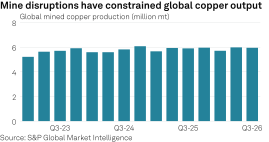
Longer-term supply has also been constrained by disappointing project ramp-ups, limited exploration and insufficient investment in new mines. "The grades are getting lower and lower," Grönlund said, adding that major producers "are not investing in bringing new assets online as quickly as we believe is necessary."
Sucden Financial expects the market deficit to deepen beyond 2027. "Supply is still expanding, primarily through greenfield and brownfield expansions, rather than through the construction of entirely new mines," Efanova said. "However, demand is projected to grow faster than supply, so we expect deficits to start expanding from 2028 onward."
Tight concentrate market
Supply pressure is particularly acute in copper concentrate. Global concentrate production fell more than 2% in the first seven months of 2026, with output declining 7% in Chile, 30% in the Democratic Republic of Congo and 29% in Indonesia, according to the International Copper Study Group.
The squeeze has been intensified by rapid growth in Chinese smelter capacity. The International Energy Agency estimates that China has accounted for more than 90% of global copper-smelting growth since 2005, increasing its share from around 15% to about half of global capacity in 2025.
"Treatment and refining charges have fallen to exceptionally low levels as smelters compete for limited concentrate supply, highlighting stress within the supply chain," ING's Manthey said.
Platts assessed the CIF China clean copper concentrate treatment charge at minus $240/mt on Oct. 16, down more than 365% from the start of 2026. Negative charges mean smelters are effectively paying a premium to secure feedstock.
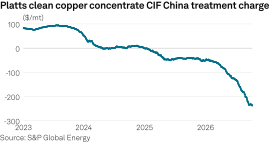
S&P Global Market Intelligence estimates that Chinese smelters are losing about $140/dry metric ton of concentrate processed at current spot charges. China produced 1.28 million mt of refined copper in August, down 0.5% from July and 1.2% lower year over year, the first month in 2026 to see a year-over-year decline.
"Chinese refined production rose in the early months of the year even as concentrate tightness intensified," Deutsche Bank's Head of Metals Research Daniel Ghali said in a Sept. 28 research note. "In recent months, however, production has struggled to maintain its breakneck pace despite China outbidding Western smelters for concentrate deliveries and increasing its use of scrap and intermediate products. This may indicate that concentrate tightness is beginning to affect smelter production."
According to Efanova, Chinese smelters have partly protected their profitability through revenue from by-products such as sulfuric acid, silver, gold and zinc. "Low charges are therefore changing the structure of refinery profitability rather than immediately forcing widespread production cuts," she said.
Regional competition
Government stockpiling is further reducing the copper available to commercial buyers. Strategic inventories may not be immediately accessible, widening the gap between reported stocks and available metal.
"As resource security takes precedence, we expect copper markets will now enter into a historic battle for metal," Ghali said. "Ultimately, this ties into the combination of de-globalization and the decade-long period of underinvestment in supply, which has created vulnerabilities such that, by year-end, stockpiling in the US and China will have encumbered 71% of global inventories."
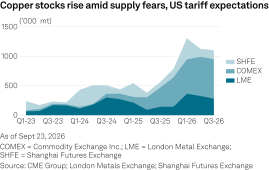
Possible US tariffs have also encouraged traders to move copper into the country, raising Comex inventories and reducing availability elsewhere. About 700,000 mt has moved to Comex, according to Efanova, with much of the metal now financed in the US and unlikely to return quickly to other regions.
"That material could remain in the US to support regional premiums or be used for policies associated with the Trump administration," Efanova said. "Even without tariffs, Europe, the US and China are likely to continue competing for available copper."
With mine supply constrained, concentrate markets tightening and inventories increasingly concentrated in the US and China, copper availability is likely to remain vulnerable. New projects, recycling and demand substitution may provide some relief, but their impact will take time to materialize. As electrification and grid investment continue, competition for copper is likely to intensify beyond 2027.
