Coal, Metals & Mining, Metallurgical Coal, Ferrous
August 27, 2026
Fewer trades, broader transparency: What changing liquidity means for coking coal price benchmarking

By Samuel Chin
Editor:
Spot liquidity's role in commodity price discovery has come into sharper focus as the seaborne metallurgical coal market continues to evolve.
Over the past several years, observable premium hard coking coal (PHCC) spot transactions in the Asia-Pacific seaborne market have declined significantly.
What was once a relatively concentrated market centered on Australian exports to North and Northeast Asia has turned into a more fragmented system characterized by shifting trade flows, growing regional diversity and changing procurement patterns.
The decline in observable spot transactions has prompted broader industry discussions about liquidity, transparency and benchmark formation.
Yet lower trade counts alone do not necessarily imply weaker price discovery. In a more fragmented market, the quality, visibility and breadth of market information may matter as much as the number of transactions themselves.
The more relevant question is whether the market continues to generate sufficient transparent and verifiable information to establish value.
Why observable coking coal spot trade liquidity has declined
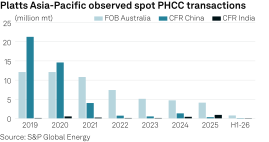
The decline in observed PHCC spot transactions in Asia-Pacific has been driven by a series of structural changes.
China's restrictions on Australian coal imports between 2020 and 2022 disrupted traditional trading relationships and redirected significant Australian volumes to India, Europe and other Asian destinations.
Meanwhile, the adoption of advanced coke making technologies reduced reliance on PHCC while Mongolian coal consolidated its role in supplying Chinese demand and Russian cargoes expanded their presence across Asian markets.
Procurement has also shifted, with more steelmakers using longer-term supply agreements, index-linked contracts, and derivatives to improve supply certainty and manage price risk outside the spot market.
Weaker steel margins and greater blending flexibility have also pushed buyers to optimize costs across a wider range of coal qualities.
Together, these changes have reduced PHCC spot activity even as metallurgical coal demand and trade continue, creating a more fragmented, geographically diverse and interconnected market.
Why liquidity remains important in the coking coal market
The importance of spot liquidity should not be understated.
Spot transactions remain among the strongest forms of market evidence because they reflect agreed price levels between willing buyers and sellers under prevailing conditions.
A larger pool of observable trades strengthens confidence that benchmarks reflect broader market value and supports transparency for procurement, contracts and risk management.
As transaction volumes decline, market participants understandably look more closely at the foundations of price assessments.
At the same time, liquidity is not measured by trades alone. Firm bids and offers, expressions of interest, grade relationships, destination economics, and related physical and derivative market information can also help establish value when they are transparent, verifiable and representative — complementing observed transactions and contributing to an understanding of prevailing market value.
The challenge is therefore not simply how many trades occur, but whether sufficient observable market evidence exists to support robust and representative price discovery.
Fewer trades do not necessarily mean limited price discovery
Transaction volumes tell only part of the story.
While observable spot trades have become less frequent, the breadth of market information available to participants has, by contrast, continued to expand.
Platts data across metallurgical coal grades shows published market activity headlines have increased substantially since 2020, reflecting input from traders, steelmakers, coke producers, miners and end users across a broader range of markets and trade flows. Platts is part of S&P Global Energy.
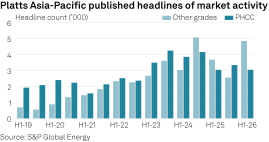
This evolution highlights an important distinction: liquidity and transparency are related, but they are not the same thing.
In today's market, bids, offers and other observable activity can provide insight into how buyers and sellers view the market, even when no trade is concluded. Published in real time, this information allows participants to follow changing market conditions as they develop.
Transparency involves more than simply collecting information. It stems from making information available to the wider market, where participants can evaluate and respond to it.
The growing breadth of observable activity also reflects how the seaborne metallurgical coal trade has evolved, with new trade flows, buyers and pricing relationships playing a growing role in price discovery.
India's growing influence on seaborne metallurgical coal trade provides a useful example.
As India's blast furnace capacity has expanded, a growing share of Australian PHCC cargoes has flowed to Indian buyers rather than traditional Northeast Asian destinations.
This shift has also been reflected in export flows. According to the S&P Global Market Intelligence Global Trade Analytics Suite, China's share of Australian metallurgical coal exports stood at 20.6% in 2016 and peaked at 24.0% in 2017, and fell to just 8.9% in the first half of 2026.
The redistribution of Australian cargoes across a wider range of destinations also illustrates how seaborne trade patterns have diversified over the past decade, broadening the range of markets and commercial relationships informing price discovery.
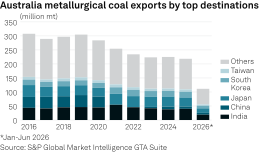
Emerging alternative supply sources and evolving procurement strategies have further broadened the range of relationships influencing seaborne coal values. Australian FOB cargoes are increasingly assessed against a wider set of supply alternatives, destination economics and value-in-use considerations.
As the market becomes more diverse and interconnected, common reference points remain important in helping participants compare value across different origins, destinations and pricing structures. Their effectiveness ultimately depends on transparent methodologies, observable market activity and continued industry participation.
Why FOB Australia remains important
Despite evolving trade flows and changing procurement patterns, FOB Australia's role as a critical reference point may have become even more important as the seaborne market has fragmented.
Australia remains the world's largest exporter of seaborne metallurgical coal, with its PHCCs serving as a key feedstock for steelmakers across Asia and beyond.
As a result, FOB Australia assessments continue to underpin physical transactions, contract negotiations, derivative settlements and procurement decisions throughout the metallurgical coal value chain.
The benchmark's importance also extends beyond cargoes directly priced on an FOB Australia basis.
Market participants frequently use FOB Australia values when assessing alternative origins, evaluating destination economics, comparing coal blends and understanding relative value across the global seaborne market.
In this more fragmented market, a transparent FOB Australia benchmark thus provides a common reference point for comparing value across routes, origins and grades. It allows different transactions and commercial relationships to be understood within a common pricing framework.
Maintaining confidence in the benchmark therefore remains important not only for Australian coal producers and consumers, but also for traders, financiers and industrial participants that rely on transparent price discovery across the seaborne market.
An industry discussion worth having
Lower spot liquidity is a reality in today's metallurgical coal markets. But liquidity alone does not define the strength of price discovery.
As trade flows, procurement practices and market relationships evolve, confidence in benchmark formation will increasingly depend on transparency, participation and the continued availability of observable market information.
In that environment, benchmark providers and market participants alike have a shared role to play through their willingness to contribute information, engage in transparent dialogue and support the benchmark processes that help connect an increasingly fragmented global market.
