Metals & Mining, Coal, Ferrous, Metallurgical Coal
August 20, 2026
India’s two-tiered coking coal market highlights growing role of smaller buyers
By Samuel Chin and Sumita Layek
Editor:
For much of the past decade, seaborne metallurgical coal pricing was shaped primarily by Chinese demand and Australian supply.
As China's import growth matures and India assumes a larger share of incremental demand, a new question is emerging: how is India's growing importance being reflected in spot-market activity and price formation?
Rather than through its largest steelmakers alone, India's influence is increasingly emerging through a fragmented network of smaller mills, merchant cokeries and traders whose activity shapes marginal demand and destination competition, even as benchmark pricing remains anchored by Australian supply dynamics.
India's rise as the demand engine
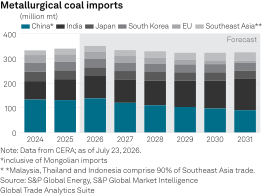
Driven by rapid steel capacity expansion, infrastructure investment and industrial growth, India has emerged as the primary source of incremental seaborne met coal demand, a trend reflected in S&P Global Energy CERA forecasts for continued import growth through 2031.
CERA projects India's met coal imports will reach 100 million metric ton by 2028 and 127 million mt by 2031. By comparison, China's imports are projected to shrink from 110 million mt to 90 million mt over the same period, including Mongolian volumes.
The defining driver of this structural growth is the continued expansion of blast furnace-basic oxygen furnace (BF-BOF) production. While many Western economies are pursuing electric arc furnace (EAF) routes to meet decarbonization goals, Indian producers, such as JSW Steel, Tata Steel and Steel Authority of India Ltd., continue to invest heavily in blast furnace capacity in support of the National Steel Policy's target of 300 million mt/year of crude steel capacity by 2030.
According to India's Joint Plant Committee (JPC), BF-BOF accounted for 43% of crude steel production in the year that ended March 2026, up from 41% a year earlier. The National Steel Policy expects this share to rise to 60%-65% by March 2031.
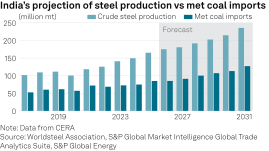
These projections underscore India's importance to the seaborne metallurgical coal market, with its demand growth increasingly reflected in spot procurement activity, destination competition and broader trade dynamics.
Pricing power at the margins
In India, import growth and price formation are not necessarily driven by the same market participants.
Many of the country's largest steelmakers secure a substantial portion of their coal requirements through long-term supply agreements with established exporters. While these arrangements provide supply security and reduce exposure to short-term volatility, they also limit participation in spot transactions that contribute directly to price discovery.
As a result, spot market activity is then increasingly driven by smaller steelmakers and merchant cokeries. The importance of these buyers lies not only in their numbers, but also in their collective purchasing activity.
According to provisional JPC data, hot metal and pig iron production outside India's seven major steelmakers stood at 6.8 million mt and 6.6 million mt, respectively, in FY 2025-26.
India's Directorate General of Trade Remedies data showed merchant coke production at just over 2 million mt during the 12 months from October 2023 to September 2024.
However, the DGTR figure was recorded during a period of intense competition from lower-priced imports and may therefore understate the scale of merchant coke production under more supportive market conditions. Industry sources and Platts estimates suggest merchant coke output likely rose to more than 4 million mt in 2025, supported by coke import quotas that improved operating conditions for domestic cokeries.
These figures suggest that while fragmented, India's smaller steelmakers and merchant cokery sectors represent a sizeable industrial base whose collective procurement activity can have a meaningful presence in spot markets.
Their varying purchasing volumes, procurement cycles and blending requirements have strengthened the role of trading houses, which aggregate demand into cargo-scale volumes and connect smaller buyers to the seaborne market.
Australian, US and Indonesian miners alike said the demand by these buyers became increasingly visible during 2025, particularly for premium mid-vol and second-tier hard coking coals. During periods of subdued Chinese demand, their buying interest helped to support seaborne prices and provided an important source of marginal demand.
The trend builds on India's earlier emergence as a more active participant in the coking coal spot market.
Consequently, India's role in seaborne price formation increasingly stems from the collective activity of fragmented buyers that are active in the spot market, rather than the procurement strategies of its largest steelmakers.
Growing visibility through the CFR India market
The growing importance of these buyers is also becoming easier to observe.
The launch of the Platts Premium Mid Vol Hard Coking Coal CFR India assessment in October 2024 reflected the country's growing importance as a destination market and provided greater transparency around Indian spot procurement activity.
The assessment has highlighted the diversity of India's buyer base, spanning integrated steelmakers, smaller mills, merchant cokeries and traders.
Many of the smaller buyers procure cargoes on a CFR India basis, often relying on traders to aggregate demand and manage logistics, with those traders in turn sourcing cargoes on an FOB Australia basis.
Together with price movements observed since launch, the assessment has improved visibility into how Indian spot demand interacts with broader market dynamics, even as Platts Premium Low Vol HCC FOB Australia remains the principal benchmark for origin-side price formation.
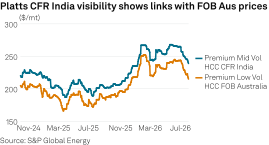
However, the buyers contributing most actively to price discovery are also among the most exposed to changes in domestic policy and profitability.
Policy-driven buyers, policy-driven influence
This was evident in 2025, when import quotas supported margins and encouraged merchant cokeries to raise production and secure additional coal cargoes, increasing their presence in the seaborne market.
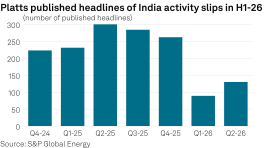
The shift was also reflected in spot-market activity captured by Platts. The number of market activity headlines contributing to the Platts CFR India assessment process fell in the first half of 2026 after remaining elevated through much of 2025, indicating weaker spot participation as margins came under pressure.
However, the replacement of import quotas with antidumping duties in 2026 created a more competitive operating environment, prompting merchant cokeries to take a more cautious approach to coal procurement and thus reducing spot-market activity.
The episode demonstrates how closely India's contribution to marginal demand remains tied to domestic policy and profitability. Consequently, its influence on seaborne price discovery can strengthen or weaken far more rapidly than aggregate import volumes alone would suggest.
How Indian demand reaches FOB Australia prices
With seaborne demand growth increasingly shifting toward India, Australian producers are evaluating sales opportunities across multiple destination markets rather than relying predominantly on Chinese demand.
For exporters, cargo values are determined not only by bids in a single market, but also by competition among buyers, particularly for premium mid-vol and second-tier hard coking coal brands widely consumed in India.
Additionally, trading houses have become an important conduit between Indian consumers and Australian suppliers, aggregating fragmented demand from smaller buyers into FOB cargo opportunities that strengthen competition for Australian supply.
Market participants said Indian buying interest has at times provided Australian producers with an alternative demand channel when traditional buyers were less active, influencing marketing strategies and the placement of available cargoes.
As a result, shifts in Indian procurement activity are becoming increasingly relevant to FOB Australia price formation through their effect on competition for available supply, cargo allocation decisions and destination competition.
A different kind of market influence
Beyond import volumes, India's influence increasingly stems from a fragmented ecosystem of smaller mills, merchant cokeries and traders contributing to marginal demand and spot procurement.
Unlike China, where market influence has traditionally been concentrated among large buyers and broad policy shifts, India's impact is more dispersed and responsive to commercial conditions.
Whether this fragmented ecosystem ultimately exerts a greater influence on seaborne price formation remains an important market dynamic to watch.
What is increasingly evident, however, is that India's market influence is emerging through a very different structure from China's: not through a handful of dominant buyers, but through the collective weight of a diverse and highly active spot-market ecosystem.
As one international trader observed: "It doesn't matter who consumes the most coal, but rather who is active in the spot market when cargoes are available."
