Coal, Metals & Mining, Metallurgical Coal, Ferrous
June 19, 2026
FERROUS WEEK: Mongolia evolves from ‘single tree’ to China’s met coal lifeline
By Olivia Zhang and Samuel Chin
Editor:
HIGHLIGHTS
E-Commodities invests Yuan 7 bil to boost infrastructure
AGVs triple customs clearance efficiency
Exports to reach 130 mil-165 mil mt after 2027
The first part of this Ferrous Series provides an updated visualization of the steel decarbonization efforts being undertaken across the Asia Pacific. The second piece takes a closer look at Japan's green transformation, while the third examines how differing interpretations of carbon accounting have emerged to comply with CBAM. The fourth report looks at Simandou's export ramp-up and the impact on iron ore markets, while the fifth looks at how the Mongolia-China coking coal trade has evolved. In the final piece, we interview an executive of coking coal trading firm E-Commodities.
The land-based metallurgical coal trade between Mongolia and China has undergone a profound structural transformation over the past two decades, evolving from a marginal supply route into China's largest source of imported coking coal.
A key player in this market has been E-Commodities Holding Ltd., one of the earliest private sector investors in the cross-border supply chain.
Speaking exclusively with Platts, part of S&P Global Energy, Zhu Hongchan, senior vice president at E-Commodities, discussed the corridor's evolution since the company's entry in 2006 and shared her outlook for its next phase of growth.
Redefining the frontier
"Over the past 20 years, Mongolian coal exports through Ganqimaodu and Ceke -- the main gateways for coking coal -- have grown from virtually nothing to the massive volumes we see today," Zhu said.
Ganqimaodu, now China's largest land port for Mongolian coking coal, derives its name from the Mongolian word Gantsmod, meaning "single tree." "That was a highly accurate description 20 years ago," Zhu recalled. "It was incredibly remote. There were no logistics facilities, railways or cargo parks, and living conditions were very harsh. Everything was primitive."
While Mongolia's vast coal reserves were always there, exports only scaled once bilateral logistics infrastructure, customs systems, border procedures and supportive policies were established, she added.
"We were the first to deploy trucks and construct logistics parks at the borders," Zhu said. What began as a modest fleet of 50 trucks has since evolved into a premier cross-border logistics network. To date, the company has invested a cumulative Yuan 7 billion ($1 billion) in the corridor's supply chain infrastructure.
Today, this footprint spans over 21 million square meters across Ganqimaodu, Ceke, Mandula, and Erenhot, with roughly 3,000 heavy-duty transport vehicles and 26,000 containers in operation, Zhu added.
In addition to transport, E-Commodities runs coal-washing facilities with a combined annual capacity of approximately 26 million mt. According to Zhu, while the company initially explored building these washing plants in Mongolia, it ultimately chose to expand its capacity in China due to superior water supply and infrastructure availability.
These heavy capital investments were essential to unlocking the region's trade potential. "Without logistics capabilities, the coal simply could not move into China," she said.
"The ports' facilities have evolved into a complete system covering mining, customs clearance, washing and rail transportation on both sides of the border. Trade volumes have surged from hundreds of thousands of mt to tens of millions and are now moving towards the 100 million mt milestone," she added.
"China has increasingly promoted containerized transportation as part of greener logistics practices," Zhu said. "Unlike open trucks, containers are covered, helping reduce dust emissions during transportation and improving environmental performance."
Automation catalyst
According to Zhu, automation has been another important stage in the corridor's evolution. While E-Commodities began evaluating automated guided vehicles before 2020, COVID-19 fast-tracked adoption as governments sought ways to keep cross-border trade moving.
"This ensured a continuous flow of coal to the market, even amid the strict border lockdowns," Zhu said.
E-Commodities was the first to deploy AGVs at Ganqimaodu and secure regulatory approval, before later expanding the technology to Ceke, according to Zhu.
"We currently have 65 AGVs in operation, which have nearly tripled customs clearance efficiency compared to traditional transport methods," Zhu added. This driverless fleet now has a designed cross-border capacity of roughly 10 million mt/year.
Next phase of growth
China imported a record 60.07 million mt of Mongolian coking coal in 2025, according to Chinese Customs data, accounting for roughly 51% of its total coking coal imports and cementing Mongolia's status as its top supplier.
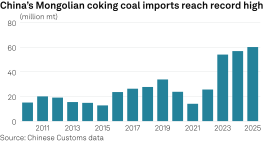
According to Zhu, this surge was propelled by logistics and a shift toward more economical land-based supply as Chinese steel mills faced tightening margins. The transition was further accelerated by China's unofficial ban on Australian coal between October 2020 and January 2023.
Zhu said Mongolia's competitive edge lies in a unique combination of quality and efficiency.
"China's demand is inelastic, yet most domestic premium coking coal is high in ash and sulfur," Zhu said. "Mongolian coal naturally features low ash and sulfur, while its open-pit operations offer a clear cost advantage. While Mongolian hard coking coals may not quite match Australia's 70 CSR levels, they typically range between 63 and 65 CSR, with some high-quality deposits hitting 66 CSR."
Unlike seaborne alternatives, Mongolia's proximity allows for direct door-to-door delivery via rail and truck, resulting in shorter lead times and superior supply flexibility, Zhu added.
Mongolian and seaborne coal will continue to coexist in China's import market. "They are both important sources for China, and they are more complementary than competitive," Zhu said.
Looking ahead, she expects total Mongolian coal exports, including thermal and coking grades, to hit 95 million-100 million mt in 2026 and climb to 130 million-165 million mt after 2027 as major cross-border rail projects come online.
"The Ganqimaodu railway expansion will add 30 million mt of annual transport capacity upon its 2027 completion," Zhu said, adding that upgrades are also underway at Ceke and Mandula.
Zhu estimates that in 2025, Ganqimaodu handled 45% of exports (mostly hard coking coal), Ceke cleared 33% (predominantly one-third coking and thermal coal), and Mandula managed 12% (a mix of both coking and thermal).
As the market matures, Zhu foresees this rapid growth stabilizing into a sustainable equilibrium: "The growth was not driven by one factor alone ... resource development, infrastructure, government policies and market demand all evolve together."
