Maritime & Shipping, LNG, Chemicals, Refined Products, Agriculture, Fuel Oil, Biofuels, Oilseeds
October 06, 2026
COMMODITY TRACKER: 5 charts to watch this week

By Staff
Editor:
EU LNG imports rose for a second month, while maritime emission intensity improved despite higher total greenhouse gases from route diversions. The India-China methanol spread narrowed to a seven-month low, Australian tallow prices fell on shifting US demand and Argentine soybean meal premiums over Brazilian supply reached a four-month high.
1. EU LNG imports rise but trail 2025 levels
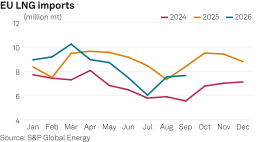
What's happening? EU LNG imports rose for the second consecutive month in September, reaching about 7.7 million metric tons, or about 10.6 billion cubic meters, according to S&P Global Energy CERA data. This represents a 1.6% increase from August but remains 8.8% lower than September 2025 levels. The US remains the EU's top LNG supplier, providing 60.7% of imports across the first nine months of 2026, followed by Russia at 16.1% and Nigeria at 6.4%. The spread between the Platts JKM benchmark and DES Northwest Europe LNG benchmark averaged $1.68/MMBtu in the three months to Sept. 30. Platts is part of S&P Global Energy.
What's next? Europe continues to face fierce competition with Asian buyers for scarcer LNG cargoes amid sustained Middle East conflict-related supply disruptions. CERA analysts project EU gas storage will reach 74% full by Nov. 1, which would mark the lowest level for that time of year on record since 2011. The coming quarter will be the final period during which Russian LNG can enter the EU before a total ban takes effect on Jan. 1, 2027.
2. Shipping emission intensity improves but total GHGs climb
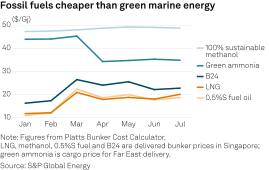
What's happening? The world's largest maritime companies by market capitalization reported declining greenhouse gas emissions per unit of transport work but rising total emissions in 2025. Ships took longer routes due to geopolitical conflicts, consuming more fuel despite investments in energy efficiency. A.P. Møller-Mærsk A/S reported that its renewable fuel use nearly halved to 1,524 GWh in 2025, down from 3,034 GWh in 2024, citing lower voluntary demand. July's average delivered bunker price for 0.5%-sulfur fuel oil was $18.66 per gigajoule in Singapore, compared with $48.69/GJ for 100% sustainable methanol, according to the Platts Global Bunker Cost Calculator.
What's next? Shipping companies will likely focus on energy efficiency improvements, fleet modernization and currently available alternative fuels like LNG and biofuels rather than waiting for regulatory certainty. The industry expects a slower transition pathway rather than reversals of decarbonization targets, with meaningful reductions achievable through operational optimization and retrofits, according to Fotios Katsoulas, research director at S&P Global Energy Horizons.
3. India-China methanol spread narrows to seven-month low
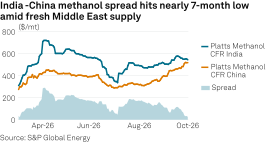
What's happening? The India-China methanol spread narrowed to a near seven-month low as Middle East arrivals eased supply concerns in India. Platts assessed the CFR India-China methanol spread at $26.50/metric ton on Oct. 1, down from $130/mt on Sept. 1. Platts assessed CFR India methanol at $544.50/mt Oct. 5, stable over the last assessment on Oct. 1. Three chemical tankers carrying about 100,000 mt of methanol crossed the Strait of Hormuz on Sept. 1, according to S&P Global Commodities at Sea data. Port stocks on India's west coast reached 200,000 mt around mid-September.
What's next? Further Middle Eastern arrivals are expected to keep Indian methanol prices under pressure, with market sources indicating additional supply for October delivery. Buyers are seeking levels of about $530/mt CFR India for October-arrival cargoes. Southeast Asia has become a more attractive outlet for sellers, with CFR Southeast Asia methanol assessed at $650/mt on Oct. 1, a $105.50/mt premium over CFR India.
4. Australian tallow prices fall as US shifts to cheaper alternatives
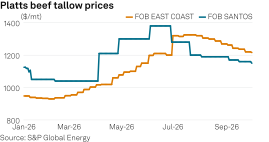
What's happening? Australian tallow prices have dropped to their lowest level in over three months as US buyers increasingly source cheaper alternatives from Argentina and Uruguay, market sources said. Platts assessed Australian tallow at $1,216/mt FOB East Coast on Sept. 30, down 4.2% month over month and the lowest since June 24 at $1,200/mt FOB East Coast. Despite Australia's tariff advantage over Brazil — 12.5% versus 37.5% — US buyers are aggressively seeking the most cost-effective origins, an Australia-based market source said. US imports of Australian tallow rose 67.9% year over year to 123,194 mt during January-July 2026, while Brazilian imports fell 57.5% to 115,008 mt, according to US Department of Commerce data.
What's next? The shift toward South American tallow may be temporary, as Argentina's export availability is seasonal, market participants said. Market participants expect the price competitiveness of Argentine and Uruguayan tallow relative to Australian material could narrow if export supplies tighten, potentially restoring US demand for Australian cargoes. US tallow imports are projected to reach around 894,500 mt in 2026, a 14% decline from the previous year, according to CERA data.
5. Argentine soybean meal premium over Brazil hits four-month high
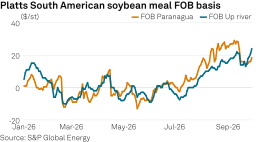
What's happening? Argentine soybean meal export premiums against Brazilian cargoes widened to their highest level since mid-May, driven by stronger European buying interest ahead of the EU Deforestation Regulation (EUDR) implementation, market participants said. On Sept. 29, Platts assessed the FOB Up River soybean meal basis at a premium of $24/short ton to Chicago Board of Trade futures, while FOB Paranaguá was assessed at plus $18.50/st. The resulting $5.50/st premium favoring Argentine meal was the widest since mid-May. Platts assessed FOB Up River at $422.18/mt versus $416.12/mt for FOB Paranaguá.
What's next? Demand for Argentine soybean meal is expected to continue as EU importers secure supplies ahead of the EUDR compliance deadline of Dec. 30, a market participant said. However, some traders said Brazilian soybean meal is becoming increasingly competitive, which could support the FOB Paranaguá basis in the coming weeks. An Italian trader said Italy remains the primary EU destination for Argentine meal, while a Dutch broker noted buyers in the Netherlands favor Brazilian supplies. CERA forecasts Argentina's exports at 30 million mt and Brazil's at 26 million mt for 2025-26, together accounting for over 60% of global soybean meal exports.
Reporting and analysis by Max Lin, Matt Hoisch, Kamna Kapoor, Muskan Agarwal, Monique Murer, Jose Roberto Gomes and Nanditha Kinavoor Madathil.
