Agriculture, Biofuels, Vegetable Oils
October 01, 2026
Australian tallow prices fall as US buyers shift to competitive origins
By Muskan Agarwal and Monique Murer
Editor:
HIGHLIGHTS
Australian tallow prices 4.2% month on month
US buyers seek Argentina, Uruguay tallow
Imports from Australia surge 67.9% yearly
Australian tallow prices have fallen to their lowest level in over three months, as buyers, mainly based in the US, increasingly seek lower-priced alternatives, particularly from Argentina and Uruguay, reshaping trade flows.
Platts, part of S&P Global Energy, assessed Australian tallow at $1,216/mt FOB East Coast on Sept. 30, down 4.2% month over month, marking the lowest level since June 24, when the assessment stood at $1,200/mt FOB East Coast.
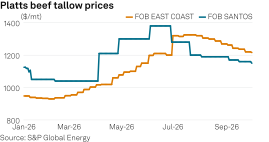
The decline comes despite Brazilian tallow remaining largely priced out of the US market because of tariff differentials.
Brazil was previously the largest supplier of tallow to the US. Still, its position has weakened after Washington imposed a 37.5% tariff on Brazilian goods, compared with a 12.5% tariff on Australian exports.
US imports of Brazilian tallow totaled 115,008 mt during January-July 2026, down 57.5% from 270,316 mt in the same period of 2025, according to US Department of Commerce data. Over the same period, US imports of Australian tallow rose 67.9% year over year to 123,194 mt.
US buyers turn to competitive alternatives
After rallying sharply on strong US demand and the reduced competitiveness of Brazilian material, Australian tallow prices have trended lower in recent weeks as buyers shifted toward lower-priced South American origins.
"US buyers are becoming much more aggressive in sourcing the cheapest acceptable origin, such as Argentina and Uruguay," an Australia-based market source said.
The data showed that US imports from Argentina fell 41.43% year on year to 66,635 mt for January-July, while volumes from Uruguay dropped 43.36% to 23,752 mt, and imports from Paraguay declined 58.65% to 2,085 mt.
However, the declines across the region partly reflect the historical structure of South American tallow exports to the US, market participants said.
Exporters have typically consolidated volumes from multiple origins, with vessels calling at ports across the region to assemble larger US-bound cargoes, including supplies from Brazil, Argentina, Uruguay, and Paraguay. Before tariffs disrupted trade flows, Brazil was the dominant supplier to the US market, making it easier to supplement cargoes with volumes from neighboring countries.
In recent weeks, however, market participants said buyers have increasingly turned to South American tallow, particularly from Argentina and Uruguay, amid its price advantage over Australian material.
"We are seeing demand from the American market," a South American broker said. The broker added that bids for November-December loading were ranging from $1,040/mt to $1,050/mt.
A US-based source echoed the sentiment. "South American tallow is now very convenient, good opportunities at the right prices," the source said, adding that it did not expect significant volumes of Australian tallow to enter the US while prices remain higher than alternatives.
Meanwhile, Brazilian tallow flows to the US continued to face economic challenges despite Australia's tariff advantage over Brazil. "The price would need to be below $1,000/mt FOB Santos for it to make sense," a US trader said.
Platts assessed the Brazilian beef tallow FOB Santos at $1,150/metric ton on Sept. 30, down $10/mt day over day.
Argentine seasonality may limit exports
Market participants based in the US and Australia indicate that the US shift toward South American tallow might be temporary, as Argentina's export availability tends to be seasonal.
Argentina's domestic tallow market is primarily supported by demand from the food industry. However, suppliers typically increase export sales when domestic consumption eases after the winter months, according to market sources. Brazil, Uruguay, and the US are among the key destinations targeted by Argentine sellers during periods of weaker local demand.
As a result, the current price competitiveness of Argentine and Uruguayan tallow relative to Australian material could narrow if export supplies tighten, potentially restoring demand for Australian cargoes from US buyers.
US tallow imports are projected to reach around 894,500 mt in 2026, a 14% decline from the previous year, according to the latest data from S&P Global Energy CERA.
