Natural Gas, LNG, Metals & Mining, Agriculture, Refined Products, Non-Ferrous, Rice, Diesel-Gasoil
June 02, 2026
COMMODITY TRACKER: 5 charts to watch this week

By Staff
Editor:
European commodities markets face supply pressures, with LNG imports declining for a second consecutive month and aluminum shipments at decade lows. Meanwhile, Brazil continues to rely heavily on Russian diesel, and Asian rice markets diverge as Vietnam's prices soften while Pakistan maintains competitive export positioning despite climate concerns.
1. EU LNG imports fall amid Middle East disruptions
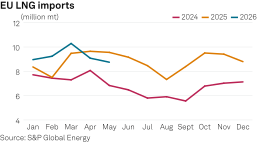
What's happening? The EU imported about 8.8 million metric tons (12.1 Bcm) of LNG in May 2026, down 8% year over year, marking the second consecutive monthly decline, according to S&P Global Energy CERA data. The US remained the EU's top LNG supplier, providing about 5.1 million mt in May. Despite monthly drops, total EU LNG imports for the first five months of 2026 stood about 4% higher year over year at 46.3 million mt. The decline stems from disruptions in the Middle East war that have cutoff international buyers from about 20% of global LNG production since late February. Platts, part of S&P Global Energy, assessed the DES Northwest Europe LNG marker at $16.712/million British thermal units June 1.
What's next? Europe faces continued challenges in attracting LNG cargoes amid competition with Asia in a tightening global market. The conflict, entering its fourth month, has forced the EU to compete for supplies, with the Platts JKM benchmark for Northeast Asia trading $2.867/million Btu above the Northwest Europe marker on May 29. Forward pricing has also hindered natural gas storage filling across the continent since April, with summer delivery prices consistently exceeding winter prices. EU gas storage reached only 40.1% capacity as of May 30, down from 47.9% in 2025 and 69.7% in 2024 at the same time, according to Gas Infrastructure Europe data.
2. EU aluminum imports hit decade low in March
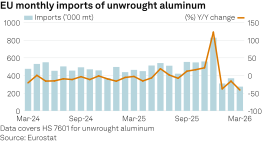
What's happening? The EU imported 274,858 mt of unwrought aluminum in March, the lowest monthly total in more than a decade, according to Eurostat data compiled by S&P Global Market Intelligence. Imports fell 41% year over year and 26% from February. The decline was primarily driven by reduced shipments from Norway, which delivered just 26,998 mt in March, down 78% from February and 76% year over year. The UAE became the leading supplier with 44,125 mt (16% share), followed by Mozambique with 30,016 mt (11% share) and Bahrain with 27,691 mt (10% share).
What's next? First-quarter 2026 cumulative imports totaled 954,600 mt, down 32% year over year. The contraction reflects market adjustments following the implementation of the Carbon Border Adjustment Mechanism on Jan. 1, which prompted importers to front-load volumes. Future import volumes may remain constrained as the regulation covers six sectors, including aluminum. Export volumes from Mozambique are expected to decline after South32 Ltd. placed its Mozal aluminum smelter under care and maintenance on March 15. On May 28, the Platts Daily Aluminum Duty Paid In-Warehouse Rotterdam Premium was assessed at $602.50/mt.
Further reading: METALS MONITOR: Rio Tinto commissions smelter expansion; US rare earth price floors aim to challenge China
3. Brazil's diesel imports led by Russian supply
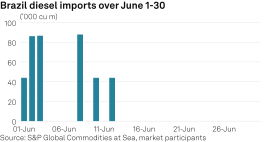
What's happening? Brazil is expecting about 420,691 cubic meters of ultra-low sulfur diesel imports scheduled for delivery in June, with discharge dates ranging from June 1-14, according to preliminary data from S&P Global Commodities at Sea. All 10 ships are currently in transit. Russia is expected to supply 298,727 cubic meters (71% of scheduled volumes), with the US contributing 93,457 cubic meters (22%) and India adding 28,507 cubic meters (7%). Santos leads June destinations with 131,707 cubic meters, followed by Manaus with 79,215 cubic meters and Itaqui with 93,457 cubic meters. For May, total imports are tracking at about 1.09 million cubic meters, down 16% from April's 1.3 million cubic meters.
What's next? Additional cargoes may be added as June progresses since all vessels are still in transit. As of May 29, Brazil has received about 613,902 cubic meters, with about 237,139 cubic meters still in transit for delivery through May 31. Russia remained the dominant supplier, supplying 572,956 cubic meters (67% of May's total), while the US supplied 278,082 cubic meters (33%). In the Brazilian DAP market, replacement costs for S10 from the US Gulf Coast and Russia have decreased amid lower freight rates. The diesel import arbitrage window has been closed for 136 consecutive days, remaining unfavorable at Real 850/cubic meter, according to Brazilian fuel importer association Abicom.
4. Vietnam fragrant rice price hit one-month low
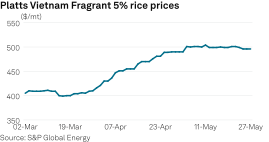
What's happening? Vietnam's fragrant rice prices fell to their lowest level in a month amid weaker demand from the Philippines. Platts assessed Vietnam Fragrant 5% rice at $494/mt FOB on May 28, down $2/mt day over day and $7/mt week over week, the lowest since May 1 at $490/mt FOB. This marks a reversal from recent strength when prices rose 26.3% from a record low of $399/mt FOB on March 17 to $504/mt FOB on May 11, supported by strong Philippine demand and tightening supply.
What's next? With the summer-autumn harvest expected to add fresh supply in the coming weeks, the combination of softer demand and increased availability could put further pressure on prices, according to market participants.
5. Pakistan rice exports projected to stay steady
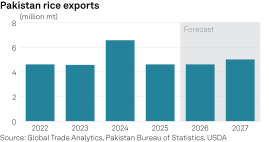
What's happening? Pakistan's rice exports are projected to remain stable during the upcoming harvest despite water shortages and concerns about El Niño. The USDA estimates 2025 exports at 5 million mt, up 8.7%, driven by a larger crop and strong demand from Africa and Middle Eastern markets, especially Iran. Pakistani rice was assessed at $354/mt FOB on May 29, up $7/mt month over month. The harvest is delayed until late September, though some sowing is ahead of schedule, offering cautious optimism.
What's next? If El Niño intensifies and global supply tightens, Pakistan could benefit from increased export opportunities. Strong demand from Middle Eastern and African markets is expected to support steady shipments. However, competition from competitively priced Indian rice and water availability during the growing season will be critical factors. Traders will monitor crop yields, weather patterns, and international demand through the harvest period to assess Pakistan's export trajectory.
Reporting and analysis by Matt Hoisch, Aly Blakeway, Euan Sadden, Kauanna Navarro, Chirag Aggarwal, Muskan Agarwal and Ayushi Baloni.
