Natural Gas, LNG
June 01, 2026
EU LNG imports fall 8% YOY in May as wartime disruptions persist: CERA
By Matt Hoisch and Aly Blakeway
Editor:
HIGHLIGHTS
Second consecutive month imports fall on annual basis
Jan-May imports up 4% YOY
EU gas storage 40.1% full: GIE
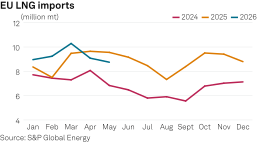
LNG imports into the European Union fell on an annual basis for the second consecutive month in May as disruptions from the Middle East war continue to curtail global energy trade, data from S&P Global Energy CERA showed.
The EU imported about 8.8 million metric tons (12.1 Bcm) of LNG in May, down 8% year over year, according to CERA data. This comes after a slightly lower year-on-year dip in monthly imports in April.
Despite the drop, total EU LNG imports throughout the first five months of 2026 remained about 4% higher year over year, at about 46.3 million mt, the data showed.
The US was the EU's top LNG trade partner throughout May, supplying about 5.1 million mt of its imports, according to the data.
In 2025, the EU sourced about 8.2% of its LNG imports from the Persian Gulf, all from Qatar, according to CERA data.
Europe struggles to attract cargoes
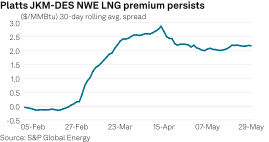
The drop in maritime traffic via the Strait of Hormuz has cut off international buyers from about 20% of global LNG production since the outbreak of the Middle East war in late February. While tankers that had already left the Persian Gulf before the conflict began had cushioned the supply shock in the early weeks of the war, Europe has had to compete with Asia for LNG in the increasingly tight global market as the conflict extends into its fourth month.
Platts, part of S&P Global Energy, assessed the DES Northwest Europe LNG marker at $15.471/ million British thermal unit on May 29. The index was $2.867/MMBtu below the JKM benchmark for LNG cargoes delivered into Northeast Asia on the same day.
Forward pricing has also persistently stymied natural gas storage filling in the EU since the filling season kicked off in April, with prices for gas delivered in the summer months consistently outpacing those for winter deliveries. EU gas storage was 40.1% full as of May 30, according to the latest data published by Gas Infrastructure Europe. This is down compared to the same time in 2025 and 2024, when stocks were filled to 47.9% and 69.7%, respectively.
"Until we see some structure in the forward curve and LNG spreads become more economical, it'll be hard to incentivize imports and storage," a Europe-based LNG trader said on May 29. "Europe is in a crunch; they're buying less and all the participants in Europe who have the shipping length are taking cargoes to other premium destinations."
