Refined Products, Agriculture, Energy Transition, Electric Power, Fuel Oil, Diesel-Gasoil, Biofuel, Renewables, Jet Fuel, Vegetable Oils, Grains
December 09, 2025
COMMODITY TRACKER: 5 charts to watch this week

By Staff
Russian fuel oil flows to Singapore rise despite US sanctions, while Tunisia stops gasoil imports from Lukoil, a major Russian company. Meanwhile, used cooking oil prices in China fall and Vietnam sees an increase in renewable energy certificate redemptions.
1. Russian fuel oil flows increase in Singapore
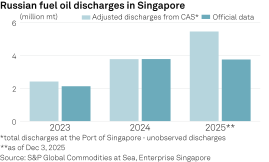
What's happening? Russian fuel oil discharges in Singapore reached a record 5.5 million metric tons by Dec. 3, notching the highest annual volume since tracking began in 2016 and a 44.6% increase from 2024, despite Western sanctions. This surge, tracked by S&P Global Commodities at Sea, highlights Singapore as a top importer of Russia's heavy distillates. The Jurong Port Universal Terminal received over 50% of these discharges.
What's next? Market participants said the discrepancy between official import data and vessel-tracked discharges, which stands at about 1.8 million mt, may arise from product definition differences amid sanctions risks. Despite the G7-EU price-cap framework, setting the Russian fuel oil cap at $45/b, and US sanctions on Lukoil and Rosneft, the trade flows highlight Moscow's continued ability to supply Asia's premier bunkering hub. This could signal sustained availability of lower-cost feedstock for regional fuel oil blending operations.
2. Tunisia shifts gasoil imports away from Russia
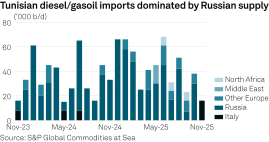
What's happening? Tunisia has ceased importing gasoil from Russian energy major Lukoil, once its largest supplier, following sanctions imposed by the US Treasury. This move signals weakening trade ties between the Russian supplier and some of its long-term markets, according to market sources and ship tracking data. Tunisia, one of Russia's top ten fuel consumers, accounted for roughly 4% of Russian exports in 2024, importing 2-3 cargoes of gasoil monthly, as per CAS data. Since Nov. 9, Tunisia has shifted to receiving supplies from Italy's ISAB refinery. Platts, part of S&P Global Energy, assessed Russia's Urals FOB Primorsk crude at a $26.65/b discount to Dated Brent on Dec. 8, marking its widest discount since April 2023.
What's next? A permanent shift in suppliers for Tunisia's state-owned STIR would end a two-year trade relationship with Lukoil and could boost demand for Mediterranean supply after a period of recent weakness, according to market sources. For Russia, meanwhile, the move could signal an increasingly challenging energy market, as Ukrainian drone attacks have continued to target critical export infrastructure and major buyers have reassessed their import practices.
3. China used cooking oil DAP prices hit five-month low
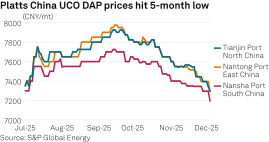
What's happening? The domestic Chinese UCO market reached a five-month low on Dec. 4, driven by low buying interest from biodiesel and sustainable aviation fuel producers amid ongoing plant maintenance. Prices have fallen significantly, with Platts assessments showing notable declines across major ports. At Tianjin Port, North China, prices dropped by 7.95%. In East China, at Nantong Port, prices saw an 8.53% decrease. Meanwhile, at Nansha Port, South China, prices fell by 6.86%. The overall outlook remains bearish, with expectations for recovery only after the Lunar New Year.
What's next? Looking ahead, market activity may remain limited as buyers exhibit caution, particularly due to weak demand for biodiesel. Although some UCO cargoes are being exported to the US, these transactions have not bolstered domestic prices. Additionally, trading in the biofuels market is sparse, with uncertainties surrounding delays in finalizing Germany's RED III decision, leaving participants hesitant as they await updates. According to market sources, these combined factors are likely to keep market sentiment subdued as the year concludes.
4. Vietnam sees rise in renewable I-REC redemptions
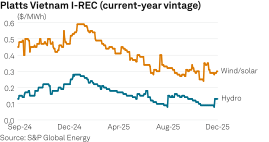
What's happening? Vietnam's International Renewable Energy Certificate market has seen a significant increase in redemptions for wind and solar RECs during the first 11 months of the year compared to 2024, according to data released Dec. 2 by the I-TRACK Foundation. Total redemptions reached 8,066,892 MWh, with wind and solar RECs experiencing a 90% year over year increase. Conversely, hydropower REC redemptions declined by 31%, amounting to 2,112,847 MWh. Issuances overall fell by 8%, with a total of 20,018,585 MWh issued. Platts assessed the current-year hydro I-RECs at 12 cents/MWh on Dec. 8.
What's next? The market, as reported by the I-TRACK Foundation and Platts, faces weak demand for large hydropower RECs, with 6,075,143 MWh remaining unredeemed, while interest in small hydropower I-RECs is rising. Compliance with RE100 standards, which require power facilities to be under 15 years old, is influencing buyer preferences. Despite the growth in wind and solar REC redemptions, a supply glut has pushed prices down, with a redemption rate of only 50% for 2025 issuances. Traders have noted a lack of inquiries, but demand is expected to rise in the coming months.
5. Black Sea wheat prices under pressure
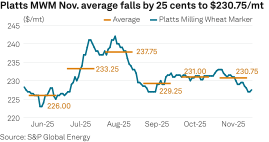
What's happening? The Platts Milling Wheat Marker has fallen to its lowest level since mid-September, assessed at $227.50/mt for late-December to first-half January loadings on Dec. 1, as sellers increasingly lower their offers. The MWM, which captures prices from the Black Sea, averaged $230.75/mt in November, down 25 cents/mt from October's average.
What's next? According to market sources, in December, Russian exporters are closely observing carriage paid to (CPT) prices, which have dropped to Rb15,000-16,000/mt. The strength of the ruble, currently around Rb77/$1, has played a significant role in tempering the decline in export prices this season. Additionally, exporters are keeping an eye on demand from East Africa, where bids were noted at $227/mt on Dec. 2. Although demand remains steady, it is relatively low, with buyers actively comparing prices with wheat from Australia, Argentina and Brazil.
Reporting and analysis by Mia Pei, Kelly Norways, Chau Kit Boey, Rachel Tan, Vivian Iroanya

Editor: