Refined Products, Maritime & Shipping, Crude Oil, Wet Freight, Fuel Oil
December 08, 2025
Russian fuel oil flows to Singapore hit record high despite sanctions: CAS

By Mia Pei
HIGHLIGHTS
Discharges surge 40% YOY in 2025
Highest annual volume since CAS tracking began in 2016
Difference of about 1.8 mil mt with the official number
Russian fuel oil discharges in Singapore have surged to a record high in 2025, according to tanker tracker data, despite intensifying Western sanctions on Moscow's maritime energy trade. The development underscores the resilience of Russian supply chains and could signal sustained availability of lower-cost feedstock for regional fuel oil blending operations.
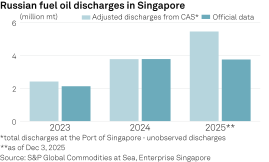
About 5.5 million metric tons of Russian fuel oil and residues were discharged in Singapore through Dec. 3 this year, representing a more than 40% increase from the same period in 2024, according to S&P Global Commodities at Sea.
This marks the highest annual volume since CAS began tracking the data in 2016, excluding "unobserved" cargoes where automatic identification system (AIS) signal gaps or proximity issues prevented confirmation of terminal discharges.
In comparison, official Singapore import data from Enterprise Singapore reported Russian fuel oil imports at about 3.7 million mt during the same period, implying a difference of around 1.8 million mt between the government figures and CAS's vessel-tracked discharges.
Enterprise Singapore, an arm of Singapore's Ministry of Trade and Industry, declined to comment on the data discrepancy.
Compliance risk
Singapore has emerged as one of the top three importers of Russia's heavy distillates discharged in 2025, according to CAS, largely due to shadow fleet operations east of Peninsular Malaysia.
While market participants noted that Russian fuel oil is not "illegal," dealing with it comes with high compliance risk under the EU price cap restrictions, a Singapore-based maritime lawyer said.
A trading analyst said traders generally avoid Russian seaborne products due to sanctions risks, but they could still buy when economics justify it.
Both the lawyer and the analyst requested anonymity due to the sensitive nature of sanctions compliance.
Throughout 2025, the busiest month was May, with adjusted discharges reaching 773,000 mt, the highest monthly total since March 2019, according to CAS.
Discharges were concentrated at the Jurong Port Universal Terminal, or JPUT, which accounted for 3 million mt, or more than 50% of the total observed discharges as of Dec. 3, CAS data showed.
When asked to comment on the matter, JPUT -- Singapore's largest oil storage terminal -- responded to Platts, stating that it is committed to being "fully compliant" with all applicable regulations, including sanctions.
"JPUT maintains a robust due diligence process, which includes sanctions screening. If any nominated vessels and/or cargoes are found to be sanctioned, JPUT will not allow such vessels to berth and/or cargoes to be discharged," JPUT's compliance department said.
Russian seaborne petroleum products are governed by the G7-EU price-cap framework, which allows shipping, insurance and other maritime services only if the cargo is purchased at or below the applicable price cap.
The EU guidance sets the Russian fuel oil price cap at $45/b, which translates to about $301.50/mt.
Bunker fuel oil prices in Singapore have remained above $400/mt in 2025, according to Platts assessments from S&P Global Energy. The FOB Singapore 380 CST high sulfur fuel oil price averaged $421/mt year to date as of Dec. 3, while the FOB Singapore 180 CST HSFO price averaged $427.8/mt.
US sanctions on Russian oil companies Lukoil and Rosneft took effect on Nov. 21, including a full transaction ban and potential secondary sanctions on their trade partners. Prior to the US announcement on Oct. 22, the two companies exported 290,000 b/d of residual fuel oil in 2025, according to S&P Global Energy CERA.
The additional sanctions raise further risks in dealing with Russian fuel oil, said another Singapore-based maritime lawyer, potentially putting a damper on flows from Russia.
However, trades may continue to occur if European and US authorities do not strictly enforce the sanctions, the lawyer said. "The risks come from enforcement actions taken in the US and EU, and if you are not exposed to those jurisdictions, then you are effectively immune."
STS complication
Market participants said the discrepancy between official imports and vessel-tracked discharges may be due to differences in product definitions and filing practices, as buyers attempt to avoid sanctions, particularly in light of transshipments occurring around Singapore's anchorages and nearby waters.
"Ship-to-ship bunker fuel blending operations, a common practice to meet bunker fuel specifications, further complicate the situation," said CAS analyst Benjamin Tang.
While Russian-origin fuel oil discharged into unobserved Singapore waters was 698,000 mt as of Dec. 3, according to CAS, Tang said such discharges at the Port of Singapore are not exclusive to Russian volumes. The total unobserved discharges at the port have remained stable compared with the previous two years.
CAS analysts said their figures are based on vessel tracking via AIS detection, complemented by third-party data, algorithms and analysts' judgment, different from official customs submissions.
Total fuel oil volumes discharged at the Port of Singapore so far in 2025 have been broadly consistent with previous years, according to CAS.
As of Dec. 3, total fuel oil and residues discharged in Singapore were 31.6 million mt, compared with 33.5 million mt in full-year 2024 and 32 million mt in full-year 2023, CAS data showed.

Editor: