Crude Oil, Refined Products, Energy Transition, Metals & Mining, Agriculture, Gasoline, Carbon, Ferrous, Oilseeds, Meat, Diesel-Gasoil
August 04, 2026
COMMODITY TRACKER: 6 charts to watch this week

By Staff
Editor:
Electric vehicle sales hit record levels amid tensions in the Middle East, while US crude inventories drop to eight-year lows amid robust refinery demand. European carbon prices ease during the summer recess ahead of EU ETS reform talks and China's hot-rolled coil exports face pressure.
1. Oil shock accelerates global electric vehicle adoption
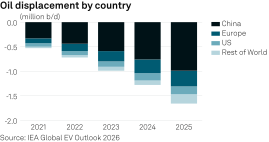
What's happening? The war in the Middle East could be accelerating global electric vehicle adoption due to rising oil prices, according to the International Energy Agency. Global EV sales hit a record 20 million units in 2025, rising 20% annually and displacing about 1.7 million barrels/day of global oil demand. In 2026, EV sales are expected to represent 28% of total car purchases, with higher oil prices improving the economics of switching. After over a month of oil price volatility linked to the war in the Middle East, running cost savings for EV drivers had risen by 20%-45% by April, according to IEA analysis.
What's next? The IEA projects EV sales will reach 50% of total car purchases by 2035. Annual displacement of diesel and gasoline by EVs is expected to triple to about 5 million b/d by 2030 and rise to 9 million b/d by 2035. According to IEA forecasts, China is expected to continue to account for half of the projected oil displacement for the next decade, although Europe and Southeast Asia remain fast-growing hubs.
2. US crude stocks fall to eight-year lows
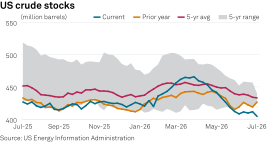
What's happening? US commercial crude oil inventories fell 7.17 million barrels to 404.51 million barrels during the week ended July 24, marking the largest draw since early June, according to the Energy Information Administration on July 29. Stocks now stand 6.4% behind the seasonal five-year average and at the lowest level since September 2018. Inventories at Cushing, Oklahoma, dropped 770,000 barrels to 18.6 million barrels, the lowest since April 2014. Strong refinery margins supported demand, with nationwide refinery utilization averaging 97.2% of capacity, the highest since December 2018.
What's next? Refinery runs are expected to remain supported by strong product cracks. The US Gulf Coast ultra-low sulfur diesel crack versus West Texas Intermediate MEH crude averaged $82.83/barrel during the week ended July 24, according to CERA data, up from a July-to-date average of $78.67/b and a June average of $57.58/b. The USGC unleaded 87 crack versus WTI MEH has averaged $54.69/b in July, up from $42.38/b in June. The USGC WTI MEH cracking margin averaged $43.92/b during the week to July 24, compared with a July average of $43.09/b.
3. European carbon prices dip amid summer lull
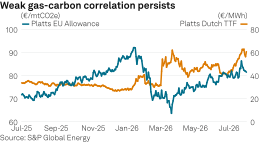
What's happening? European carbon prices edged lower through the week ending July 31 as the European Parliament entered its summer recess. EU Allowances traded at €82.50/metric ton of carbon dioxide equivalent on July 31, down 1% from €83.40/mtCO2e on July 24. Platts assessed EUAs for the December 2026 contract at €81.46/mtCO2e on July 30. The modest decline occurred as lawmakers departed Brussels on July 27 for their month-long break. Market participants positioned cautiously ahead of trilogue negotiations on EU ETS reform, expected to begin when members reconvene on Aug. 24.
What's next? Upcoming talks will focus on the European Commission's July 17 proposal, which outlined regulatory adjustments including slowing the linear reduction factor, extending free allowances tied to decarbonization commitments, and expanding the EU ETS scope. Analysts at S&P Global Energy CERA expect prices to rise to €86/mtCO2e by December, with averages of €81/mtCO2e in the third quarter and €84/mtCO2e in the fourth quarter. BNP Paribas forecasts EUA prices will average €87/mtCO2e in the first quarter of 2027, climbing to €90/mtCO2e by the fourth quarter. The council has set a deadline to complete comprehensive EU ETS reform by the first quarter of 2027.
4. China's HRC market pressured by weak demand
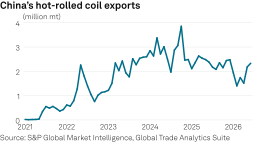
What's happening? China's hot-rolled coil market is under significant pressure as exports decline and domestic demand weakens. Platts assessed Chinese domestic HRC at an average of Yuan 3,325/mt ($492/mt) over July 1-30, down 1.9% from June and 4% lower than May. China exported 11.1 million mt of HRC in the first half of 2026, down 23.4% year over year amid a rise in antidumping cases. Vietnam, China's largest HRC export market, saw shipments fall 39% year over year to 1.585 million mt after the imposition of 23.10%-27.83% antidumping duties in July 2025 and 27.83% anti-circumvention duties in April.
What's next? HRC exports are expected to continue to decline through the remainder of 2026 due to rising trade barriers. Three new hot-strip mills with a combined capacity of 8 million mt/year were commissioned during January-July, with 10 additional projects totaling 28 million mt/year under construction or planned. Mill sources anticipate a seasonal demand recovery from construction and manufacturing sectors during late August and September, but the rebound may not exceed 2025 levels. HRC inventories at major spot markets reached 2.25 million mt as of July 20, up 26.4% year over year, prompting production cuts that remain insufficient to offset weakening demand.
Related content: METALS MONITOR: Trump limits recoverable minerals exports; EU cuts Ukraine's duty-free steel quota
5. Europe eyes firmer soybean meal prices
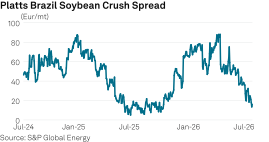
What's happening? European soybean meal prices are rising amid growing supply concerns and deteriorating crush margins in Brazil. On July 29, Platts assessed soybean meal FOB Netherlands at Eur365/mt, up 4.7% month over month, while EXW Tarragona rose 5.4% to Eur365/mt. The increase follows a sharp decline in Brazilian processing margins, with Platts assessing the Soybean Crush Spread FOB Paranaguá at $13.50/mt on July 27, the lowest level since mid-October 2025 and down approximately 80% from the start of 2026. Brazil accounted for 52% of EU soybean meal imports in the 2025-26 marketing year, compared with a 10-year average of 48%.
What's next? Brazil faces uncertainty over the pace of soybean processing in the second half of 2026 as crush margins remain under pressure. Forward margins remain negative due to strong soybean prices and competition from oilseed exports, according to CERA analysts in the Global Soybean Complex Short-Term Outlook report published July 24. While several market participants said it was too early to forecast how conditions might evolve, the potential for reduced processing in Brazil is beginning to weigh on market sentiment, given the country's importance as a soybean meal supplier to Europe.
6. North Asia chicken, pork prices fall on weak demand
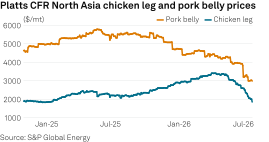
What's happening? North Asian chicken leg and pork belly prices continued to decline toward the end of July, pressured by high inventory levels and persistently weak demand. Platts assessed the CFR North Asia chicken leg price at $1,860/metric ton for August-September loading to Tokyo on July 28, marking a 28% month-over-month drop and returning to levels last seen in January 2025. The CFR North Asia pork belly price was assessed at $2,980/mt for September-October loading to Busan, down 24% from the previous month and at the lowest level since the assessment began in November 2024. The price spread between chicken leg and pork belly has narrowed significantly since the second half of 2025.
What's next? Japanese market participants continue to refrain from purchasing pork and chicken, citing ample stocks, falling domestic spot prices, and fully utilized cold storage capacity. Estimated ending stocks of frozen chicken meat in Japan reached 158,346 mt in May, up 5.8% month over month and 2.1% year over year, according to Agriculture & Livestock Industries Corp. data. In South Korea, Spanish pork import volumes rose 55% year over year in the first half of 2026, accelerating the price decline. Market participants expect financial strain among importers may become more evident after the peak pork consumption season ends, with some players potentially exiting before any meaningful recovery can occur.
Reporting and analysis by Kelly Norways, Christopher Vanmoessner, Irina Breilean, Eklavya Gupte, Jing Zhang, Nanditha Kinavoor Madathil, Jose Roberto Gomes, Nuo Geng Chen and Rubashiny Veeramohan.
