Refined Products, Crude Oil, Gasoline, Diesel-Gasoil
July 30, 2026
Global oil shock offers boost for EV switching, fossil phaseout: IEA

Editor:
HIGHLIGHTS
EV uptake displaced 1.7 mil b/d of oil in 2025
Running cost savings for EV drivers up 20%-45%
Fuel subsidies, EV tariffs could delay switching
The global oil shock from the war in the Middle East is accelerating the adoption of electric vehicles, according to the International Energy Agency, which sees the transition displacing 5 million barrels/day of oil by the end of the decade.
Global EV sales hit a record of 20 million units in 2025, rising 20% annually and displacing some 1.7 million b/d of global oil demand, according to the IEA. In 2026, EV sales are expected to make up 28% of total car purchases, rising to 50% by 2035, the agency said in a report published July 30.
Rapid electrification of the transport sector has been the driving force behind projections of a plateau in global oil demand, which the IEA has said could peak as early as 2030 under its stated energy policies.
However, higher oil prices could spur new adoption through additional policy initiatives and better economics for drivers, the IEA said, recalling historic shifts linked to previous crises.
For example, the supply shocks of the 1970s triggered the introduction of fuel-efficiency standards, while the coronavirus pandemic encouraged a wave of EV subsidies, according to the IEA. More drastically, countries such as Ethiopia have previously banned the import of conventional internal combustion engine vehicles to cut their fuel bills, the agency said.
"The road transport sector represents close to half of oil demand today, and policy responses to the long tail of the current crisis stand to shape the global car market for years to come," the IEA said in its annual report.
Supply disruptions in the Middle East are already pushing the limits of consumer price elasticity in key fuel markets, as importers face a critical product shortfall.
In the diesel market, prices continue to set record highs, with European product cracks now approaching an unprecedented $90/b premium to crude in the paper market, according to Platts assessments from S&P Global Energy.
Some countries in Southeast Asia, including Vietnam, have already unveiled plans to broaden EV tax incentives as a result of the crisis, while 30 countries broke records for monthly EV sales in March, the IEA said. After over a month of oil price volatility linked to the war in the Middle East, running cost savings for EV drivers had risen between 20% and 45% by April, according to IEA analysis.
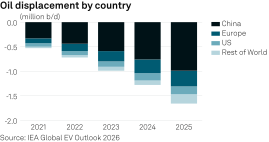
Oil displacement set to triple
Based on current policies, the annual displacement of diesel and gasoline by EVs is expected to triple to about 5 million b/d by 2030 and rise to 9 million b/d by 2035, the IEA said.
The IEA's latest outlook assumes the global EV fleet would grow to more than six times its current size by 2035, reducing oil demand from the transport sector to about 44 million b/d. However, stronger policy action could accelerate the transition, the report said.
Fossil fuel demand reductions are expected to come mostly from passenger and commercial cars, the IEA said. Electrification of trucks -- the second-most oil-intensive transport sector -- is also gaining momentum and is projected to avoid 1 million b/d of fossil fuel consumption by 2035, according to the agency.
China, the world's largest oil consumer, continues to lead the electrification boom. In 2025, China accounted for 1 million b/d of the 1.7 million b/d of global oil demand displaced by EVs, which recently made up 60% of all new car sales in the country, the report said. China is expected to continue accounting for half the projected oil displacement through to 2035, according to the report.
Meanwhile, in Europe, EV sales have continued to increase, representing 28% of all vehicle sales in 2025 and rising strongly again in the first quarter of 2026, the IEA said. EV sales in the US remained stable at about 10%, but came under pressure at the end of the year following the phaseout of supportive tax credits, the agency said.
Switching costs
On a global scale, the shift away from ICE vehicles has been largely driven by economics, according to the IEA. In China, 70% of battery EVs are already cheaper than conventional diesel and gasoline-powered cars, while affordability has also improved in countries with greater access to low-cost Chinese EVs, the IEA said.
The attractiveness of switching to EVs would therefore depend on government decision-making on issues such as fuel subsidies or import tariffs that can increase the cost of EVs, according to the IEA.
Reacting to recent oil price swings, dozens of governments have opted to subsidize diesel and gasoline costs, weakening the economic case for switching to EVs, the agency said. A sharp decline in oil prices or higher electricity costs may also reduce incentives for consumers to buy EVs, the IEA said.
Oil-importing countries have a stronger incentive to encourage EV uptake, although the transition would require grid investments and fiscal reform to offset lost fossil fuel revenues, the IEA said in the report. By 2035, the IEA expects electricity demand from EVs to rise sixfold to over 1,500 terawatt-hours, growing total global demand by 4%.
