Agriculture, Meat
July 29, 2026
North Asian chicken leg, pork belly spreads narrow on sluggish demand, rising inventories
Editor:
HIGHLIGHTS
Japanese cold storage remains at full capacity
High inventories strain South Korea, Japan importers
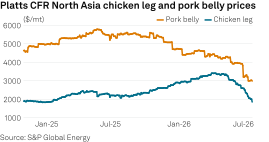
Since the second half of 2025, the price spread between Platts-assessed North Asia chicken leg and pork belly prices has narrowed significantly. By April, the gap had closed to $1,000/metric ton, and from the second quarter of 2026 onward, both products have trended downward in tandem amid weak demand and mounting inventories.
North Asia chicken leg and pork belly prices continued their downward trajectory toward the end of July, pressured by high inventory levels and persistently weak demand, multiple Asia-based trade sources told Platts, part of S&P Global Energy.
Platts assessed the CFR North Asia chicken leg price at $1,860/mt for August-September loading to Tokyo as of July 28, marking a 28% month-over-month drop and returning to levels last seen in January 2025.
The CFR North Asia pork belly price was assessed at $2,980/mt for September-October loading to Busan, down 24% from the previous month and at its lowest level since the assessment began in November 2024.
Most market participants in Japan continued to refrain from purchasing pork and chicken, citing ample stocks, falling domestic spot prices, and fully utilized cold storage capacity.
"Honestly, we can't buy anymore because there is no space in the refrigerator," a Japanese chicken meat importer said.
Cold storage operators have warned importers to move existing stocks or face additional charges, local importers added.
Despite these challenges, some purchases were deemed necessary to maintain relationships with Brazilian packers, according to multiple meat importers.
Trade activity was further constrained by a weak yen and high-priced inventory in storage and transit, trade sources said.
Heavy shipments of boneless chicken legs from Brazil to Japan between March and June created an inventory glut, causing domestic spot prices for unsized boneless legs (BL200Up) to plunge by about 51% from mid-April to Yen 370/kg ($2.26/kg) at the end of July, according to several Japan-based trade participants.
Estimated ending stocks of frozen chicken meat in Japan reached 158,346 mt in May, up 5.8% month over month and 2.1% year over year, data from the Agriculture & Livestock Industries Corp. showed.
On the supply front, Brazilian suppliers were redirecting some boneless leg volumes to the Middle East due to weak demand across Asia, including Japan, South Korea, and the Philippines, trade sources said.
"Other countries are buying [Brazilian boneless legs] at better prices than Japan," the first importer said.
Spain pork spillover strains Korea; Japan absorbs initial shock
Japan and South Korea took divergent paths after the December announcement of African swine fever in Spain.
Japan's pork prices spiked initially after losing access to Spain, a key supplier accounting for about 165,000 mt, or about 17% of its total pork supply.
In contrast, South Korea continued to receive Spanish pork through regionalization arrangements, which helped cap price increases and kept downward pressure on the market.
Prices in both countries have since softened, mainly due to oversupply and subdued demand.
In South Korea, competitively priced Spanish pork accelerated the decline, with import volumes rising 55% year over year in the first half of 2026.
Operational issues worsened the situation. Importers who bought aggressively earlier in the year at higher prices are now holding large inventories of expensive pork, according to South Korean sources.
Market participants expect that after the peak pork consumption season ends, financial strain among importers may become more evident. One participant said the market may need "a reset," with some players exiting before any meaningful recovery can take hold.
