Crude Oil, Refined Products, Chemicals, Agriculture, Energy Transition, Diesel-Gasoil, Jet Fuel, Rice, Biofuel, Carbon, Aromatics
January 27, 2026
COMMODITY TRACKER: 5 charts to watch this week

By Staff
US refinery output has remained high in early 2026, putting pressure on Asian refining margins, which may continue to face challenges. Meanwhile, European carbon prices have risen due to geopolitical factors, while Vietnamese rice prices fell to a two-month low amid weak demand.
1. Asian refining margins decline on US refinery output
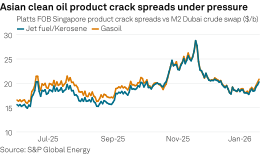
What's happening? High US refinery utilization rates, at over 95%, supported by cheaper Venezuelan crude, are reducing Asian refining margins. Singapore gasoil swap crack spreads against Dubai crude have dropped from $21.60/ barrel in Q4 2025 to $19.10/b so far in Q1 2026. South Korea's domestic complex refining margin has fallen 70 cents/b to $11.50/b, while gasoline margins have decreased $2/b, reflecting the competitive pressure from US refineries.
What's next? According to industry sources, South Korea plans to supply 400-410 million barrels of clean products to the Asia-Pacific region in 2026. Refiners have renewed most term supply contracts across Asia, Oceania, and North America. Global events like the soccer World Cup and potential semiconductor industry recovery are expected to support jet fuel and diesel demand, with US jet fuel sales showing a 13.3% year-on-year increase in Jan-Nov 2025.
2. EU carbon prices rise amid geopolitical signals
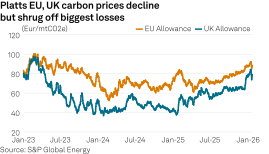
What's happening? European carbon prices ended the week of Jan. 23 up at near Eur90/metric ton CO2e, amid rising volatility driven by geopolitical signals following US President Donald Trump's remarks to other world leaders at the World Economic Forum in Davos, Switzerland. Tariff threats took center stage early during the trading week, leading to a sharp price drop, before softening signals around the US intentions to acquire Greenland led to a market rebound across European stocks, with European carbon allowances tracking the move.
What's next? Market participants are closely watching EU auction prices, which will determine how quickly volumes earmarked for the REPowerEU fund are phased out of the market. The bloc plans to gather Eur20 billion from carbon auctions, with the funds contributing towards ending reliance on Russian fossil fuels and accelerating the green transition. At current auction prices, the targeted revenue could be reached by May or June, after which supply in the primary market will be reduced.
3. Vietnam's rice prices hit two-month low
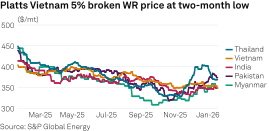
What's happening? Vietnam's 5% white rice prices have fallen to their lowest level in over two months, pressured by weak export demand and limited trading activity, market sources told Platts, part of S&P Global Energy. Vietnamese 5% white rice is currently the second cheapest among major Asian exporters, alongside Myanmar 5% WR, and at a premium of $1/mt to India, but at discounts of $25/mt to Pakistan and $26/mt to Thailand, according to Platts data on Jan. 21. Despite limited spot availability ahead of the Lunar New Year holidays, buying interest for 5% broken white rice remained muted, sources said.
What's next? The fall in prices indicates that buyers are adopting a wait-and-see approach, with anticipation of increased supply from the forthcoming Winter/Spring harvest dampening immediate purchasing interest. According to sources, prices were likely to remain under pressure in the near term, as Vietnam's rice supply is expected to increase with the approach of the peak Winter/Spring harvest season from February through April.
4. Asian paraxylene prices climb on futures rally
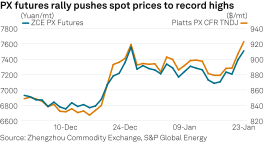
What's happening? Asian paraxylene spot prices reached their highest level in nearly 17 months on Jan. 26, climbing to $929.67/mt CFR Taiwan/China and $908.67/mt FOB Korea. The price increase is driven by a significant rally in PX futures on the Zhengzhou Commodity Exchange, with traders attributing the surge in part to investment optimism in petrochemicals.
What's next? According to market participants, paraxylene prices are likely to remain firm into 2026, anticipating tighter supplies and strong demand. Polyester production rates have temporarily dropped to 87%, with downstream activity slowing ahead of the Lunar New Year. PTA producers are seeing improved margins around Yuan 500/mt, despite low buying interest. Though the futures rally may have stalled for now, market participants remain optimistic about physical demand, expecting a quick recovery in China's downstream polyester production post the festive holidays.
5. Brazil diesel prices remain firm despite import arbitrage
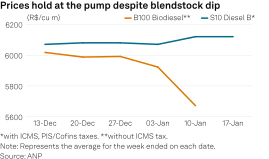
What's happening? Brazil's retail diesel prices have remained firm despite an open diesel import arbitrage and a dip in biodiesel contract levels. An analyst at one of Brazil's major fuel distributors told Platts that distributors are trying to recoup lost profits from the second half of 2025. The increase of state-level VAT ICMS, which was raised 4.5% to Real 1.17/liter for diesel on Jan. 1, also helped support prices at the pump. Regional differences, however, persist, with monthly quotas with domestic producers Petrobras and Acelen making imports less attractive in Northeast Brazil. Platts assessed biodiesel DAP Paulinia at Real 5,495/cu m on Jan. 19, a 5.9% reduction from the previous month.
What's next? Weaker seasonal demand for diesel B has also kept the market cautious on price moves, with market sales easing, and negotiations being sporadic. Market participants suggest further price declines are unlikely in the short term. Stakeholders are awaiting clearer signals regarding tax policy, blending mandates, and demand recovery.
Reporting and analysis by Philip Vahn, Irina Breilean, Chirag Aggarwal, Tanveen Kaur, Pankaj Rao, Gabriela Brumatti, Renato Rostas
