Chemicals, Aromatics
January 26, 2026
Asian PX spot prices power to over one-year high amid rally in Chinese futures

By Pankaj Rao
HIGHLIGHTS
Physical market subdued, low downstream demand pre-Lunar New Year
Optimism high for 2026 on tight PX supplies, robust demand
Asian paraxylene spot prices continued to rise Jan. 26 despite a subdued physical market as domestic downstream production slows down ahead of the Lunar New Year, reaching their highest in nearly 17 months largely on the back of a surge in Chinese futures.
Platts, part of S&P Global Energy, assessed the Asian paraxylene CFR Taiwan/China and FOB Korea markers at $929.67/metric ton and $908.67/mt, respectively, Jan. 26, both up $7/mt day over day. This follows $16/mt day over day rises for both markers on Jan. 23.
The current assessments are the highest since Aug. 30, 2024, when they were both at $931/mt, Platts data showed.
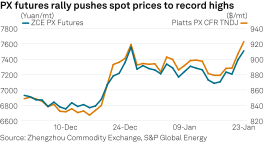
After a relatively calm start to January, a fresh rally in PX futures on the Zhengzhou Commodity Exchange during the week of Jan. 23 led to another significant jump in physical spot prices, a trader in China said.
The PX 2603 futures were up Yuan 118/mt from the previous day at Yuan 7,508/mt on Jan. 23 while the TA2605 futures rose Yuan 150/mt to close at Yuan 5,448/mt, ZCE data showed.
PX2603 futures gained a further Yuan 14/mt Jan. 26 to close at Yuan 7,522/mt, though the TA2605 futures eased back Yuan 10/mt to Yuan 5,438/mt, ZCE data showed.
The strong show in the futures market is mainly being driven by a flood of funds, or, as another Chinese trader put it, "hot money", which was first observed in December, prompting a rise in PX physical spot prices.
"The amount of Chinese investment is truly impressive," the first trader said.
The sustained flow of funds is possibly being driven by increasing optimism across various petrochemical products, including PX, the trader added.
Market sentiment remains optimistic for PX prices in 2026 due to tighter supplies and strong demand, a third Chinese trader said.
"We are all optimistic about this year's PX and PTA," the third trader said.
Furthermore, while some new PX capacities are expected to come online in China by the end of 2026, supply still remains tight, especially during peak consumption periods in Q2 and Q3, the first trader said.
"How much longer this futures rally continues is hard to predict, but for now, market participants will aim to make the most of the current situation," a Chinese broker said.
"First step is Yuan 7,600/mt," the broker said, referring to expectations of PX futures moving even further higher.
Physical market calm
Although the futures market has been busy, the current physical market shows little of the same enthusiasm, according to the first Chinese trader.
"There are no clear signals [on spot market], and the current prices have already surpassed what the fundamentals can sustain," the trader said.
Currently, the ongoing lull of the winter season for downstream products, along with an earlier-than-usual slowdown in polyester production, is weighing on spot market activity, the second Chinese trader said.
"Operation rates of polyester are down to 87% this week [ending Jan. 23]," the trader said, adding that operations were at 90% a week earlier.
Due to poor buying interest, several polyester plants in China have opted to curb production earlier than usual, with a full resumption in activity expected to pick up only after the holidays, sources said.
The sustained rally in the futures prices, though, bodes well for PTA producers as margins have vastly improved despite sluggish downstream demand.
Current domestic Chinese PTA margins have moved higher to around Yuan 500/mt, supported by the robust futures market. Previously, margins were ailing at levels below breakeven, around Yuan 200-250/mt, the second Chinese trader said. "PTA margins can recover [even though] no buying interests for real goods [as] downstream orders are low," the same trader said.
From a trading perspective, the floating price, or the spread between physical and paper prices, for March and April cargoes remains discounted, further underscoring a subdued physical market, a Singapore-based trader said.
At the Asia close Jan. 26, the March and April floating values were assessed at minus $5/mt and minus $4/mt, respectively, Platts data showed.

Editor: