Agriculture, Refined Products, Biofuel, Diesel-Gasoil
January 20, 2026
Brazil finished diesel prices hold despite cheaper imports, lower bio fees
By Renato Rostas and Gabriela Brumatti
HIGHLIGHTS
Diesel B prices firm at the pump amid higher tax, profit recoup
Domestic output quotas turn imports less attractive
Higher soybean oil availability, tough negotiations drop biodiesel fees
An open diesel import arbitrage and a dip in biodiesel contract levels in Brazil have failed to result in lower prices at the pump, as distributors aim to recoup profits following months of more expensive fuel sourcing and amid higher taxes for 2026.
State-level VAT ICMS was increased Jan. 1 for gasoline, anhydrous ethanol, diesel, and biodiesel, following a decision from Brazil's National Council for Finance Policy, or Confaz. For diesel, the tax was raised 4.5% to Real 1.17/liter, with Real 0.78/liter retained within the biodiesel chain.
Historically, consumers take the hit from ICMS increases, with price changes being reflected at the end-user level. And data from Brazil's National Oil, Gas and Biofuels Agency, or ANP, shows that retail prices have edged somewhat higher but especially during a time when companies try to widen their margins.
"Distributors are rebuilding margins while producers are actually bearing the costs," said a large biodiesel producer.
A market intelligence analyst at one of Brazil's major fuel distributors told Platts, part of S&P Global Energy, that they were trying to recoup some lost profit from the second half of 2025, but it would ultimately depend on average biodiesel indications from ANP.
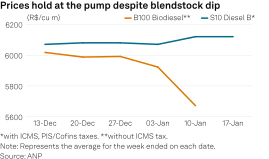
Weaker demand for diesel and biodiesel has also kept the market "on the defensive" against any price adjustments, according to a medium-sized distributor with operations in the Northeast and Center-West of the country. With distributors well-supplied, sales in the spot market have eased, and negotiations have become very sporadic.
"However, we also don't see room for a significant drop in prices at the consumer level in the short term. The adjustment has been more volume-based, with the market waiting for clearer signals before any repositioning," said the distributor.
Diesel arbitrage opens up
With the prospect of rising taxes, participants eyed imports as a way to ease costs, especially since the import arbitrage started to open around the end of 2025.
The Platts import parity price at the southeastern Santos port dipped below the domestic reference on Dec. 11 and has yet to come back. For diesel that has already passed through customs in Brazil's main ports, offers were also being heard at a discount to the Petrobras reference since then.
Fossil fuel prices revolve around Petrobras' postings in Brazil, since the state-owned company meets around 75%-80% of the country's diesel needs, for example. The entire FCA assessment suite in the country -- from the Northeast to the South -- went negative vs Petrobras on Jan. 5 and stayed below that mark.
Platts last assessed unfinished ultra low sulfur diesel, or S10 diesel A in Brazil, at Real 3,172.60/cu m on an FCA Santos basis Jan. 19, a Real 130/cu m discount to Petrobras' EXA Paulinia postings, and S10 FCA Itaqui at Real 3,104.50/cu m, Real 20/cu m below Petrobras ETM Sao Luis.
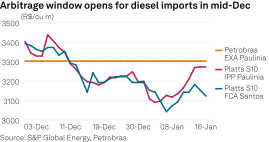
"We're focusing on buying on a need-to basis at the ports, taking a little advantage of the open arbitrage," a southern regional distributor said. They had yet to see a significant bump in end-user prices, however, saying sales were still being reported at a Real 240/cu m discount to Petrobras.
Amid the weaker season for diesel consumption, however, imports slowed down in the country. It was only with a wide supply from Russia, where refineries were coming back online after their heavy maintenance season and drone attacks from Ukraine, that steep discounts appeared in the market and led to that product dominating port line-ups in January.
Despite those less expensive imports, a distributor in Northeast Brazil stated that its monthly quotas with Petrobras made it so that import flows would be different depending on the region of the country.
"In Fortaleza, we are not seeing much supply of imported diesel; on the other hand, in Sao Luis [Itaqui], there are many import offers, but we have a high volume committed [to Petrobras] there," said the source.
Those quotas with not only the country's main supplier Petrobras, but also with private refiner Acelen in the Northeast, lifted the average sourcing price for distributors and turned imports less attractive.
Biodiesel fee decline
On the biodiesel side, which today makes up 15% of the diesel B blend (finished diesel) in the country, the market felt the effects of price pressure as early as mid-December, when the bimonthly negotiations of logistics contracts began for the January-February window.
Mainly driven by higher soybean oil availability and increased pressure from distributors, logistics differentials for Brazilian biodiesel, also called fees, were more than Real 570/cu m lower than the prior two-month period, considering an average of the regions assessed.
As a consequence of the decrease in fees and weaker demand during the period, spot market prices for biodiesel fell sharply in January, despite the increase in ICMS tax.
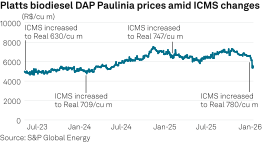
Platts assessed biodiesel DAP Paulinia for one-to-seven-day delivery at Real 5,495/cu m on Jan. 19 (or Real 6,275/cu m, including the increased ICMS tax), a 5.9% reduction compared with the Real 5,838/cu m of the previous month, on Dec. 19 (Real 6,585/cu m with the previous ICMS tax of Real 747/cu m).

Editor: