Refined Products, Maritime & Shipping, Agriculture, Energy Transition, Fuel Oil, Bunker Fuel, Meat, Biofuel, Renewables, Jet Fuel
December 16, 2025
COMMODITY TRACKER: 4 charts to watch this week

By Staff
As the end of the year draws near, S&P Global Energy editors and reporters are keeping an eye on sustainable aviation fuel volumes and projections for 2026. India's bunker fuel market is expected close the year with slightly higher volumes than last year, while price trends of imported chicken from Brazil are shifting amid labor issues and regional demand fluctuations.
1. Global SAF growth to decelerate in 2026: IATA
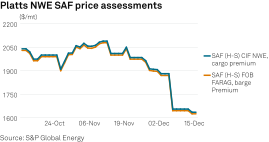
What's happening? The International Air Transport Association expects global sustainable aviation fuel production to reach about 1.9 million mt in 2025, roughly double 2024's 1 million mt, before slowing to 2.4 million mt in 2026 as high costs and policy uncertainty weigh on new investments. Even at 2.4 million mt, SAF would cover only around 0.8% of global jet fuel demand, underscoring how far the industry stands from its 2030 and 2050 decarbonization goals. Platts, part of S&P Global Energy, assessed the SAF (HEFA-SPK) FOB FARAG premium to jet barges down $225/mt, or 12%, in the week to Dec. 10, closing at $1,645/mt.
What's next? Without clearer long-term support and risk-sharing mechanisms, developers may defer or downsize projects, especially in high-cost Organization for Economic Cooperation and Development markets, where feedstock competition and construction costs are elevated. For Asia-Pacific producers with access to cheaper feedstocks and lower capital costs, this presents an opportunity to capture a greater share of early SAF demand, provided they can meet the strict sustainability and traceability requirements in the EU and UK markets.
2. India bunker demand stable in November amid falling prices
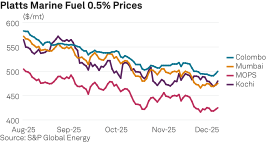
What's happening? India's west coast bunker fuel demand remained resilient in November as declining prices and improved domestic refinery supply supported steady consumption at key ports including Mumbai, Kandla and Kochi. East coast facilities struggled with limited uptake despite adequate product availability. The November average of Platts-assessed very low sulfur fuel oil delivered to Mumbai was $489.65/mt, down $13.07/mt month over month. Meanwhile, cyclone-related disruptions in Sri Lanka cut November bunker volumes by 18.75%, according to a Bunkerworld survey. The November average of Platts-assessed VLSFO delivered to Sri Lanka was $508.8/mt, down $09.02/mt month over month.
What's next? The regional bunker fuel market outlook for December appears positive as Sri Lankan traders who spoke to Platts anticipate volume recovery when weather-related disruptions ease. Market participants anticipate continued demand for high-sulfur fuel oil from the dry bulk segment, which is expected to drive overall volumes. Indian traders also expect to see a continued rise in demand for HSFO in Mumbai.
3. Asian chicken prices outpace Middle East on low stocks
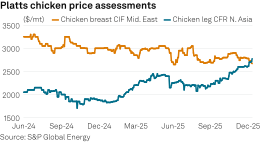
What's happening? Prices of Brazilian frozen boneless chicken leg imported to North Asia have climbed to a premium over breast meat shipped to the Middle East for the first time since Platts began assessments in June 2024. Platts assessed CFR North Asia chicken leg up $925/mt, or 50% year over year, at $2,775/mt Dec. 10, while Platts assessed the Middle East skinless boneless chicken breast at $2,680/mt CIF Jebel Ali Dec. 10. The shift reflects an oversupply of Brazil-origin breast meat in the Middle East and a strong demand for bone-in legs within Brazil, which is limiting availability of boneless leg exports to Japan. The high costs of deboning amid labor shortages in Brazil are adding upward pressure on leg prices.
What's next? Japanese importers are restocking amid low inventories, likely to support CFR North Asia chicken leg prices. In contrast, Middle Eastern cold storage remains saturated with breast meat which will slow buying. Brazil may adjust production to balance global supply, according to sources who spoke to Platts, although the persistent labor shortage for deboning is likely to constrain boneless leg output.
4. Renewable diesel, ticket markets surge following German legislative clarity
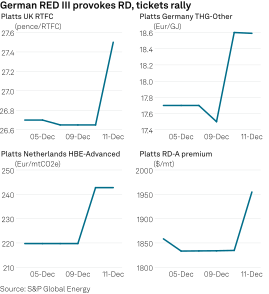
What's happening? After weeks of delays, Germany's Federal Cabinet approved its Renewable Energy Directive, or RED III, bill on Dec. 10, confirming that the double crediting of advanced biofuels will cease from Jan. 1, 2026. Although widely expected, the confirmation of the policy triggered rallies across European tickets and renewable diesel markets, with obligated German parties now required to secure more volumes of advanced fuels and tickets to be compliant in 2026 and beyond. This is underpinned by an increased ambition in Germany's greenhouse gas reduction in transport mandate, targeted at 15% in 2026 and rising to 59% by 2040.
What's next? While Germany's bill will still need to be stamped with full parliamentary approval, Dec. 10 signaled to the market that nearly all policies within the bill will take effect retroactively from Jan. 1, 2026. Legislative clarity in Germany has also reduced regional uncertainty, supporting prices in the UK's RTFC and the Dutch HBE market.
Reporting and analysis by Samyak Pandey, Somesh Jain, Rubashiny Veeramohan, Ishrah Ahmed, Olly Wroe
