Agriculture, Meat
June 01, 2026
INSIGHT CONVERSATION: Roberto Perosa, Brazilian Beef Exporters Association
By Renan Araujo and Rafael Savoia
Editor:
In this Insight Conversation series on global protein markets, leaders from the shrimp, pork and beef sectors examine the forces reshaping international trade. This is the fourth of five in-depth interviews where industry executives share their insights on how tariffs, import quotas, regional conflicts and cost inflation are redirecting protein trade flows and challenging established market dynamics.
Brazil's dominance in global beef markets is reaching a critical inflection point. After record-breaking exports in 2025, the world's largest beef exporter now sits at the center of shifting trade flows, a tightening supply cycle and rising geopolitical friction.
Roberto Perosa, president of Brazilian Beef Exporters Association (ABIEC), speaks with Renan Araujo and Rafael Savioa, S&P Global Energy agriculture and food editors, about current industry challenges. Perosa outlines how Brazil's beef sector is balancing booming global demand with mounting constraints, such as China's quotas, as it positions itself as a key supplier in an increasingly fragmented, higher-value protein landscape. ABIEC represents nearly 99% of Brazil's beef exporters.
How is Brazil positioned in global beef production and exports, and what steps has the industry taken in recent years to drive growth and maintain its market strength?
Brazil saw two exceptionally strong years. In 2024, Brazil already achieved record exports, and those shipments were surpassed in 2025. Beef exports in 2025 reached about 3.5 million metric tons, generating close to $18 billion in revenue.
Export volumes in 2025 rose by about 20% over the year, and export value by nearly 40%, reflecting higher value-added products. Today, Brazil is the world's largest beef producer and exporter.
This progress reflects coordinated improvement across the entire supply chain. Cattle producers have become more specialized, investing in productivity, quality, earlier finishing and technology. At the same time, the processing industry has adapted to handle higher-yield animals. Brazil's global reach expanded to 177 countries, showcasing its ability to meet diverse market demands and consumer preferences.
How is the association expanding into new markets for Brazilian meat and how is a less globalized environment impacting exports?
ABIEC drives market expansion through sustained trade promotion and strong institutional engagement, including trade fairs, matchmaking and direct outreach to key stakeholders.
In China, for example, beyond two major annual trade fairs, we have focused on expanding Brazilian beef beyond major cities, working directly with regional supermarkets, industry associations and provincial governments. Presence in the US is growing and Southeast Asia remains a key expansion frontier, particularly for offal and beef for processing.
However, rising protectionism directly affects exports as the sector now faces quotas, tariffs, sanitary barriers and geopolitical risks alongside production challenges.
While global beef demand continues to grow, restrictions in some markets remain a key hurdle, prompting a stronger focus on ensuring Brazil's active role in international trade negotiations to safeguard its market access.
Are there specific markets where Brazilian beef is at risk of losing share to competitors? How is the industry responding to China's new measures?
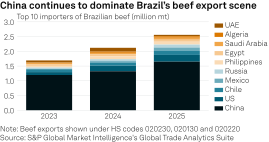
China remains the central focus, accounting for about 50% of Brazil's beef exports, so any shift there quickly impacts the entire supply chain.
China's 2026 quota significantly reduced Brazil's exports from about 1.7 million mt to 1.106 million mt, a 35% reduction. That represents a reduction of close to 3 million heads of cattle. When a buyer as large as China cuts volumes at this scale, it affects the entire chain.
The industry is responding with concern and close dialogue with the Brazilian government, with the key challenge being not just meeting the quota but managing the period after it is filled, when Chinese demand will drop.
There is growing demand in new markets such as Indonesia, the US and Southeast Asia, but in the short term, they cannot fully absorb the volumes China is stepping back from. We are therefore pursuing several measures to prevent a surge in the first half of the year followed by a sharper impact in the second half.
Over the past year, we held extensive negotiations with China through both government and industry channels, with multiple visits undertaken to address the issue. While the measure was aimed at supporting China's domestic cattle sector, it has significantly altered Brazil's export dynamics for 2026.
In response, we have been working with the Brazilian government to develop a set of measures to mitigate the impact. There is no single solution. What we need is stability. That involves managing export flows, negotiating with China, securing credit lines, supporting both industry and producers, opening new markets and strengthening existing ones.
With external demand for beef still strong, driven by the US, MENA halal markets and Southeast Asia, and with several key producers entering a phase of tighter supply, do you expect a shift in global beef supply-demand dynamics?
I do see an important structural shift taking place in the global beef market. Demand remains strong and geographically diverse -- across the Americas, the Middle East, North Africa and Southeast Asia -- while several major producers are experiencing herd contraction.
This is already a reality, particularly in the US, which is facing its smallest cattle cycle in decades, directly impacting global supply. At the same time, beef is a protein that does not respond quickly to production cycles. Unlike other proteins, supply cannot be increased in the short term.
As a result, reductions in herd size in key producing countries tend to lead to tighter supply and firmer prices over the medium term. Brazil stands out as one of the few countries with real capacity to expand production, thanks to its scale, competitiveness and well-structured supply chain. This creates opportunities, but also greater responsibility, as Brazil plays an increasingly central role in global beef supply.
What role would transparent and standardized price benchmarks play in the evolving global beef trade?
This topic is becoming increasingly relevant as the market grows more global and complex. International beef trade is still largely based on direct negotiations, bilateral contracts and market-specific requirements, which naturally leads to price differences depending on destination, cut, processing level and sanitary standards.
At the same time, there is a natural push toward greater transparency as volumes grow and new markets enter the picture. That said, it is important to recognize that beef is a highly heterogeneous product. Unlike standardized commodities, beef involves a wide range of cuts, quality grades and country-specific requirements.
Any move toward greater standardization needs to reflect this complexity. From my perspective, the most important factors are predictability, security in commercial relationships and a climate of trust between exporters and importers.
This interview has been edited for length and clarity.
