Crude Oil, Refined Products, Energy Transition, Agriculture, Maritime & Shipping, Fuel Oil, Renewables, Carbon, Biofuel, Bunker Fuel
November 11, 2025
COMMODITY TRACKER: 5 charts to watch this week

By Staff
As COP30 convenes in Brazil, the Ukraine conflict continues to affect Russian refining and crude exports. Meanwhile, the European green hydrogen sector struggles with project cancellations, while data center power demand is set to double by 2030.
1. War-driven emissions rise as Russian refineries targeted ahead of COP30
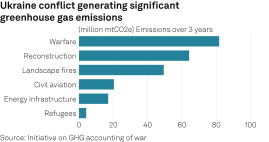
What's happening? Russia's ongoing invasion of Ukraine has generated significant greenhouse gas emissions and caused major damage to energy infrastructure, including Russian refineries and oil supply networks, Platts reported. Ukrainian attacks on Russian oil refining have led Russia to redirect some crude volumes to export markets in recent months. During this period, discounts on Russian crude have grown, with Platts assessing Urals crude at a $12.4/b discount to Dated Brent at the end of October.
The Initiative on GHG Accounting of War estimates that greenhouse gas emissions attributable to the conflict in its first three years totaled almost 237 million mt of CO2 equivalent, including 17 million mtCO2e from attacks on energy infrastructure.
What's next? The conflict in Ukraine is expected to continue to have a significant impact on Russian refining runs, exports and price levels. For Ukraine, shifting to decentralized renewable energy in order to enhance energy security is now a strategic priority following years of Russian attacks on its power grid. Some activists and energy companies are also looking to the 30th UN Climate Change Conference taking place in Belém, Brazil, on Nov. 10-Nov. 21, as an opportunity to advocate for better reporting of the climate impact of militaries and push for countries to place cleaner energy at the core of energy security policies.
2. Green hydrogen developers hope EU rule change will cut costs
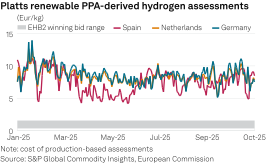
What's happening? The European renewable hydrogen sector is grappling with significant project cancellations and a retreat from investments by major energy companies, though projects are progressing where conditions are right. As of mid-2025, nearly 18 GW of hydrogen production projects were at an advanced stage, but 7 GW had been canceled or paused, according to S&P Global Energy analysts. Most awarded capacity under the EU's second hydrogen auction was withdrawn because of infrastructure delays and market uncertainty. Industry leaders say strict EU rules on hourly matching of new renewables for hydrogen production add around Eur2/kg to production costs, estimated in the region of Eur8/mt at present.
What's next? The Hydrogen Council says European green hydrogen demand could reach 5 million metric tons per year by 2030, if regulatory hurdles are addressed. Projected supply is only about 1.1 million mt/year under current conditions. The refining sector is leading the way in renewable hydrogen adoption, supported by clear regulatory frameworks and integrated supply chains, helping to cut costs. The EU is considering relaxing its green hydrogen rules.
3. Global data center power demand to double by 2030
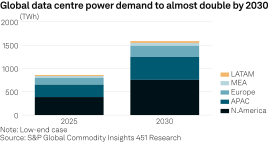
What's happening? Global data center power demand is expected to almost double by 2030 amid the rapid growth of data centers in the US and Europe, according to the low-end case scenario from S&P Global Market Intelligence 451 Research. Data center energy demand typically includes hyperscale, enterprise, leased and crypto-mining data centers. In the low-end case scenario, North American data center power demand is already set to reach more than 386 TWh in 2025, rising to around 755 TWh by 2030, according to 451 Research. European demand is projected to hit 145 TWh by the end of this year, growing to 238 TWh by 2030.
What's next? AI infrastructure investments could be diverted to markets where power access is more readily available, given high grid congestion in Europe's key data center hubs – such as Dublin, Frankfurt and Amsterdam. In the US, the Stargate Project intends to invest around $500 billion over the next four years, building new AI infrastructure for OpenAI. The first gigawatt capacity deployed, out of 16 GW, from the Nvidia and AMD deals, is expected to begin in the second half of 2026. The deal with Broadcom secures another 10 GW of custom-designed AI accelerators and systems for OpenAI.
4. Asian used cooking oil prices decline due to weak buying interest
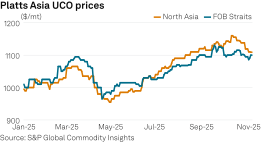
What's happening? Asian UCO prices have fallen due to low buying interest, influenced by several factors, including maintenance of SAF facilities, EU buyers remaining adequately supplied, and uncertainties surrounding the implementation of the RED III. The domestic UCO market in China is also bearish, primarily due to scheduled SAF plant maintenance in the fourth quarter, which has lowered buying interest.
What's next? Biofuels industry experts said they remain optimistic about the UCO market outlook, in part because of new policies aimed at boosting biofuels feedstock use and demand in the near future. In October, China authorized three producers to export sustainable aviation fuel, granting them a combined quota of 828,000 mt/year to supply global markets with cleaner aviation fuels. In the week of Nov. 3, China's Ministry of Commerce expressed support for the blending of domestically produced biodiesel with marine fuel oil within Chinese comprehensive bonded zones. According to industry experts, the entire market is focused on these details of biofuels policies and if the implementation details are addressed, it could boost the market at least in Q1 2026.
5. Singapore bunker fuel sales hit record amid US-China trade tensions
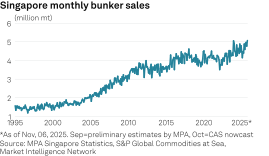
What's happening? Singapore's bunker fuel sales are estimated by S&P Global Commodities at Sea to hit a new record in October at 5.07 million mt, up 7.6% from September, as shipowners diverted vessels and increased ship-to-ship transfers following China's announcement of retaliatory port fees on US-linked ships. The surge coincided with China's Golden Week and heightened shipping activity amid the port fee tussle, with competitive premiums in Singapore drawing demand away from Zhoushan, though capped by even lower prices at Fujairah.
What's next? With the US and China suspending port fees on ships linked to each other from Nov. 10, Singapore-based ship operator sees Singapore's bunker demand staying sensitive to US-China policy shifts. Easing restrictions could boost cross-basin shipping and support further bunker sales, though any impact is expected to be gradual and shaped by broader trade trends.
Reporting and analysis by Rosemary Griffin, James Burgess, Maxim Grama, Chau Kit Boey, Mia Pei, Max Lin, Naomi Neoh
