Electric Power, Energy Transition, Renewables
November 05, 2025
Global data center power demand expected to almost double by 2030

By Maxim Grama
HIGHLIGHTS
AI workloads, Neoclouds, tenancy models
UK Tech Prosperity Deal, AI Continent action plan
US Stargate Project, OpenAI deals, partnership
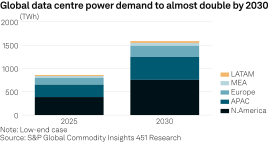
Global data center power demand is expected to almost double by 2030 amid the rapid growth of data centers in the US and Europe, according to the low-end case scenario from S&P Global Market Intelligence 451 Research.
Data center energy demand typically includes hyperscale, enterprise, leased and crypto-mining data centers.
In the low-end case scenario, North American data center power demand is already set to reach more than 386 TWh in 2025, rising to around 755 TWh by 2030, according to 451 Research. European demand is projected to hit 145 TWh by the end of this year, growing to 238 TWh by 2030.
In Europe, challenges in financing and developing infrastructure are associated with the risk-averse investor type in Europe compared to the US.
Additionally, to deliver new data center capacity, European policymakers must address constraints in grid access, which are already strained due to the ongoing electrification of industry.
"A multifaceted approach is necessary for effective energy management, integrating various technologies such as batteries, data centers, bitcoin mining, and AI to address the complexities of the evolving energy landscape," said Daniel Jogg, CEO of Enerhash.
An increase in power generation from renewable technologies is creating opportunities for larger renewable generation companies to develop innovative solutions that integrate AI and Bitcoin mining into energy systems, Jogg said.
The amount of electricity negatively priced hours reached another record high in 2025 at 3,687 across EU10 major power markets, up from 2,897 in 2024, and more than double from 2023.
In Europe, the major hyperscalers such as Microsoft and Amazon account for around 9 GW each of total corporate energy procurements, followed by Google at around 4 GW, Platts data shows.
"Data centers can be a challenge or an opportunity for Europe's power sector, depending on how flexible they can be on location and demand shape," said Glenn Rickson, associate director of European power research at S&P Global Energy.
"We estimate that data centers will account for around a quarter of all European power demand growth by 2030, but the range of possibilities around this growth rate are significant. Grid connection queues may be a limiting factor for data center expansion, made worse by speculative connection requests that artificially inflate the demand outlook and complicate grid planning for TSOs," Rickson said. "One solution to this -- for both supply and demand connection requests -- is to shift from a 'First come, first served' approach to a 'First ready, first connected' approach, as the UK is seeking to do."
In the Asia-Pacific, the lower-end data center demand is estimated to reach 493 TWh by 2030, up from 267 TWh in 2025. The total global power demand from data centers is estimated to increase from 860 TWh in 2025 to 1,587 TWh by 2030, 451 Research data shows.
AI investments in Europe, US
AI infrastructure investments could be diverted to markets where power access is more readily available, given high grid congestion in Europe's key data center hubs – such as Dublin, Frankfurt and Amsterdam.
The UK and US governments announced a technology agreement in September focused on AI, which includes plans for a 50-MW supercomputer, scalable to 90 MW, developed by Nscale in partnership with Microsoft, NVIDIA, and OpenAI.
Additionally, Google opened its first UK data center at Waltham Cross, Hertfordshire, on Sept. 16, 2025, powered by a renewable energy portfolio managed by Shell.
"Shell's diverse portfolio of renewable power supply, access to batteries and electricity trading and optimization expertise enables us to meet the evolving needs of world-leading companies like Google and support the growth of data centers," said David Wells, executive vice president of Shell Energy. "This gives us the scale and flexibility to help Google meet its decarbonization goals."
The UK-US Tech Prosperity Deal secures around GBP31 billion ($42 billion) of investment into UK AI and tech infrastructure from US tech firms, with AI chip maker NVIDIA planning to deploy around 120,000 graphics processing units (GPUs) in the UK, its biggest rollout in Europe to date, according to the UK government.
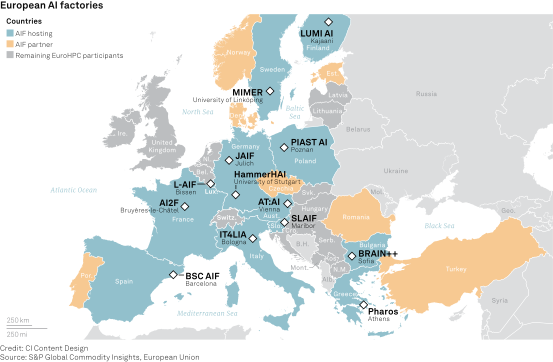
In Europe, the AI Continent Action Plan aims to develop AI technologies to enhance competitiveness and adoption in key sectors. The European Commission said in June that it had received 76 expressions of interest to set up AI gigafactories from 16 member states across 60 different sites. Currently, the EU has at least 15 AI factories and several antennas supporting the pan-EU AI ecosystem, bringing the total to 19 AI factories.
Antenna partner countries for the EU include Iceland, Moldova, Switzerland, the UK, North Macedonia and Serbia.
The EU announced a Eur200 billion investment fund in February at the AI Action Summit in Paris, with Eur20 billion allocated for AI gigafactories, which will feature approximately 100,000 last-generation AI chips.
In the US, the Stargate Project intends to invest around $500 billion over the next four years, building new AI infrastructure for OpenAI.
Since the Stargate Project announcement in late January, OpenAI has secured deals and partnerships with Broadcom, AMD, Arm and NVIDIA, bringing the infrastructure and technology investments to almost $1 trillion.
The first gigawatt capacity deployed, out of 16 GW, from the Nvidia and AMD deals, is expected to begin in the second half of 2026. The deal with Broadcom secures another 10 GW of custom-designed AI accelerators and systems for OpenAI.
Main global chip designers are NVIDIA, Qualcomm, AMD and Broadcom.
Tenancy pricing models, Power costs
Power costs may account for as little as 5% on a wholesale facility to mid-20% on retail facilities. However, power costs also vary based on location. For instance, 8 cents/kWh would equate approximately $44/kW/month at 75% uptime, paid by a tenant to a data center operator.
Cloud tenants can make investments in short-term compute by leveraging the temporary or scalable computing resources offered by cloud providers, which helps tenants to manage variable workloads.
"The tenant's investment is approximately $30,000/kW for short-lived computing equipment," said Alex Stoewer, CEO of Greenlight. "If this equipment depreciates to zero over five years, the depreciation rate is $500/kW/month."
In the tenant business model, tenants pay for services like space, often sold as power capacity, as well as cooling and network access, and their revenue is generated from the services they provide using this outsourced infrastructure.
Neoclouds are a new class of cloud providers specifically designed to handle the high-performance computing and immense GPU demand of modern AI workloads. Unlike general-purpose cloud platforms, which offer a wide array of services, neoclouds focus almost exclusively on providing GPU-as-a-Service (GPUaaS).
Tenancy pricing models vary. One pricing model is the cost per kilowatt-hour, a usage-based model where tenants are charged based on actual, metered power consumption, often used for very large deployments.
Another model is cost per rack, a fixed-price model that includes a set amount of space, power, and connectivity for a single rack. A third model is cost per square foot, typically used for very large enterprise clients.
AI workloads can fluctuate significantly, leading to inconsistent power usage.
"These machines are essentially responding to requests," Dan Thompson, principal research analyst at 451 Research, said. "For training, these are really large requests being made by the builders of the models, a task they ask the machines to do on an ongoing basis. Inferencing, however, is when the users of the models are asking questions of them, and the machines are generating a response."
If a model or application is particularly popular -- like ChatGPT -- its power demand can be fairly consistent, as users use it throughout the day. In contrast, less popular models or applications may experience very spiky demand, with users engaging intermittently before leaving, Thompson said.
In 2024, asking rates in the most active US data center markets, including Northern Virginia, ranged from $150/kW/month to $190/kW/month. In other markets, prices reached between $170/kW/month and $200/kW/month. These price variations were driven by increasing demand and volatile energy costs, according to a CBRE industry report.
The US national average asking prices in 2023 increased to $163.44/kW/month, up year over year from $137.86/kW/month, the CBRE report showed.
Average data center utility power for new build is forecast to rise to almost 110 MW by 2030, from almost 47 MW in 2025, according to 451 Research.
The cost of AI infrastructure buildout
The infrastructure utilized for inferencing shares similarities with that used for training, although this is not universally applicable and remains largely in the experimentation phase.
"My primary concern is less about incurring additional costs and more about wasted or underutilized expenditures," Thompson said.
"For instance, if I'm constructing a 1-MW GPU-based compute pod intended for AI inferencing, and my application fails to gain significant popularity, the data center provider and the power company are still obligated to supply 1 MW of power at any given moment, in case my application suddenly requires intensive computing. Otherwise, the resources remain idle, waiting for demand," Thompson explained.
Historically, data centers have consistently requested more power capacity than they actually need.
"While 1 MW may not seem like a significant issue, the real concern arises when gigawatts of power and data center infrastructure are deployed only to sit unused, leading to substantial financial waste," Thompson said. "With the current surge in AI demand, this situation becomes particularly alarming, given the scale of the massive projects being proposed and constructed."

Editor: