Energy Transition, Hydrogen, Renewables
November 05, 2025
Green hydrogen developers reckon with reality check in Europe

HIGHLIGHTS
Slow policy implementation hampers industry
Refinery sector driving Europe’s green hydrogen
Regulation change could cut costs by Eur2/kg
The European renewable hydrogen sector has faced fierce headwinds in 2025, with a slew of high-profile project cancellations and major energy companies abandoning investments in the space, but developers are finding routes to market where conditions align.
Most of the awarded capacity under the EU's second green hydrogen subsidy auction withdrew before signing grant agreements, and developers have also turned down UK grants, suggesting deeper structural problems in the nascent sector.
Industry leaders reference regulatory uncertainty, delays to policy and funding awards, escalating costs and difficulties securing long-term binding offtake.
But Ivana Jemelkova, CEO of industry body the Hydrogen Council, gives a more nuanced appraisal, pointing to a steady stream of large-scale projects reaching financial close and starting construction.
"Everybody can throw their arms up in the air and say, 'Oh, it's a total failure,'" Jemelkova told Platts, part of S&P Energy, in an interview. "That's not true, and that's not helpful either."
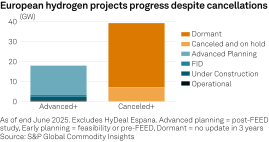
Almost 18 GW of European renewables-powered electrolytic hydrogen production projects were at an advanced stage as of the end of the second quarter of 2025, according to Energy analysts, with 490 MW of this operational, compared with 7 GW canceled or on hold.
But the large volume of project cancellations cannot be ignored, and points to real hurdles the industry and policymakers must overcome, with the bulk of announced projects -- 95 GW -- at an early stage of development.
"The low number of final investment decisions made to date is sobering and illustrates how uncertain the market outlook is," RWE Generation's Chief Operating Officer Hydrogen, Sopna Sury, said.
Lagging policy delaying projects
The EU's flagship subsidy scheme for green hydrogen -- the European Hydrogen Bank -- awarded its second auction in May, with Eur992 million ($1.1 billion) for 2.3 GW of electrolysis capacity over 10 years.
However, 1.9 GW of that capacity withdrew ahead of a September security deposit deadline.
Deutsche ReGas pulled its 210-MW H2-Hub Lubmin project in Germany, citing national legislation implementation delays that created too much uncertainty.
"An unclear regulatory environment hampers market development and limits our ability to secure long-term contracts with potential industrial customers," a company spokesperson said at the time.
Similarly, delays to pipelines that would connect the 560-MW Zeevonk electrolyzer in the Netherlands forced project developers Vattenfall and Copenhagen Infrastructure Partners to forgo EU funding.
The developers intend to progress these projects later, but the immediate funding will be reallocated to reserve projects with higher per-kilogram costs, delivering less capacity.
"When we look deeper into why projects are not moving forward, the number one challenge is policy implementation," Jemelkova said.
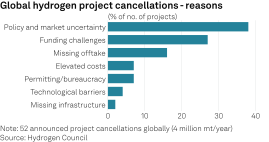
Globally, of the 52 projects publicly canceled in the 18 months to September, 38% were due to policy and market uncertainty, with a further 27% citing funding challenges, the Hydrogen Council said in its Global Hydrogen Compass report in September.
Missing offtake was the third-highest reason, accounting for 16% of project cancellations.
"Just like with solar, wind and others, the policy intervention, the government intervention was what started that positive cycle of volume up, cost down," Jemelkova said. "In theory, those policies exist, but they largely exist on paper."
The key policy driving green hydrogen uptake in Europe is the EU's revised Renewable Energy Directive.
Under RED III, the EU requires 42% of hydrogen in industry to come from renewable sources by 2030, and 1% of transport fuels to come from renewable hydrogen.
However, EU member states have been slow to transpose the rules into national law, with all countries missing the May deadline, and only a handful having adopted legislation so far.
Compounding these delays, strict EU rules requiring green hydrogen production to match new renewable power generation add significant costs.
From 2028, renewable power for electrolyzers must come from new installations, with hourly matching requirements beginning in 2030.
"We believe this adds roughly around Eur2/kg," Shell Hydrogen President Andy Beard told Platts.
Costs could fall to around Eur6/kg without the criteria, he said.
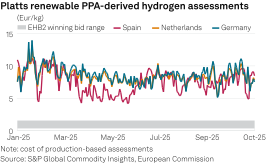
Platts assessed EU-compliant Dutch green hydrogen production costs at an average of Eur8.50/kg ($9.75/kg) in October (alkaline electrolysis with renewable power purchase agreement).
Refinery sector progress
The refining sector is leading the charge in renewable hydrogen project developments in Europe, with the transport fuel regulations giving a clear signal for decarbonization initiatives.
"The refinery route is a critical enabler for this early adoption because it allows a quicker implementation of low-carbon hydrogen into the fuel mix," Beard said. "It doesn't require a big infrastructure rollout of direct use," while avoiding the compounded technical risks associated with some synthetic fuel projects.
Shell, which is already operating one of the largest electrolyzers in Europe, has taken a final investment decision on two industrial-scale renewable hydrogen facilities in Europe that are under construction -- the 100-MW Refhyne II project at the Rheinland refinery in Germany and the 200-MW Holland Hydrogen I project in the Netherlands to supply its Pernis refinery.
Beard credits the company's integrated position for enabling project progression, noting how existing hydrogen experience in refinery processes, supportive regulatory regimes in Germany and the Netherlands, and established infrastructure create favorable conditions.
In Rotterdam, Gasunie is building a pipeline to connect the electrolyzer to the Pernis plant, with Shell as the anchor customer.
"That infrastructure has allowed us to match the supply with the last missing piece of the puzzle, which is demand," Beard said.
He said the captive demand from the refinery allowed the company to spread costs across the full value chain without creating affordability issues for end customers.
The company is also leveraging its power trading and offshore wind portfolio to supply electricity to the plants.
Similarly, German utility RWE was able to progress with its 300-MW GetH2 Nukleus project in Germany, negotiating long-term refinery offtake from TotalEnergies.
"The maturity of both the GET H2 Nucleus in Lingen and the hydrogen storage in Epe enabled us to negotiate a 15-year offtake agreement with TotalEnergies for 30,000 metric tons/year of green hydrogen from 2030," RWE's Sury, said.
The company ordered long-lead items for the project and started preparatory work ahead of funding commitments from the government, enabling it to move early. The first 100-MW phase is due to start operations by the end of 2025.
Cost gap
The refining sector's success contrasts sharply with other industrial applications struggling to close cost gaps amid missing policy incentives.
The fertilizer sector is another incumbent hydrogen-consuming industry, but it faces competitive pressures from imports and elevated costs following Russia's invasion of Ukraine.
Steel producers and heavy transport operators exploring hydrogen for decarbonization targets encounter similar economic challenges without adequate policy support.
The Hydrogen Council estimates policy implementation could increase the value of using green hydrogen to over $10/kg from $1-$2/kg. And green hydrogen demand could reach 5 million mt/year in Europe by 2030 if existing policies are fully implemented, it said.
As things stand, regulation-driven demand is expected to reach 2.8 million mt/year by then, industry group Hydrogen Europe said, with supply just 1.1 million mt/year.
Nevertheless, the early pioneers strike an optimistic tone.
"When you look at the numbers and you look at the pace of the way the industry is evolving, it matches quite closely to the fast rollout of other renewables like solar or wind," Shell's Beard said. "We're talking potentially 10 million mt [globally], which would be roughly 10% of the market today by 2030, which is considering we started only a few years ago, that's quite good momentum."

Editor: