29 July, 2026
July 2026 — EU’s revised sustainability reporting standards, UK and Australia modern slavery reporting reforms and New Zealand’s climate standard

Regulation is shaping the sustainability agenda and changing the way companies do business in different jurisdictions, but keeping pace with constant regulatory updates has become a mammoth task for businesses and investors. In this recurring series, S&P Global Energy Horizons presents key developments to sustainability regulations and standards from around the world.
In this month's update covering June 22 to July 22, we look at the European Commission’s adoption of revised sustainability reporting standards, moves by both the UK and Australia to strengthen their modern slavery reporting requirements and New Zealand’s proposal to adopt a global climate disclosure standard.
EUROPE
EU banking regulator publishes final draft on sustainability-related disclosures
The European Banking Authority (EBA) on June 22 published its final draft technical standards amending its Pillar 3 disclosure framework for environmental, social, and governance (ESG) risks. Pillar 3 of the Basel framework, created after the 2008 financial crisis, sets out disclosure requirements for financial institutions. Under the amendments, small institutions would be required to disclose only key information on ESG risks, like climate physical and transition risks and fossil fuel exposure. The amendments enhance ESG disclosure requirements for large institutions, but they also meet the European Commission’s objectives of streamlining sustainability reporting, the EBA said. Institutions would no longer be required to report EU Taxonomy-related disclosures and the number of mandatory datapoints would be reduced. The EBA will submit the final draft to the Commission for adoption. The technical standards will apply from Dec. 31, 2026, and smaller institutions will be subject to the standards from Dec. 31, 2027.
UK proposes tightening modern slavery reporting requirements
The UK government on June 30 proposed legislation that would strengthen reporting requirements under the Modern Slavery Act 2015 (MSA) by amending the act. The act currently requires businesses with annual revenues of £36 million or more to publish an annual modern slavery statement disclosing modern slavery risks in their operations and supply chains. The amendments would mandate reporting of the steps companies have taken to identify and mitigate risks of slavery and human trafficking in their supply chains; what policies they have undertaken; the due diligence processes they have implemented; staff training in identifying risks; and an assessment of the effectiveness of steps taken to prevent modern slavery risks measured against performance indicators. Should companies not have undertaken measures to prevent human slavery in their supply chains, they must explain why. The proposed legislation also introduces financial penalties for noncompliance limited to £1 million, or 1% of total revenues. Some public authorities would also be subject to reporting under the MSA.
EU supervisory bodies propose amendments to EU Taxonomy disclosures
Three European supervisory bodies on July 1 proposed amending some EU Taxonomy-related disclosures following the European Commission’s move to simplify reporting frameworks. The EU Taxonomy is a classification system of sustainable economic activities. The European Securities and Markets Authority (ESMA), the EBA and the European Insurance and Occupational Pensions Authority (EIOPA) published their proposals following a request for technical advice from the Commission on simplifying several key performance indicators (KPI). ESMA said it is proposing simplifications to the Taxonomy disclosure framework for non-financial undertakings and asset managers, including the operational expenditure KPI. EIOPA is proposing simplifying its underwriting KPI, while the EBA suggests simplifying its fees and commissions KPI, trading book KPI and off-balance sheet exposures KPI for credit institutions. A consultation is open until Aug. 12, 2026.
European Commission adopts amended sustainability reporting standards
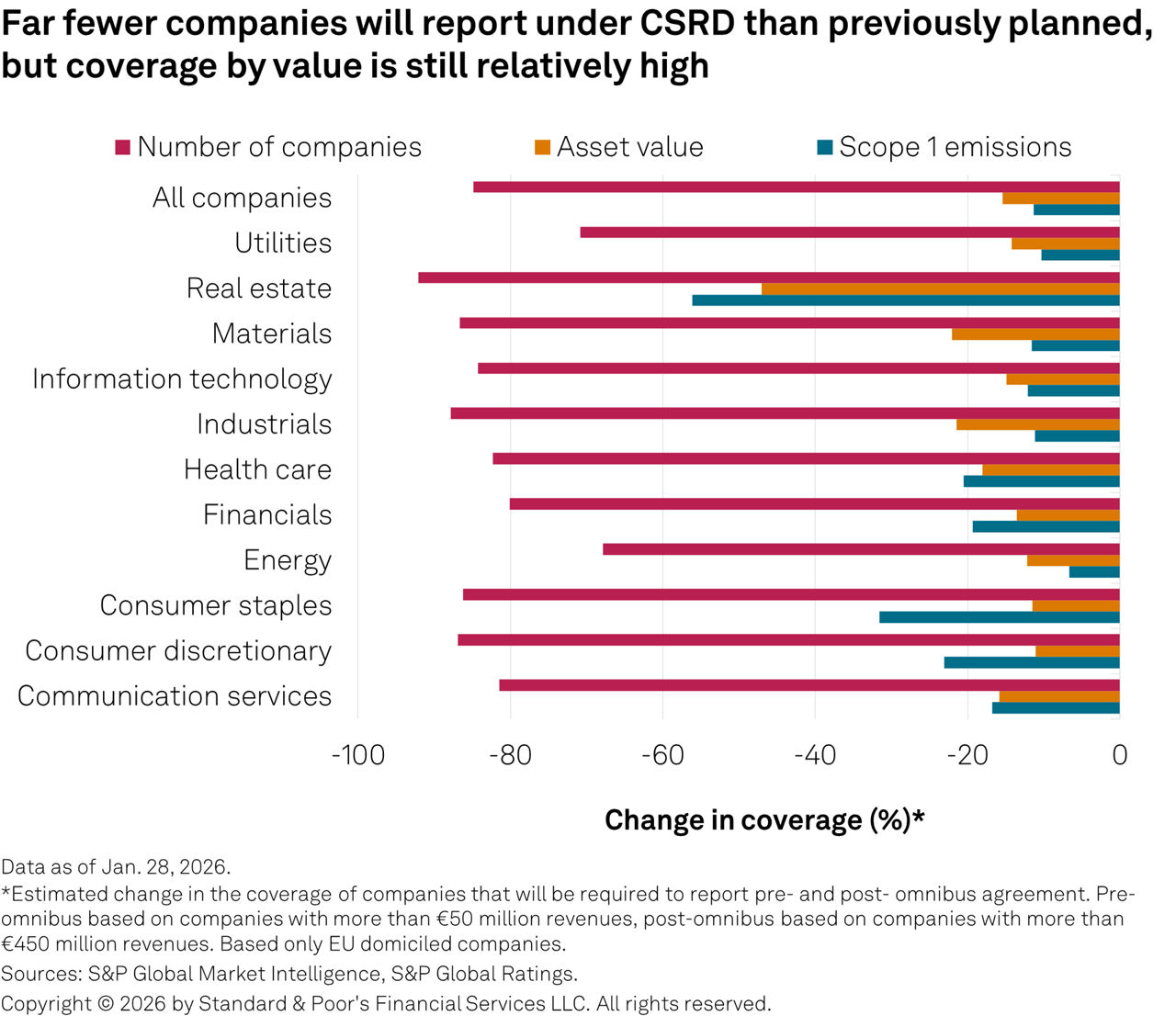
The European Commission on July 3 adopted revised European Sustainability Reporting Standards (ESRS), the set of disclosure standards for companies subject to the Corporate Sustainability Reporting Directive (CSRD), and a revised voluntary reporting standard for small and medium-sized enterprises. The ESRS amendments will reduce reporting of mandatory datapoints companies by more than 60%, and, reporting costs for companies will drop by more than 30%, the Commission said. The voluntary standard, a standardized simplified framework for companies not in scope of the CSRD, is meant to make it easier for companies to respond to larger firms’ requests for sustainability-related information. It also introduces a “value chain cap” through which companies subject to the CSRD cannot request additional sustainability information from companies with less than 1,000 employees. The standards will now be subject to a two-month scrutiny period by the European Parliament and the Council of the EU. The period can be extended for two months. Should there be no objections, the amendments will enter into force after their publication in the EU’s Official Journal.
European Commission adopts amendments to deforestation rule
The European Commission on July 13 adopted amendments to the EU Deforestation Regulation (EUDR), which aims to ensure that key goods placed on the EU market will not contribute to deforestation and forest degradation. The amendments remove cattle hides, skins and leather, re-treaded tires, soybeans for sowing, some rubber products, conveyor and transmission belts, and aircraft and motor vehicle seats from the regulation’s scope, the Commission said. They add soluble coffee, certain palm oil derivatives, and frozen cattle tongues. The regulation will apply from Dec. 30, 2026, for large and medium-sized operators and for micro and small operators subject to the EU Timber Regulation, and from June 30, 2027, for other micro and small operators. The new products will be subject to the regulation as of Dec. 30, 2027. The Commission also published amendments to regulation governing EU Deforestation Regulation IT system, permitting small companies to submit a simple, one-time declaration instead of regular submissions.
European Commission proposes reform of emissions trading system
The European Commission on July 17 proposed reforms to the EU’s Emissions Trading System (ETS), a cap-and-trade scheme designed to reduce emissions. The proposals would reduce the Linear Reduction Factor, a mechanism that determines the cap on emissions, to 3.7% for the 2031 to 2035 period and 1.7% between 2036 to 2040, down from 4.3% currently. Doing so effectively slows the pace of emissions cuts beyond 2030. The Commission said the move would align with the EU’s emission reduction target of 90% by 2040 compared to 1990 levels. It also said free allocation of emission allowances will continue beyond 2030 but will be conditional upon companies developing decarbonization plans and investing an amount equivalent to 100% of the value of their free allocation into such projects. The Commission also proposed the creation of a €100 billion Industrial Decarbonization Bank to fund decarbonization plans.
ASIA-PACIFIC
New Zealand proposes adopting global standard for climate disclosures
New Zealand’s External Reporting Board (XRB), which establishes financial reporting standards, on June 30 proposed issuing a new climate reporting standard, based on the International Sustainability Standards Board’s (ISSB) IFRS S2 climate standard. The XRB said its proposal would bring its existing climate standards into line with international standards. The XRB said the proposals also seek to harmonize New Zealand’s standards with those of Australia’s climate reporting framework to reduce compliance costs for companies subject to Australian reporting requirements. Australia adopted standards based on the ISSB’s in 2025. The XRB also said its proposed standard, NZ IFRS S2, would also take into account local market conditions and would consider what changes would be needed “to fit with New Zealand’s legislative and regulatory settings, reporting practice and market context.” Since 2023, listed companies with a market capitalization of more than NZ$60 billion and financial institutions with assets of more than NZ$1 billion have been subject to the country’s climate-related standards, based on the Task force on Climate-Related Financial Disclosures, which form the foundation of the ISSB standards. NZ IFRS S2 would become mandatory in 2033 following a transition period. A consultation period runs until Sept. 30, 2026.
Listen to how Canada is adopting the ISSB standards
South Korea establishes timelines and scope for sustainability disclosures
South Korea’s government on July 8 decided that large listed companies will be required to disclose sustainability-related information aligned with the ISSB’s standards as of 2028 based on financial year 2027, according to the country’s Financial Services Commission (FSC). Companies listed on South Korea’s benchmark KOPSI index with more than total consolidated assets worth 10 trillion South Korean won or more will be required to report as of 2028, with the threshold lowered to 5 trillion South Korean won from 2029. Companies with assets of more than 2 trillion South Korean won may be required to report from 2030 pending a review. There will be a three-year relief for reporting on Scope 3 emissions, or those that occur up and down a company’s supply chain. South Korea issued two sustainability-related disclosure standards based on the ISSB’s standards in March 2026.
Listen to how the UK and Mexico are adopting the ISSB standards
Australia plans to strengthen modern slavery laws
The Australian government on July 16 announced plans to strengthen its modern slavery laws to help companies identify and address risks in their global supply chains. The proposed reforms would make it a criminal offense for companies with annual consolidated revenue of more than A$100 million to fail to prevent modern slavery in their supply chains. Businesses would need to be able to prove they have taken “reasonable steps” to prevent modern slavery, the government said. It also said it plans to introduce civil penalties for noncompliance with Australia’s Modern Slavery Act 2018. The government plans to hold a consultation on the proposed reforms, which could include a deferred prosecution agreement scheme and remedies for victims.
Japanese financial regulator publishes revised Corporate Governance Code
Japan’s Financial Services Agency (FSA) on July 21 published the country’s revised Corporate Governance Code, which encourages companies to take a medium- to long-term approach to investment. The revisions reduce the number of principles that companies have to adhere to from 83 to 30 to enable boards to focus on core responsibilities, the FSA said. They also seek to encourage directors to assess emerging risks like cybersecurity risks, supply chain disruption and technological information risks. Under the revised code, companies are expected to submit annual reports at least three weeks prior to shareholder meetings. Companies are expected to submit corporate governance reports reflecting the revised code by July 2027 at the latest. Companies may take a “comply or explain” approach when applying the Code.
UNITED STATES AND CANADA
Canada publishes draft categories for sustainable finance taxonomy
Canada on July 9 proposed three categories for its planned sustainable investment taxonomy: a green category would apply to low-carbon investments like renewable energy and storage solutions; a transition category would include decarbonization-related investments in high-emitting sectors such as steel, cement and chemicals manufacturing; and an abatement measures category would apply to investments that seek to achieve substantial and near-term emission reductions in hard-to-abate sectors like the upstream production, refining, and distribution of oil and gas. The green and transition categories will be included in the first phase of the taxonomy’s development, planned for mid-to-late 2026, while development of the abatement measures category will begin in 2027. Canada’s newly formed Canadian Taxonomy and Transition Planning Council, along with the Canadian Climate Institute and Business Future Pathways organizations, are developing taxonomy guidelines for six sectors by the end of 2027, including electricity, buildings, transportation, mining, manufacturing and agriculture and forestry. A public comment period runs until Aug. 13, 2026.
California proposes delay to corporate emission reporting deadline
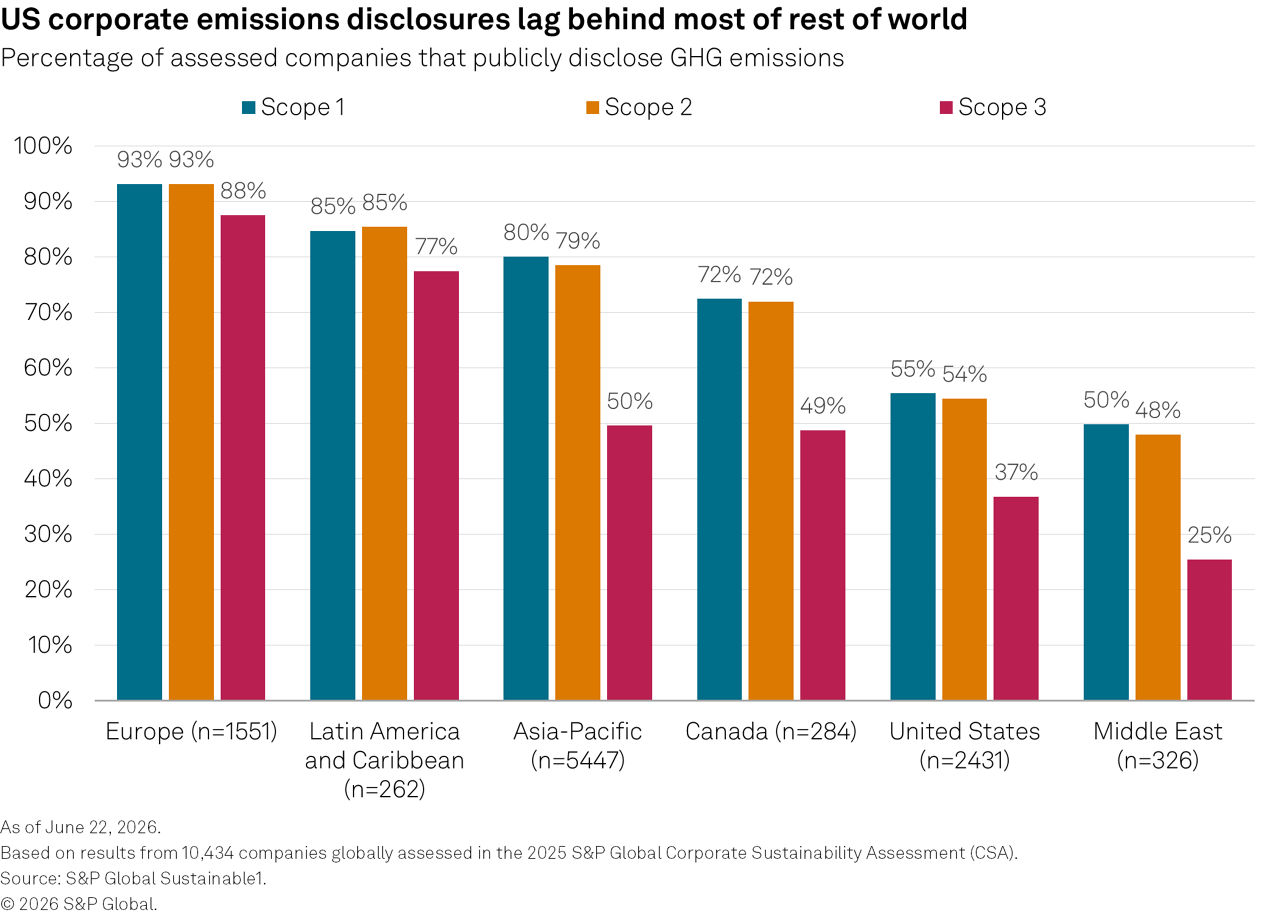
The California Air Resources Board (CARB) on June 24 proposed delaying its deadline for companies to start reporting greenhouse gas emissions to Nov. 10, 2026, from Aug. 10. 2026. CARB said the extra time will allow it to make “limited changes” to its initial regulation proposed in February 2026 to “clarify certain requirements.” The regulator said on July 21, 2026, that it will publish additional guidance on fee information and emission reporting by Sept. 1, 2026, ahead of the November deadline. Companies are required to start reporting Scope 1 and Scope 2 emissions from 2026 and Scope 3 emissions from 2027. CARB has proposed companies use the GHG Protocol’s 15 categories for Scope 3 reporting, with a phased-in approach beginning with the five most reported categories: business travel; purchased goods and services; fuel and energy-related activities; employee commuting; and waste generated during operations.
This piece was published by S&P Global Sustainable1 and not by S&P Global Ratings, which is a separately managed division of S&P Global.
Content Type
Theme
Language