
S&P Global Energy
Platts Iron Ore Index: Anchoring pricing clarity in a changing market
Changing iron ore qualities make the need for an independent, transparent benchmark more critical than ever
On this page
Contributors: Staff
Editor: Debiprasad Nayak
Published: May 2026
Introduction
Over nearly two decades, the Platts Iron Ore Index (IODEX) has developed, supported by the industry, into a benchmark referenced across both physical and financial iron ore markets.
Launched in 2008 as the first daily spot price assessment for iron ore delivered to China, the benchmark has become a widely used barometer of seaborne iron ore price in the global demand center.
While the IODEX itself has baseline specifications reflecting medium-grade fines with iron content between 60% and 63.5%, the market’s trust in the benchmark has made it also the pricing basis of high- and low-grade fines, as well as lump, pellet and concentrates.
Equipped with Platts suite of differentials for key impurities like alumina, silica and phosphorus; brand assessments and freight rates, the market has come to make use of a set of tools providing unparalleled informational transparency in the pricing of a wide variety of iron ore products.
In addition to being the principal reference for physical term and spot cargoes, IODEX-settled financial derivatives have become an effective risk management tool for steelmakers, producers and traders alike, having grown over the years in terms of market depth and breadth of participants. This principally defines the value of a benchmark reference – a transparent and consistent reference specification against which material in a wider ecosystem can trade seamlessly and efficiently.
Over the past year, the quality of key iron ore brands delivered to the market has shifted. Degradations of orebodies and operational and environmental limitations have driven changes to product specifications. Platts, as the custodian of the IODEX benchmark assessment, has consulted the industry extensively through regular, open dialogue over the past year to ensure the benchmark evolves with market needs.
As these revisions work through supply chains and commercial terms, buyers and sellers face a more complex valuation challenge: how to price a variety of cargoes that vary around a common baseline in a way that remains transparent and comparable.
The purpose of a benchmark is not merely to produce a number; it is to provide a consistent reference point that can withstand scrutiny as market relationships evolve.
This paper sets out the benchmark principles that matter most for iron ore, what the IODEX represents, how it is assessed, and how it relates to adjacent markets: China’s port stock market and the futures market that settles against IODEX.
Role of a benchmark in iron ore markets
Iron ore pricing must account for two realities in a meaningful and systematic way: variety, or the broad range of forms and grades that iron ore comes in, and within each category, variation, or how cargoes differ around a baseline specification. A benchmark must therefore provide a method to normalize relevant market information to a clearly defined standard so that bespoke cargo price levels can be compared on a like-for-like basis.
Platts price assessments for medium-, high- and low-grade fines, lump, pellet and concentrates seek to account for the variety of iron ore products that are traded in the market.
Around each price assessment, Platts differentials for timing, value-in-use (VIU) and brand adjustments deal with variation in market activity from the stated baseline specifications to unmatched detail and daily frequency.
The more clearly base specifications are defined, the easier and more efficient it is for the wider market to trade against it, particularly when cargoes differ materially in delivery timing, chemistry and brand attributes.
What Platts IODEX represents
The Platts IODEX is designed to reflect the tradable price of medium‑grade iron ore fines delivered to China at 5:30 pm Singapore/Beijing time. It is published against baseline specifications intended to represent a common reference point for the market: 61% Fe, 4.5% silica, 2.5% alumina and 0.1% phosphorus, among other specifications.
No physical brand matches the baseline specifications exactly. The benchmark, therefore, functions as an anchor to which varying data points are normalized. Cargoes of different specifications can be priced by applying premiums or discounts to the IODEX to account for differences between the cargo and the benchmark baseline.
The IODEX assessment is internally coherent with its accompanying set of impurity VIUs assessments for the main medium-grade fines brands.
Changes to the price of each of these components are validated with market participants each day, and have, over time, been borne out by observed changes in broader supply and demand fundamentals.
Viewed as an ecosystem, the benchmark and its accompanying differentials enable market participants to express the iron ore price in a consistent language: a common reference price plus transparent adjustments for timing, chemistry and brand/cargo factors that any party can arrive at step by step.
How Platts IODEX is assessed in practice
Market on Close: establishing repeatable tradable price assessments
Platts assessment process considers information gathered throughout the day. Each data point collected plays a role in determining the market tradeable price of medium-grade fines at the specific time stamp of 5:30 pm.
Platts price reporters actively engage with the broader market to gather information leading up to the time stamp, seeking to understand how the market has traded through the day, whether in response to the release of data around steel consumption or ore inventory levels, or macroeconomic announcements.
The price of iron ore, like any other commodity, fluctuates intraday, and a time-stamped – or Market on Close – approach that Platts takes allows for clarity around repeatable value at one particular point in time.
A time-stamped approach also supports meaningful analyses of spreads. When a benchmark and associated differentials are assessed at a common close, the market can compare premiums, discounts and timing structure with greater precision and ease.
Normalization: translating data points to the benchmark baseline
At 5:30 pm, verified bids, offers and deal information are normalized to the IODEX baseline. Normalization focuses on three main dimensions: delivery timing, chemical specifications, and other price-relevant brand or cargo factors.
Delivery timing
A market structure defined by seasonal factors and uneven supply-and-demand fundamentals across delivery periods means that cargoes vary in price depending on when they will arrive.
Platts is the first price reporting agency to recognize and account for delivery timing in its methodology.
The IODEX reflects the tradable price of cargoes arriving around the midpoint of the 14-56 day forward delivery window. Depending on a cargo’s delivery timing compared to that midpoint, its value is normalized using the prevailing physical market structure, capturing the price differentials across forward delivery dates.
Chemical specifications
Normalization for chemistry adjusts the value of a cargo from the specifications on which it was offered to the IODEX baseline.
The five main medium-grade brands traded in the seaborne market and that inform the IODEX are Pilbara Blend Fines, Mining Area C Fines, Newman High Grade Fines, Jimblebar Fines and Brazilian Blend Fines. Other than these, Platts also normalizes other brands like IOC6 and medium-grade variations of Carajas fines to the IODEX.
Iron content is normalized on a pro‑rata basis to 61% Fe. For the impurities alumina, silica and phosphorus, Platts publishes daily value‑in‑use assessments reflecting how the market prices these components under prevailing conditions.
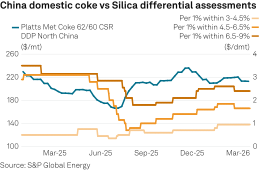
Impurity VIU assessments are grounded in observed market relationships and broadly reflect the economics of ironmaking. For example, higher silica increases slag yield and thermal requirements in the blast furnace, and in turn, the coke rate. When coking coal prices fall, the incremental cost of processing high‑silica ores declines, and market sensitivity to silica may lessen; when coal prices rise, silica penalties may strengthen. This relationship is reflected in Platts 1% silica differentials.
In the first half of 2025, as coking coal and coke prices in China fell to multiyear lows, processing high-silica fines became less costly. In other words, the market became less price-sensitive to high-silica fines, and this was reflected in the decline of the silica differentials across the three bands published by Platts. As China coke prices rebounded later in the year, the silica differentials correspondingly inched higher.
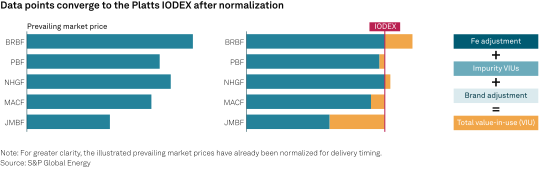
Platts IODEX and impurity VIUs successfully account for a variety of different brands in the seaborne market, and are consistently validated by trades, bids and offers.
This extends to 63% Fe Brazilian Blend Fines, following adjustments using Platts impurity VIU differentials.
Brand and cargo factors
Beyond timing and chemistry, Platts assesses and publishes brand adjustments for the main medium-grade fines, accounting for factors such as physical and metallurgical properties, quality consistency, brand‑specific supply and demand drivers, and delivery optionality.
Convergence and internal consistency
A key validation principle is convergence: after normalizing for each of the above variations from the baseline using differentials from the prior day, one should expect trades to converge to a single benchmark value: the IODEX.
Likewise, outstanding bids and offers, once normalized, should bracket the IODEX, with bids below and offers above.
A lack of convergence after applying the prevailing physical structure, Fe, impurity VIUs and brand adjustments would indicate that one or more normalization inputs have changed from the previous day.
By comparing cargoes with contrasting timing or quality, Platts identifies the normalization factor that has changed on the day, and tests and validates them in a virtuous cycle through observed market data and feedback, ensuring that the system of inputs remains coherent and reflective of broader market fundamentals.
Fixed and floating prices: parts of an ecosystem
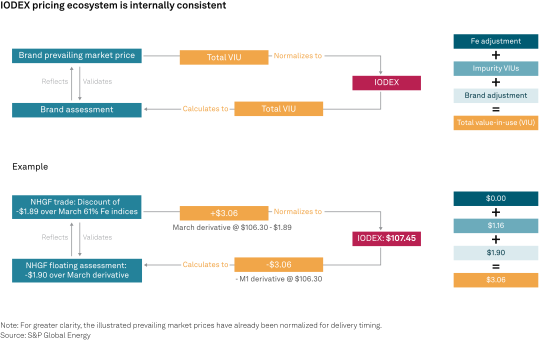
A benchmark reflects the physical commodity as the market prices it. Physical cargoes may trade on a fixed or floating price basis, expressed as a premium or discount to an index for a given quotation period. A coherent benchmark ecosystem needs to support consistent translation between floating and fixed values at each point in time. Across all markets, Platts views fixed price indications as the clearest expression of price.
Within Platts iron ore pricing ecosystem, the benchmark is designed to be internally consistent with associated differentials and brand assessments. In practice, market participants often express the aggregate impact of timing, chemistry and brand differences as a differential to the prevailing price of the IODEX derivative for the relevant month. Platts translates such expressions of value into fixed-price equivalents for the purpose of determining the daily benchmark assessment.
Platts iron ore assessments are open to market scrutiny, and as market participants know that they can question how the assessment for each of the moving parts was arrived at, they have come to expect full transparency in the steps involved in doing so, via daily rationales, commentaries, and direct communication with Platts price reporting team.
Benchmark strength amid quality shifts and market events
Benchmark robustness is most evident when the market changes. Periods of shifting product specifications, as well as episodic disruptions, can test whether a benchmark continues to represent mainstream value and whether its associated differentials remain coherent.
As producers revise quality specifications and the market re‑prices relative brand value, a benchmark anchored in transparent normalization helps the market separate what changed – chemistry, brand factors, physical market structure – from what did not.
Where mainstream cargoes realign around a different typical chemistry, the market expresses that evolution through observed discounts, premiums and differential behavior relative to the benchmark baseline. This is only possible if the baseline is clearly and consistently defined and the steps to arrive at it from different starting points are consistent.
Similarly, where normal trading is impeded, such as when brands face import restrictions or sudden shifts in buyer preferences, the methodology should provide clarity on how observed data is treated and how resulting brand and benchmark relationships are reflected. In practice, these episodes tend to manifest as shifts in brand adjustments and spreads.
Leading up to announcements by producers BHP and Rio Tinto in 2024 and 2025, lowering quality specifications of their brands, the IODEX, with 62% Fe specifications, was an anchor of price: brands that delivered below contracted specifications have traded at a discount, while those that have managed to keep quality consistent have traded at parity or even a premium to the IODEX. Platts introduced a 61% Fe IODEX equivalent to equip market participants with a timely comparable reference.
With cargoes of revised specifications arriving in China from the end of July 2025, Pilbara Blend Fines, Mining Area C Fines and Newman High Grade Fines traded at nearly parity to one another and to the 61% Fe IODEX equivalent. They also traded at larger discounts to the 62% Fe IODEX, in line with expectations of how reduced quality would be measured against constant benchmark specifications.
This indicated how the market saw the price of some of the main iron ore brands to be well represented by the baseline specifications of the 61% Fe IODEX equivalent.
This is well reflected in the 2025 assessment data, which shows the variety and depth of market participation in the assessment process and the record number of data points collected.
Portside markets: complementary and distinct
The seaborne iron ore market developed first as China’s steel industry expanded and relied on large, forward-priced, dollar-denominated trades to secure bulk supply, giving rise to global benchmarks such as the IODEX.
As imports and port inventories grew, a domestic portside spot market evolved in parallel, enabling smaller, yuan-denominated, near-term transactions that reflect immediate Chinese supply-demand conditions. In 2017, Platts launched its Iron Ore Port Stock Index (IOPEX), which has been progressively expanded to reflect portside activity in northern and eastern China, and along the Yangtze River ports.
Market attention has increased over the years on the Chinese portside market as a reference point for iron ore pricing.
This stems partly from concerns that when the quality of a delivered cargo falls below stated specifications, contractual penalties may not always compensate a buyer sufficiently for potential losses when a cargo is resold at port, where pricing is more directly driven by prompt demand, iron content and moisture.
Being part of the same value chain, the two markets have distinct features that complement rather than substitute each other. A seaborne benchmark like the IODEX provides a globally recognized reference for the iron ore prices and the backbone for long-term contracts and cross-border trade, while the IOPEX reflects localized, near-term conditions in China’s vast spot market.
While IOPEX and IODEX both relate to medium-grade iron ore, they are built on different commercial and cost structures. By having two distinct price references, market participants have the opportunity to examine the unique signals that may emerge from each, providing clarity and certainty.
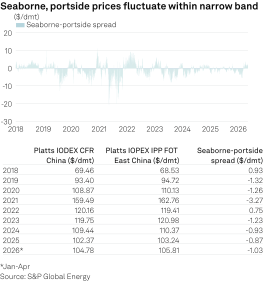
Market participants have so far dealt with expectations of delivered cargo quality coming in lower than contractual specifications by trading them at discounts to the seaborne index.
The formal lowering of product quality specifications by producers over the past two years has also addressed potential contention arising from the gap between typical, seaborne and actual, landed specifications being too wide.
This means that market participants can now more clearly differentiate between the remaining fundamental differences.
Key differences in portside and seaborne markets
| Port stock | Seaborne | |
| Currency | Yuan | Dollar |
| Basis unit | Wet metric ton (wmt) on Free-on-truck (FOT) basis | Dry metric ton (dmt) on Cost and Freight (CFR) basis |
| Delivery timing | Prompt delivery | Delivery in a few weeks/months |
| Typical cargo size | 2,000-20,000 mt | >50,000 mt |
| Quality specifications | Based mainly on actual specifications | Based mainly on typical specifications |
| Payment terms | Telegraphic transfer, cash against document | Letter of credit |
| Cost/Tax inclusions | Includes value added tax (VAT) and port fees | Does not include value added tax (VAT) and port fees |
Typically traded in much smaller parcel sizes of a few thousand metric tons upward, the portside market, by nature, sees a higher number of trades than the seaborne market, which trades in larger cargo sizes. Trading terms and conditions are, however, less standardized, and may reflect elements of bilateral negotiations which need to be accounted for when informing an index, so that it is clear how variation in data relates to the benchmark. Platts recorded a record number of data points collected in both seaborne and port stock markets in 2025.
Importance of risk management tools
Derivative markets enhance benchmark confidence
Iron ore derivatives have grown over the years since the first over-the-counter swaps were traded in 2008, mirroring developments in other commodities, in which deep and liquid futures and options markets exist.
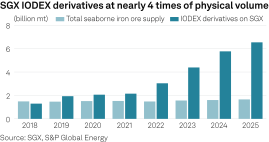
Liquidity in the SGX IODEX derivatives contracts, settled against the Platts IODEX, has supported risk management for physical market participants, who directly trade a third of volumes.
Other participants include global multistrategy asset management firms, commodity hedge funds, commodity trading advisors and banks that may be providing hedging and investment on behalf of their customers, who bring the benefit of additional liquidity.
The total volume of dollar-denominated iron ore derivatives traded first exceeded the total volume of seaborne supply in 2019 and has since grown in 2025 to be nearly four times the physical seaborne volume, reflecting market confidence in the underlying benchmark’s independence, methodological rigor and transparency. Among dollar-denominated derivatives, iron ore ranked among the top 15 most liquid commodity futures contracts globally.
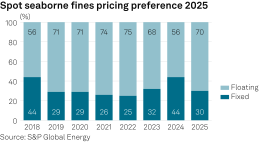
The liquid derivatives market today provides physical market participants with an effective tool to manage their price and counterparty risks, when nearly all physical term contracts and 70% of physical spot contracts are priced on a floating basis.
Converting floating prices to outright equivalents
A liquid derivatives market supports assessment of floating price physical bids, offers and trades. Where a cargo is traded on a floating basis, expressed as a premium or discount to an index for a given month, the value of the corresponding derivative helps establish an observable, market-based reference for converting that floating price into an outright equivalent at the time of trade.
For example, if a physical cargo is traded at a $1/dmt premium to the June average of IODEX, the value of June futures at the time of the trade can be used as the base, with the agreed $1/dmt premium added to derive an outright equivalent.
This two-step approach supports comparability between floating and outright price indications and reflects common practice within iron ore and across commodity markets.
Where there is a conflict between a fixed-price datapoint and a floating-price data point, the former prevails under Platts methodology, ensuring that physical pricing information is always prioritized for an assessment of physical cargo value.
Conclusion
As iron ore quality profiles evolve and relative brand relationships shift, the market’s need for a clear and consistent reference price increases. A benchmark that is transparent and internally consistent provides a common language for pricing across timing structures, chemical variation and brand attributes.
Platts IODEX is designed to meet these requirements through a time‑stamped assessment process, systematic normalization to defined baseline specifications, and a published ecosystem of differentials and assessments that supports bespoke cargo valuation.
Understanding how the seaborne market is complemented by China’s port stock market and how the physical and derivatives markets reinforce each other helps market participants use benchmarks more effectively.
Ore quality changes and evolving environmental standards and ambitions in the mining and steel industry have put the spotlight on understanding quality and chemistry. Platts IODEX is the benchmark of choice for the seaborne iron ore market, while Platts IOPEX brings transparency to the evolving Chinese port stock market. Both are complemented with a unique suite of differentials for timing, value-in-use and brand adjustments that provide transparency and efficiency for the iron ore market for decades to come.