Metals & Mining Theme, Ferrous
February 26, 2026
ASIAN IRON ORE MARKET 2025 REVIEW: Move toward lower specifications, import curbs reshape trade
HIGHLIGHTS
Seaborne iron ore shifts to 61% Fe pricing
Chinese firms lead market reporting at 59%
Port stock prices exceed seaborne levels
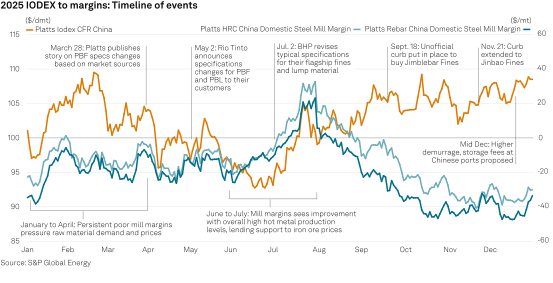
The Asian iron ore market saw significant changes in 2025, key among them were major Australian producers moving toward lower-grade specifications, while market participants also faced price disruptions due to increased supply amid persistently weak steelmaking margins before levels improved in the second half of the year.
Record shipments by producers and buyers penalizing material with lower iron and higher impurity levels, citing uncertainty about the ore's performance before they reach Chinese shores, pushed spot prices of seaborne iron ore to the year's lowest level of $92.75/dmt on June 18.
As steel margins recovered in June-July following a steady decline in coking coal and coke prices in China, demand for iron ore returned, lifting prices through the rest of 2025. An unofficial curbon Chinese purchases of BHP products effectively sidelined Jimblebar Fines from the medium-grade fines pool, potentially buoying prices.
Platts IODEX averaged $102.37/dmt CFR China in 2025, above the $100/dmt threshold for most steel mills. Prices have remained firm in January, after IODEX specifications were updated to a 61% Fe basis from 62% Fe, and averaged $105.62/dmt.
S&P Global Energy CERA analysts expect iron ore prices to remain resilient in the first half of 2026, as the ramp-up of Simandou in Guinea appears to be slower than initially announced. CERA analysts project around 15 million-20 million mt of exports from the new project in 2026.
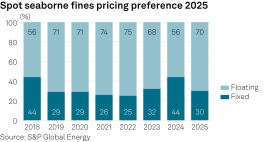
Share of floating price deals
Australian material entered the market withrevised specifications from the second quarter of 2025, after which producers sought to establish the value of their cargoes by selling mainly on a fixed-price basis.
As brands gradually found their relative positions to the 61% Fe index near the year-end, transactions were predominantly conducted on a floating price basis.
Through the year, floating price transactions account for 70% of all seaborne fines spot deals, up from 56% a year ago, according to data compiled by Platts.
From Nov. 24, 2025, Australian mainstream medium-grade iron ore fines traded between producers, traders, and steelmakers nearly entirely on a 61% Fe basis in floating-price spot transactions, Platts data showed.
This transition to 61% Fe index pricing was also observed in lump. Sixteen spot deals for Newman Blend Lump concluded on a 61% Fe index basis in December 2025, compared with a single trade done on a 62% Fe index basis, after its producer BHP started offering buyers both pricing options.
This shift in pricing was also seen in the low-grade segment, as a spot cargo of 56.5% Fe Super Special Fines was sold at a discount of 7.39% over the 61% Fe January IODEX on FOB basis in December.
Pricing on a floating basis returned when the January derivative contract on SGX became the front-month contract, often used as the quotation period in floating-price deals.
Chinese companies most active in reporting
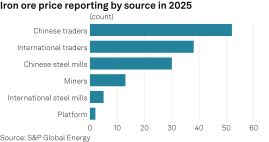
Chinese companies accounted for the biggest share of information reported to Platts at 59% in 2025, consistent with the country's significant role in the iron ore spot market. This included 30 steel mills and 52 trading companies.
A total of 38 international trading firms, 13 mining companies, five international steel mills, and two trading platforms also contributed to Platts' price reporting in 2025.
In total, Platts published 35,451 headlines, or heards, containing iron ore price information, covering fines, lump, pellet, concentrates, and pellet-based direct-reduced iron.
Heards for deals involving seaborne cargoes numbered 1,377 in 2025, up 19.8% year over year, of which 46 involved cargoes coloaded on the same ship. Such cargoes were counted as a single deal and accounted for 3.3% of the total spot trades.
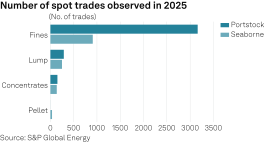
Fines accounted for 66% of the observed spot trades in the year, followed by lump at 18%, concentrates at around 10%, and pellet at 2.5%.
In 2025, 33% of the trades reported to Platts resulted from Platts' survey of and verification with market participants. The remainder comprised deals reported by miners, on trading platforms, and during the Platts Market on Close assessment process.
After Chinese mills stopped buying BHP's Jimblebar Fines on Sept. 18, 2025, following unofficial curbs, and then Jinbao Fines on Nov. 21, the market observed a sharp drop in spot transactions on trading platforms in the last quarter of 2025.
Total reported seaborne iron ore trades on platforms dropped 78% from the previous quarter in Q4 2025. Bilateral transactions increased by 26% over the same period, as some Chinese participants have avoided direct participation in miners' open tenders.
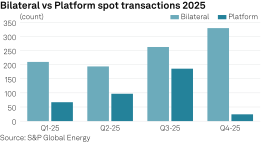
The volume of spot seaborne iron trades reported to Platts increased by 31% year over year to over 170.25 million mt in 2025.
At the same time, Platts reported 3,603 spot transactions for the portside iron ore market in China, up 25% from 2024. Fines accounted for 88% of the observed Chinese onshore spot trades in the year, while lump trades accounted for around 8%, domestic concentrates around 4%, and imported pellet and concentrate around 0.4%.
Seaborne cargoes discharged and declared to customs tend to trade in smaller cargo sizes of around 5,000 mt, leading to the higher number of transactions observed.
China port stock prices
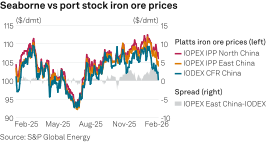
China's portside iron ore market saw prices hold above seaborne levels for much of 2025. The price spread widened in the final quarter, as trade curbs drove differentiated market dynamics and purchasing strategies.
The import parity price for Platts iron ore port stock indices, or IOPEX, in East China averaged $103.24/dmt in 2025, 87 cents/dmt higher than seaborne prices in the form of the IODEX. The spread widened in Q4 2025 to $1.23/dmt and subsequently to $3.90/dmt on Jan. 16, the largest since June 2024.
As steel mills avoided buying seaborne cargoes directly from BHP, procurement from the portside market picked up in the last quarter. Additionally, a gradual narrowing of mill margins fueled buying from the portside. As mills scaled back pig iron production and became more cautious about large-volume commitments in raw materials, preference grew for hand-to-mouth purchases in smaller volumes.
For many years, an extended period of free storage across major Chinese ports for iron ore, typically for 90 days in Shandong, has helped miners and traders to build port inventories, creating an onshore market settled in the yuan.
In a move to curb hoarding of iron ore at ports, the free storage period was shortened to 30 days starting in 2026, market participants said. According to market sources, storage fees then start at Yuan 0.10/mt/day and gradually increase until a cap of Yuan 1/mt/day from 180 days.
The new port storage charges could increase the resale cost of cargoes in the portside market, and thereby sustain the port price premium over seaborne prices, market participants said.