
S&P Global Energy Platts / Energy Security Sentinel
Ukraine War
Russia’s invasion triggering attacks on commodities infrastructure and sanctions and reconfiguring trade flows
Risks and Sanctions
Russia’s invasion of Ukraine unleashed unprecedented risks to commodities production and supply, resulting in major price volatility and rerouting of significant volumes of its oil and gas. Rising supply and demand risks led Russian oil producers to seek new markets, sell at steep discounts and incur additional costs. Significant volumes of Russian oil have also been pushed into the shadow fleet by sanctions targeting Russian oil revenues.
Sanctions pressure remains high on Russia, with the EU and UK providing no relief during the supply crisis caused by the conflict in the Middle East in 2026. The US issued temporary sanctions waivers, but they have since expired, and broader Western pressure on Russian oil revenues remains.
Beyond sanctions, the war has had a devastating impact on commodities infrastructure across the region, with oil, power, metals, shipping and agricultural facilities all coming under attack.
War in Ukraine
Russia's invasion of Ukraine has resulted in attacks on commodities production, processing and supply, as both sides strike infrastructure in the conflict zone and beyond. Kyiv has repeatedly targeted Russian oil supply and refining capacity.
Analysts at S&P Global Energy CERA estimate that 40% of Russia’s refining capacity was offline as of the end of July 2026, pushing Russian crude runs to 21-year lows. Russia has focused on crippling Ukrainian power capacity as well as gas production and supply. Other targets since the conflict began include grain facilities, shipping and Russian oil and gas supplies to Europe. Attacks have been recorded on the Baltic and Black Seas, across Ukraine and deep into Russia. In total, S&P Global Energy has tracked more than 500 security incidents since the conflict began.
40%
40% of Russia’s refining capacity was offline as of the end of July 2026, pushing Russian crude runs to 21-year lows.
Sanctions on Russian oil
Sanctions imposed on Russia in response to its invasion of Ukraine launched in February 2022 have had a radical impact on the Russian oil sector. Russia found itself quickly isolated by a coalition of partners led by the US, the EU and the UK, with many countries slashing imports of Russian oil and gas.
Before the invasion, the EU alone was importing about 2.3 million barrels/day of Russian crude. Western import bans and price caps have led Russia to redirect most of its crude exports to the East, particularly India and China.
As of mid 2026, the EU and UK price caps on Russian crude stand at
$44.10/b
Key measures include price caps that have raised the costs and risks associated with shipping Russian oil, widened the discounts on Russian crude and led to a ballooning shadow fleet that now accounts for 22% of the global tanker fleet.
US President Donald Trump provided some relief to the sector in 2026, approving temporary sanctions waivers for some exports of Russian oil, as the global market grappled with a collapse in supply from the Middle East. These waivers have ended, but could return if the supply situation deteriorates or there is meaningful progress in peace talks to end the conflict in Ukraine.
EU and UK legislators continue to ramp up pressure on Russian oil revenues and have avoided offering significant sanctions relief since the US and Israel attacked Iran in February 2026. Potential future targets include a full ban on insurance and maritime services for Russian oil.
On Dec. 5, 2022, the EU banned most seaborne Russian crude imports. The EU, G7 and Australia also approved a $60/b price cap for Russian crude. After a period of lower oil prices, the EU subsequently agreed to cut this, introducing a floating price cap at 15% below the prevailing market rate from February 2026.
In response to the price shock from the Middle East war, however, the bloc changed the mechanism to avoid having to revise the price cap higher again, and froze the threshold at $44.10/b for a year starting July 2026.
On Feb. 5, 2023, the EU banned imports of most Russian refined products. The EU, G7 and Australia also approved price caps of $100/b on products that typically trade at a premium to crude, and $45/b on those that generally trade at a discount.
The EU has approved sanctions on refineries in India, China and Belarus for processing Russian crude. Georgia’s Kulevi refinery has been given until Jan. 25, 2027 to demonstrate that it has stopped processing Russian oil, or it will also be subject to sanctions.
In January 2026 the EU closed what had been dubbed a "refining loophole" by banning imports of fuel made from Russian crude. The measure was expected to hit flows from key Russian importers like India and Turkey, although refiners were offered exemptions if they could segregate their Russian and non-Russian crude processing or demonstrate they had paused Russian imports and processing for at least 60 days.
The UK vowed to copy the restrictions and implemented its own ban in May. However, it exempted diesel and jet fuel, its two largest oil product imports, by issuing a temporary sanctions waiver, which it has committed to revoke by Jan. 1, 2027.

A ceasefire that included significant sanctions relief wouldn’t necessarily unlock any disrupted streams of oil because Western sanctions on Russian oil have generally been constructed to try to limit Moscow’s oil revenues to the extent possible while keeping crude flowing to markets.
—S&P Global Energy
Europe and Gas
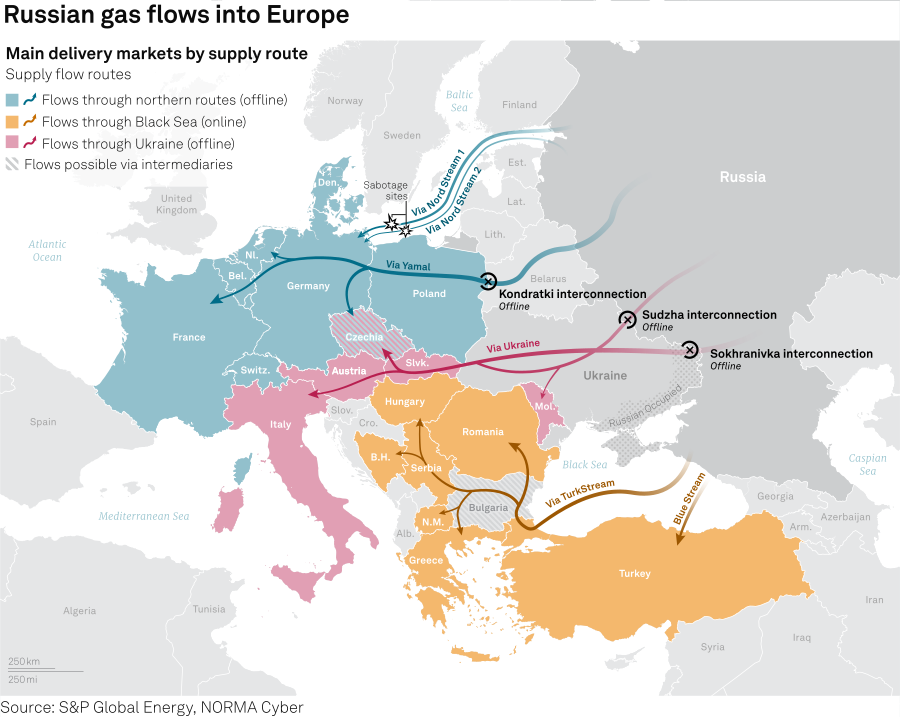
Most of Europe’s previous sources of Russian pipeline gas have been cut off since the 2022 invasion of Ukraine. The only remaining entryway is through Turkey via the TurkStream pipeline. The artery is crucial for landlocked Hungary and Slovakia, which remain highly reliant on Russian flows for their energy needs.
While partial bans on imports of Russian pipeline gas under spot and short-term deals went into effect across the first half of 2026, a ban on all pipeline imports into the EU is due to take effect in autumn 2027.
LNG, Norway continue to offset lost Russian gas in Europe
LNG and Norwegian pipeline gas imports continue to offset the EU’s lost Russian gas imports as Brussels pushes ahead with a gradual phaseout of flows from the EU’s once-dominant supplier.
Indeed, the pivot to LNG has been one of the most consequential changes to the European gas market to emerge since the invasion of Ukraine. While the proliferation of LNG import terminals has boosted the flexibility of the continent’s energy system, it has also exposed it to price movements in the highly globalized market for the fuel.