Refined Products, Crude Oil, Diesel-Gasoil, Gasoline
October 22, 2026
US-Russia diesel deal adds volatility to Atlantic tanker market
Editor:
HIGHLIGHTS
Limited volumes, attacks may curb wider market impact
Western sanctions still restrict owners lifting Russian cargoes
A US agreement to resume imports of Russian diesel could disrupt Atlantic trade flows, although limited volumes and continuing attacks on Russian energy infrastructure are expected to temper the impact on the tanker market, analysts said.
The agreement reverses Washington's previous stance on Russian energy imports and introduces further volatility into an already complex tanker market, shipbroker SSY said in an Oct. 12 research note.
Europe's diesel deficit should continue to support US exports, but the return of Russian barrels could gradually alter the balance, analysts at S&P Global Energy Horizons said Oct. 22.
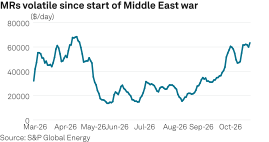
"MR rates may remain supported by Europe's diesel deficit and continued US exports, although improving prompt vessel availability and the resumption of Russian diesel flows could limit further gains in Atlantic employment," Horizons said.
The Platts Medium Range tanker index was assessed at $63,464/day Oct. 21, up from $60,540/day at the start of October and almost double its Feb. 27 level of $32,109/day.
The US remains a net diesel exporter, with shipments averaging 1.34 million barrels/day in 2026 to date, up from 1.17 million b/d in 2025, according to S&P Global Commodities at Sea data. Key destinations include South America and Northwest Europe.
Russian diesel has flowed primarily to non-EU buyers in the Mediterranean and North Africa, including Turkey and Egypt, as well as to Brazil.
The US agreement was unlikely to have a significant effect on the wider market because of the limited volumes involved and continuing attacks on Russian energy infrastructure, SSY Senior Tanker Analyst Adam Lanning, told Platts Oct. 22.
EU, G7 and UK restrictions also remain in force, constraining the pool of shipowners willing or able to transport Russian products. Price-cap mechanisms continue to apply under those frameworks.
However, if Russian supply eases tightness in the US market, Washington could maintain exports to a wider range of buyers, the SSY Oct. 12 note said.
Russian supply remains constrained
Russia banned diesel exports outside Central Asia and Mongolia in July to stabilize domestic prices. In theory, about 2 million mt of diesel could have been placed in storage, but that is unlikely to have happened, Carnegie Russia Eurasia Center Senior Fellow Sergey Vakulenko said on the organization's website Oct. 13.
Tanker-loading data indicated that seaborne diesel exports continued despite the ban, Vakulenko said. Russia has limited diesel storage capacity and filling available tanks could have forced refiners to reduce runs, further restricting gasoline production amid domestic shortages.
Russian export availability has also been constrained by Ukrainian attacks on refineries, ports and terminals, which have continued despite attempts to reach a Russia-Ukraine energy ceasefire.
The International Energy Agency cut its estimate of Russian refinery runs in September by 100,000 b/d to 3.9 million b/d. It forecast fourth-quarter runs at 4 million b/d, down 1.1 million b/d year over year.
Nevertheless, the diesel volumes covered by the US agreement are unlikely to pose significant operational difficulties for Russia, Vakulenko said.
