Maritime & Shipping, Crude Oil, Refined Products, Wet Freight, LPG
October 20, 2026
US sanctions relief could lift tanker rates in Russia, inject capacity to Gulf shuttles: analysts

By Max Lin
Editor:
HIGHLIGHTS
Sanctions relief could shift tanker capacity
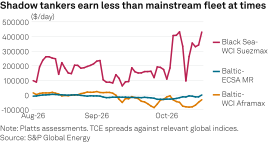
Shadow fleet earns less than mainstream at times
Safety concerns persist for aging shadow fleet
US sanctions relief on shadow-fleet tankers could redirect ships from Russian oil trades toward the Middle East, potentially raising Russian freight costs while easing some of the tanker shortages around the Strait of Hormuz, shipping analysts said.
In recent public remarks, Energy Secretary Chris Wright said the US will allow legitimate businesses to acquire sanctioned tankers for non-sanctioned trades to reduce shipping costs, though Washington has yet to announce a detailed relief proposal.
The number of oil and LPG tankers sanctioned by Western authorities amounted to 1,226 as of the end of August, with the US having been particularly targeting VLCCs, according to S&P Global Energy Horizons research.
But BRS Shipbrokers estimated only 148 tankers in deepsea trades, equivalent to 2.5% of the global total by vessel count, were sanctioned solely by the US Office of Foreign Assets Control as of Oct. 19. Of those, only 14 appeared to have been idle for more than three months based on location signals.
The "overwhelming majority" of ships that could become candidates for mainstream employment were therefore already deployed in likely sanctioned trades, mainly carrying Russian clean petroleum products, BRS said.
That means sanctions relief could redistribute existing tanker capacity rather than simply release large amounts of idle tonnage. "It may not drive looser oil or tanker market fundamentals," BRS said in a research note. "It would instead see more mainstream oil carried at the expense of Russian or Iranian oil."
Trade dynamics
In recent weeks, shadow fleet operators in Russian trades have often been making less than mainstream trades, where ship requirements have jumped on Hormuz disruptions.
The average MR time-charter-equivalent earnings for the Baltic-East Coast South America was $15,518.14/day lower than the Global Clean Tanker Medium Range Index on Oct. 1-16, according to Platts assessments. Platts is part of S&P Global Energy.
But Gibson Shipbrokers said tanker rates for Russian exports could increase if ships currently serving their trades were drawn into Middle East business.
"The length of any waiver matters too, as a short-term reprieve may not be enough for charterers to commit to longer voyages, and the risk of renewed tensions after next month's midterm elections [in the US] may further limit appetite," the brokerage said in a note.
Gibson said 84% of OFAC-only tankers were in the Middle East, Indian Ocean or East Asia, with just 16 ships in European waters.
Their most likely employment could be Hormuz shuttle services, Gibson said, as recent attacks have constrained tanker supply. BRS similarly said previously sanctioned ships could prove attractive for cross-Hormuz shuttling, potentially easing pressure on mainstream tonnage currently performing such voyages.
The VLCC rate for transporting 265,000 metric tons of crude from the Persian Gulf to West Coast India was $95.83/mt on Oct. 19, much higher than the pre-conflict level of $19.15/mt Feb. 27, according to Platts.
BRS said some shadow fleet operators could also use sanctions relief to sell their tankers into the current strong secondhand market, provided Washington gave buyers sufficient assurances that they would not face sanctions risks over the vessels' previous trading histories.
The secondhand price for a 15-year-old VLCC has risen 177% over the past year to $160 million, while for a Suezmax of similar vintage it has grown 127% to $92 million, Xclusiv Shipbrokers estimates.
Safety concerns remain
A lifting of sanctions would not necessarily remove concerns surrounding vessels' condition or operation, especially if they were still listed by the UK and the EU, where most third-party liabilities insurers and classification societies are based and whose authorities have not signaled any willingness to coordinate with the US on sanctions relief.
Gibson said 70% of OFAC-listed tankers were at least 20 years old, including 120 of 163 VLCCs. Without International Group protection and indemnity insurance and classification by an International Association of Classification Societies member, few mainstream charterers would be able to employ them, it said.
Removing an OFAC restriction is different from making a ship "genuinely acceptable for mainstream employment," given potential obstacles including age, technical condition, vetting, insurance and charterer compliance requirements, according to S&P Global Energy Horizons analyst Fotios Katsoulas.
"The pool that could realistically migrate back into mainstream trading is therefore likely to be materially smaller than the overall sanctioned fleet," Katsoulas said.
INTERTANKO, the world's largest industry body representing independent tanker owners, also warned against treating legal sanctions relief as equivalent to a vessel meeting mainstream safety and compliance standards.
"Lifting sanctions on cargoes, and on the carriage of them by these vessels, does not make these vessels any safer and adds risks to safety at sea, the marine environment and coastal states," INTERTANKO said in a statement.
The group said any return should involve scrutiny of vessel condition, insurance and ownership, arguing that lawful cargoes should be transported by properly maintained and adequately insured ships with transparent ownership.
Separately, the International Chamber of Shipping told Platts that all shipowners should adhere to industry safety, environmental and insurance standards established by the International Maritime Organization.
"At this stage it is difficult to assess the likely impact of the US proposal. A key element will be clarity on how this proposal will interact with vessel sanctions imposed by the EU and UK," the ICS said in an emailed statement.
