Crude Oil, Maritime & Shipping, Refined Products, Chemicals, Energy Transition, Wet Freight, LPG, Hydrogen, Dry Freight
October 01, 2026
INTERVIEW: War-risk insurance costs rise as sanctions complicate casualty response

By Max Lin
Editor:
HIGHLIGHTS
Listed areas expand in Black Sea, Middle East
Sanctions delay casualty response, worsen losses
Nuclear propulsion faces liability framework gaps
Shipping companies operating in contested waters are facing higher requirements for war coverage and legal complications, as attacks spread across multiple military conflicts and sanctions threaten to delay casualty response, according to Neil Roberts, head of marine and aviation at the Lloyd's Market Association.
The Joint War Committee of LMA, which represents insurers in the world's largest marine market, has expanded the "listed areas" -- where they see heightened operational risks -- in the Black Sea, the Red Sea, the Persian Gulf, and the Arabian Sea this year.
With a rising number of ship attacks in the Iran-US, Houthis-Saudi and Russia-Ukraine conflicts, Roberts, who chairs the committee, told Platts in a recent interview that the revisions to London market war-risk zones reflected a changing threat environment.
"There have been quite a significant number of attacks that have fallen outside of the [earlier] listed area," said Roberts, referring to intensifying attacks of Russia and Ukraine on commercial ships linked to each other's trades before nearly all of the Black Sea was listed last month.
Higher insurance expenses
The move exposes a wider range of voyages to additional insurance procedures and costs, as marine insurers would charge additional war risk premiums in the high-risk waters. Higher insurance costs have ultimately affected the delivered cost of energy and commodity cargoes.
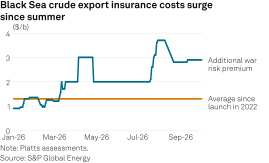
The additional war risk premium (AWRP) for crude oil shipments from the Black Sea rose from $2 per barrel on July 17 to $3.7/b on July 29, the highest in recent years, before easing to $2.9/b on Sept. 30, according to Platts assessments.
Platts is part of S&P Global Energy.
For shipowners and charterers, Roberts said one practical implication of listed-area changes is the need to communicate with insurers before entering designated locations.
"If an area is listed and the vessel wishes to go there, yes, they should notify their underwriter," he said. "Otherwise, they won't have cover."
The warning comes as vessel operators continue to navigate evolving risks in the Black Sea, Red Sea and Persian Gulf waters, where over 100 merchant ships have been attacked so after this year, based on estimates of International Maritime Organization, national governments and security consultancies.
In the Middle East, tanker operators and charterers have faced a more than 40-fold increase in headline AWRP rates, calculated as a percentage of hull value, for transiting the Strait of Hormuz, while coverage periods have shortened amid rapidly evolving risks since the Iran war began in late February.
The companies are also receiving fewer no-claim bonuses – which could amount to 50% in peace times – because of the severity of industry losses, according to Roberts.
The International Union of Marine Insurance, the world's largest trade association representing marine insurance companies, recently estimated that insurers could have lost $2 billion in the Middle East war.
Sanction complications
Roberts also highlighted rising operational risks for the shipping industry as the number of sanctioned vessels grew, particularly complicating responses to marine casualties.
Western governments had sanctioned a total of 1,226 oil tankers and LPG carriers as of Aug. 31, according to S&P Global Energy Horizons data, and those ships -- mainly designated due to their links to Iranian or Russian trades -- regularly operated in conflict zones.
In August, Omani authorities reported about 390 square kilometers of oil spilled from the sanctioned Suezmax Caroline Bezengi, which had been stranded after being damaged in an attack two months prior.
"It wasn't insured at all, I don't think ... because of its designation," Roberts said. "It's the one we've been, the industry as a whole, predicting and now it's happened."
When sanctioned parties are involved, responders will need government permits before conducting certain activities, potentially slowing salvage operations and pollution response efforts.
"If there's a sanction involved, you need to get licenses before you can do anything, and that delay can make the loss worse," Roberts said.
The problem has implications for shipowners, cargo owners and coastal authorities alike because delays can increase environmental damage, prolong shipping disruptions and raise overall costs.
"You can't begin to deal with the sanctioned company until you've got the official permission to do it," he said. "You have to get the license first, which may or may not be given."
Nuclear questions
Beyond geopolitical risks, Roberts said shipowners pursuing decarbonization will also face evolving insurance and liability considerations.
While much of the shipping industry's attention has focused on alternative fuels such as methanol, ammonia and hydrogen, insurers are also examining how future technologies could affect risk profiles and coverage requirements.
Roberts said marine nuclear propulsion may eventually require changes to existing liability frameworks, with safety regulations for its adoption in commercial shipping yet to be fully developed.
"As I understand it, there's a need for change in the liability regime," he said. "In insurance, there would be a need to look at our wordings, which almost all of them exclude nuclear."
For ship operators evaluating long-term investment decisions, he said the challenge goes beyond fuel technology itself.
"The main problem is the infrastructure," Roberts said. "If your vessel is powered by one of these new fuels, you are limited to where you can get supplies."
