LNG, Maritime & Shipping, Crude Oil, Refined Products
September 23, 2026
INTERVIEW: Marine insurers lose billions supporting Hormuz energy flows: IUMI

By Max Lin
Editor:
HIGHLIGHTS
IUMI estimates $2 billion losses in Hormuz crisis
Ship crossings plunge 85% from pre-conflict level
Governments launch facilities to aid shipping
Insurance companies have lost billions to cover war risks for shipping during the ongoing US-Iran conflict to support global energy trades, despite a jump in headline premium rates, according to a senior official of the International Union of Marine Insurance.
Cargo and hull insurance premiums for Strait of Hormuz transits have risen by tens of times since the outbreak of Middle East war at the end of February, with International Maritime Organization data showing 84 ships attacked in the region, resulting in at least 23 crew casualties.
In July, the UN agency called on governments to curb insurance costs for transits through the Strait of Hormuz to facilitate more seaborne cargo flows amid energy supply worries.
IUMI, the world's largest trade association representing marine insurance companies, has pushed back the intervention. "We definitely didn't make any surplus in this particular situation," Secretary General Lars Lange told Platts in an interview. "The rough estimate [of our losses] would be somewhere around two billion US dollars."
The estimates are mainly associated with marine insurers' losses in covering off-hire and ship damage arising from the war. Lloyd's of London, the operator of the world's largest marketplace for marine insurers, earlier said its members lost $1.9 billion insuring the shipping crisis in January-June.
Despite a much higher per-voyage premium for Hormuz passage, Lange said total insurance revenue has fallen sharply due to far fewer transits, as many ship operators avoid the region because of safety risks.
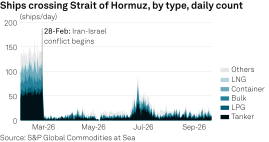
Daily ship crossings via Hormuz, a key chokepoint that handled 20% of global seaborne oil and LNG flows in peacetime, have collapsed to roughly 20 so far this month, down from the pre-conflict level of more than 130, according to S&P Global Commodities at Sea data.
Marine insurers have kept offering war coverage through the crisis, and are expected to continue doing so to serve long-term clients in the energy supply chain despite losses, according to Lange. The premium levels would be determined by supply-demand fundamentals in insurance markets, he added.
"Our membership is business entities, and their target is, at the end of the day, to make a surplus," Lange said. "The insurer will do its best endeavors to come up with a fair price, and if the price is too high, a competitor would come with the market-adequate price and get the business instead."
Government measures
During the conflict, the US has launched a $40 billion reinsurance facility via state-owned Development Finance Corp with commercial insurers including Chubb to cover Hormuz transits, while Saudi Arabia is creating a marine insurance pool led by Saudi Re combining government funds with private insurers. In the UAE, government-owned DP World has offered cargo insurance coverage against physical loss related to war.
Lange said sovereign states could step in to insure the supply of goods in war times, sometimes coordinating with the private sector, pointing to war facilities for Black Sea trades as another example.
Following Russia's full-scale invasion of Ukraine in 2022, Kyiv partnered with Lloyd's and Marsh McLennan to establish the Unity insurance facility to cover war risks for ships transporting non-military cargo with an aim of offering discounts to market rates.
While generally embracing political neutrality during conflicts, insurers could often opt to cover certain parties over others due to legal risks, according to Lange.
"We are always outside the political landscape ... We are business entities," Lange said. "[But] we comply with sanctions, and we comply with other political requirements. So that limits us."
European insurance companies, for example, have refrained from dealing with Russian trades in most cases.
Since 2023-2024, the EU and G7 have banned maritime service firms from participating in Russian oil trades unless the barrels are sold at below certain thresholds, which some insurers said leads to increased administrative burden.
As an organization, IUMI does not oppose sanctions and only wants governments to provide clear, precise instructions and sufficient grace periods when introducing new rules, according to Lange.
"But compliance with sanctions goes without saying for our membership," he said. "That is political reality nowadays."
Platts is part of S&P Global Energy.
